 Kwisi: O dinosaure efe?
 Ntwa ya didinosaure
 Peiso ya didinosaure
 Dipapadi tse nyane tsa didinosaure
 Albamo ya ditikara
 Manane a TOP a didinosaure
 Nkgethele!
Sinocephale
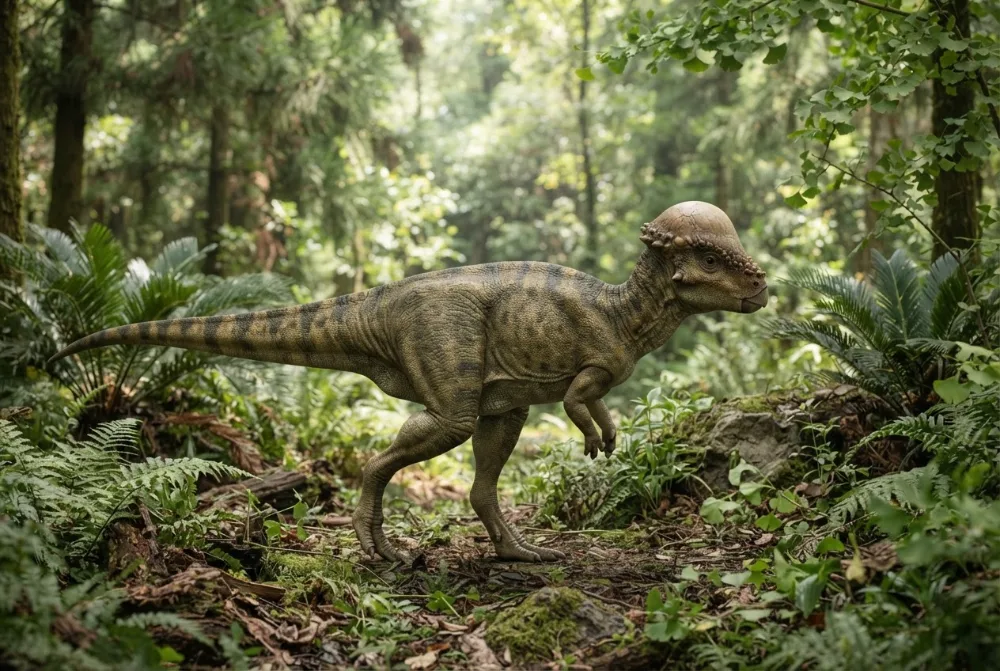
Sinocephale was a small, dome-headed dinosaur that lived in what is now China. It walked on two legs and used its thick, bony skull to head-butt rivals. Only a piece of its skull has been found, but scientists think it was a plant-eater.15
E phetse neng?
E ne e le kgolo hakae?
E ne e le telele hakae?
E ne e le boima hakae?

 telele jwaloka dikatse tsa lapeng tse 4 ho tloha nkong ho isa mohatleng🍌telele jwaloka dibanana tse 12 di behilwe ka molaboima jwaloka dikatse tsa lapeng tse 12🍉boima jwaloka mahapu a 9🧸boima jwaloka bana ba kereshe ba 2.5🎒boima jwaloka bana ba sekolo ba 1.5🏃e ne e ka matha dimitara tse 100 ka metsotswana e 8.2 (motho ya lebelo ka ho fetisisa o hloka 9,6)
Sinocephale e ne e le kgolo hakae ha e bapiswa le WENA?
Ke dipalo feela ho browser ya hao. Ha ho letho le bolokwang kapa le romelwang kae kapa kae.
E ne e le lebelo hakae?


Dintlha tse monate
Sinocephale is the first pachycephalosaurid dinosaur ever found outside of North America.2
Its skull had a heart-shaped outline when viewed from above, because the back edge was deeply curved inward.1
The only known fossil is a piece of the skull roof, called a parietal bone. The original was lost, but plaster casts were found and used for study.12
Sinocephale was originally named as a species of Troodon in 1953, then moved to Stegoceras, and finally got its own genus in 2021.1
It lived during the Late Cretaceous, about 83 to 66 million years ago, in a floodplain environment with rivers.51
Sinocephale is related to famous dome-headed dinosaurs like Pachycephalosaurus and Prenocephale.1
Dipotso tse botswang haholo ka Sinocephale
?How big was Sinocephale?
Nobody knows for sure, because only a piece of the skull roof has been found. The dome was about 7.5 centimetres (3 inches) thick, but the full body size is unknown.14
?Did Sinocephale have a heart-shaped skull?
Yes. The back edge of its skull was deeply curved inward, giving the skull a heart-shaped outline when seen from above.1
?When did Sinocephale live?
Sinocephale lived during the Late Cretaceous, about 83 to 66 million years ago, in what is now Inner Mongolia, China.1
?What did Sinocephale eat?
Scientists think it was a plant-eater, based on its dome-headed dinosaur relatives, though no teeth or jaws have been found.1
Mosenyi wa ditshomo
Tshomo: Some people think Sinocephale was a theropod dinosaur like Troodon.
Nnete: Sinocephale is actually a pachycephalosaur, a dome-headed plant-eater, not a meat-eating theropod.1
Bakeng sa ditsebi tsa didinosaure
- Lebitso la saense
- Sinocephale
- E rehilwe ke
- Evans et al. 20215
- Sehlopha
- Dihlooho tse chitja
- Lelapa / leloko
- Pachycephalosauridae5
- Tlhophiso
- Ornithischia > Pachycephalosauria5
- Dilemo tsa mafika
- dilemo tse dimilione tse 84 ho isa ho 66 (Campanian / Maastrichtian)5
- Dibopeho tsa mafika
- Ulansuhai5
- Dinaha
- Tjhaena5
- Direkoto tsa difosili
- 1 ho The Paleobiology Database5
- Ho sibollwa
- The fossil was found in 1930 or 1931 by Swedish paleontologists in Inner Mongolia. It was named Troodon bexelli by Birger Bohlin in 1953, but later renamed Sinocephale bexelli in 2021.1
- E sa ntse e phehwa kgang
- Scientists are not sure exactly how old the Ulansuhai Formation is, so the age of Sinocephale is still debated.1
Moo dintlha di tswang teng
- Sinocephale (en.wikipedia.org)
- Description and revised diagnosis of Asia’s first recorded pachycephalosaurid, Sinocephale bexelli gen. nov., from the Upper Cretaceous of Inner Mongolia, China (web.archive.org)
- Sinocephale bexelli | Dinosaur Database by DinoAnimals.com (dinoanimals.com)
- Description and revised diagnosis of Asia’s first recorded pachycephalosaurid, Sinocephale bexelli gen. nov., from the Upper Cretaceous of Inner Mongolia, China (cdnsciencepub.com)
- Sinocephale in The Paleobiology Database (CC BY 4.0): dilemo, dibaka, dibopeho tsa mafika, tlhophiso.
Ntlha e nngwe le e nngwe leqepheng lena e na le nomoro e supang mohlodi wa yona. Haeba re fositse ho hong, re kopa tshwarelo, re balatedi ba didinosaure, ha re koranta ya saense. Re bolelle ho [email protected] mme re tla e lokisa.
 Rex o lapile! Dino Wiki ke projeke ya ntate bakeng sa mora wa hae ya ratang didinosaure, ke mahala, ha ho dipapatso, ha ho disebedi. Batho ba baholo ba ka fepa Rex seneke ho thusa hore e dule e le inthaneteng.Fepa Rex
 Pachycephalosaurus
 Stegoceras
 Prenocephale
 Sphaerotholus
 Foraminacephale
 Brontotholus
 Tyrannosaurus
 Triceratops
 Velociraptor
 Spinosaurus
 Ankylosaurus
 Parasaurolophus