 Kwisi: O dinosaure efe?
 Ntwa ya didinosaure
 Peiso ya didinosaure
 Dipapadi tse nyane tsa didinosaure
 Albamo ya ditikara
 Manane a TOP a didinosaure
 Nkgethele!
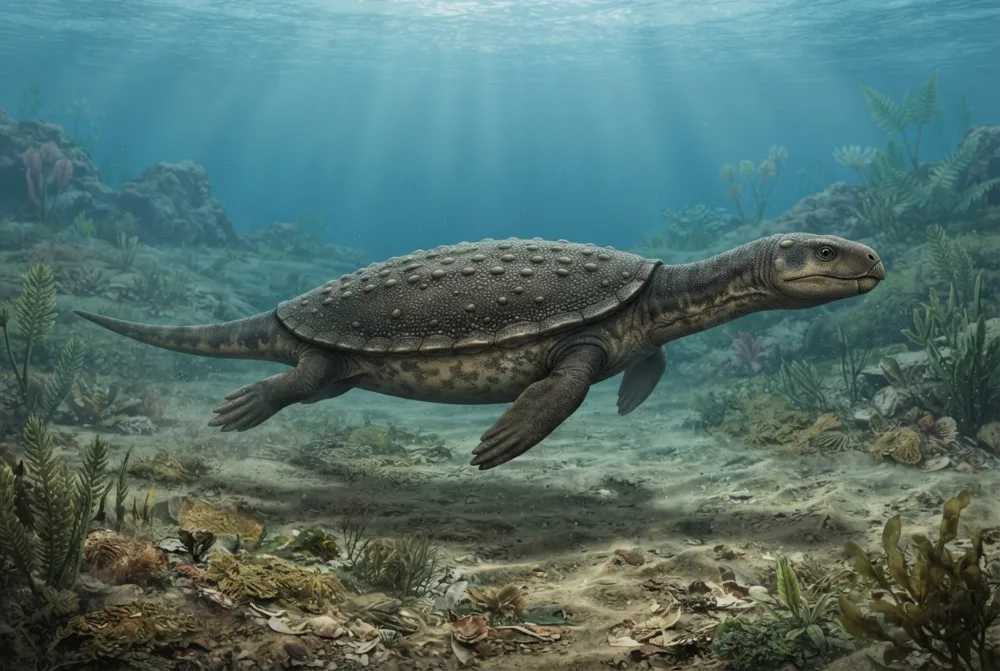
Sinocyamodus
Sinocyamodus was a marine reptile that lived during the Late Triassic, about 232 to 222 million years ago. It looked like a turtle with a flat, bony shell and a beak for crushing shellfish. This placodont was the first of its kind found in the eastern Tethys Ocean, changing what scientists thought about where these reptiles lived.1
E phetse neng?
E ne e le lebelo hakae?


Dintlha tse monate
Sinocyamodus was a placodont, a group of marine reptiles that were not dinosaurs but relatives of modern turtles.1
It was the first placodont discovered in the eastern Tethys Ocean, showing that these reptiles were not only found in the western Tethys as scientists once thought.1
Only one species is known: Sinocyamodus xinpuensis.1
The first adult specimen was reported in 2018, and it looked different from younger fossils, showing that Sinocyamodus changed as it grew.1
Bakeng sa ditsebi tsa didinosaure
- Lebitso la saense
- Sinocyamodus
- E rehilwe ke
- ha e tsejwe3
- Sehlopha
- Dihahabi tsa lewatle
- Lelapa / leloko
- Cyamodontidae3
- Tlhophiso
- Placodontia > Sauropterygia3
- Dilemo tsa mafika
- dilemo tse dimilione tse 234 ho isa ho 227 (Carnian)3
- Dibopeho tsa mafika
- Xiaowa3
- Dinaha
- Tjhaena3
- Direkoto tsa difosili
- 1 ho The Paleobiology Database3
- Ho sibollwa
- Sinocyamodus was named by Li Chun in 2000 based on fossils from the Late Triassic of Guizhou, southwest China. It was the first placodont reptile found in the eastern Tethys region.1
- E sa ntse e phehwa kgang
- Scientists are still unsure about the exact size and weight of Sinocyamodus, as only a few fossils have been found.1
Moo dintlha di tswang teng
- Sinocyamodus (en.wikipedia.org)
- PBDB Taxon (paleobiodb.org)
- Sinocyamodus in The Paleobiology Database (CC BY 4.0): dilemo, dibaka, dibopeho tsa mafika, tlhophiso.
Ntlha e nngwe le e nngwe leqepheng lena e na le nomoro e supang mohlodi wa yona. Haeba re fositse ho hong, re kopa tshwarelo, re balatedi ba didinosaure, ha re koranta ya saense. Re bolelle ho [email protected] mme re tla e lokisa.
 Rex o lapile! Dino Wiki ke projeke ya ntate bakeng sa mora wa hae ya ratang didinosaure, ke mahala, ha ho dipapatso, ha ho disebedi. Batho ba baholo ba ka fepa Rex seneke ho thusa hore e dule e le inthaneteng.Fepa Rex
 Nothosaurus
 Placodus
 Lariosaurus
 Cyamodus
 Cymatosaurus
 Proneusticosaurus
 Massospondylus
 Plateosaurus
 Coelophysis
 Podokesaurus
 Thecodontosaurus
 Eudimorphodon