 Kwisi: O dinosaure efe?
 Ntwa ya didinosaure
 Peiso ya didinosaure
 Dipapadi tse nyane tsa didinosaure
 Albamo ya ditikara
 Manane a TOP a didinosaure
 Nkgethele!
Sinomacrops
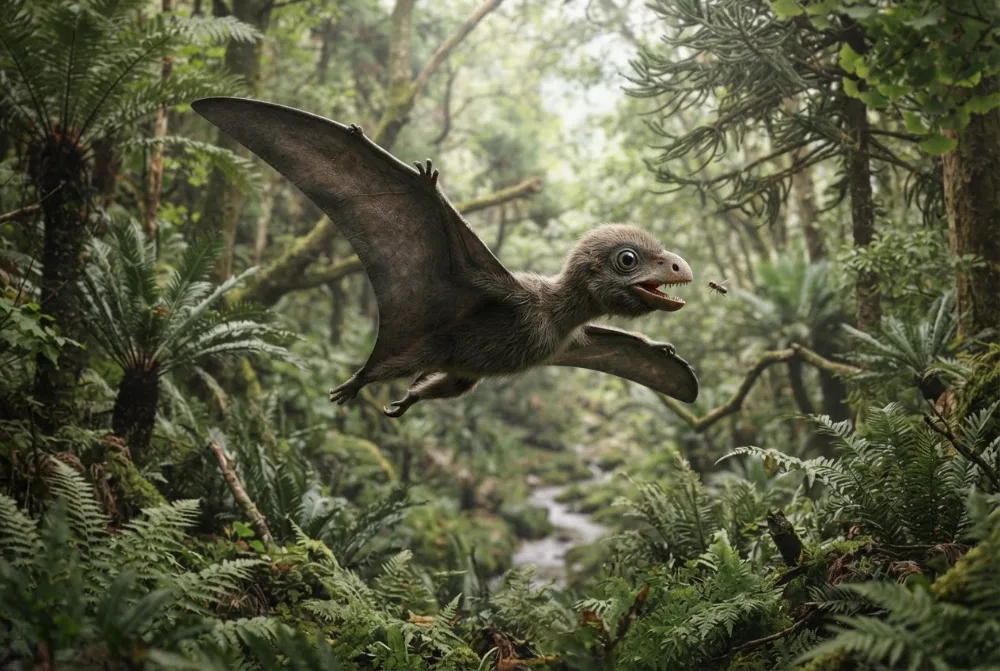
Sinomacrops was a tiny flying reptile that lived about 160 million years ago. It had huge eyes and a short, rounded snout, and it probably fluttered between trees catching insects.1
E phetse neng?
E ne e le kgolo hakae?
E ne e le telele hakae?
Sinomacrops e ne e le kgolo hakae ha e bapiswa le WENA?
Ke dipalo feela ho browser ya hao. Ha ho letho le bolokwang kapa le romelwang kae kapa kae.
E ne e le lebelo hakae?


Dintlha tse monate
Sinomacrops is known from a single crushed skeleton, but it is the first anurognathid skull seen from the side.1
Its lower leg bone, the tibiotarsus, was twice as long as its thigh bone, which is unusual.1
It had three closely spaced teeth in the front of its upper jaw, a feature unique to this species.1
Sinomacrops is the second anurognathid pterosaur found in the Tiaojishan Formation in China.1
Its closest relative is Batrachognathus, and together they form a group called Batrachognathinae.1
The fossil was found in rocks that are between 165 and 155 million years old, from the Middle to Late Jurassic.3
Dipotso tse botswang haholo ka Sinomacrops
?Was Sinomacrops a dinosaur?
No, Sinomacrops was a pterosaur, a flying reptile that lived at the same time as dinosaurs, but it was not a dinosaur itself.2
?How big was Sinomacrops?
It was tiny, but the exact size is not known because only one crushed skeleton has been found. It was small enough to flutter between trees.2
?What did Sinomacrops eat?
It probably ate insects. Its short snout and teeth suggest it caught bugs while flying, like other anurognathid pterosaurs.1
?When did Sinomacrops live?
It lived about 164 to 158 million years ago, during the Middle to Late Jurassic period.2
Mosenyi wa ditshomo
Tshomo: Some people think Sinomacrops was a dinosaur because it lived with dinosaurs.
Nnete: Sinomacrops was a pterosaur, a flying reptile, not a dinosaur.1
Bakeng sa ditsebi tsa didinosaure
- Lebitso la saense
- Sinomacrops
- E rehilwe ke
- Wei et al. 20213
- Sehlopha
- Dihahabi tse fofang
- Lelapa / leloko
- Anurognathidae3
- Tlhophiso
- Pterosauria3
- Dilemo tsa mafika
- dilemo tse dimilione tse 165 ho isa ho 155 (Callovian / Oxfordian)3
- Dibopeho tsa mafika
- Tiaojishan3
- Dinaha
- Tjhaena3
- Direkoto tsa difosili
- 1 ho The Paleobiology Database3
- Ho sibollwa
- Scientists named Sinomacrops in 2021 after studying a fossil found at Mutoudeng in China. The species name bondei honors paleontologist Niels Bonde.1
- E sa ntse e phehwa kgang
- Scientists still debate exactly where anurognathids like Sinomacrops fit in the pterosaur family tree, and whether they lived mostly in trees.1
Moo dintlha di tswang teng
- Sinomacrops bondei , a new anurognathid pterosaur from the Jurassic of China and comments on the group (pmc.ncbi.nlm.nih.gov)
- Sinomacrops (en.wikipedia.org)
- Sinomacrops in The Paleobiology Database (CC BY 4.0): dilemo, dibaka, dibopeho tsa mafika, tlhophiso.
Ntlha e nngwe le e nngwe leqepheng lena e na le nomoro e supang mohlodi wa yona. Haeba re fositse ho hong, re kopa tshwarelo, re balatedi ba didinosaure, ha re koranta ya saense. Re bolelle ho [email protected] mme re tla e lokisa.
 Rex o lapile! Dino Wiki ke projeke ya ntate bakeng sa mora wa hae ya ratang didinosaure, ke mahala, ha ho dipapatso, ha ho disebedi. Batho ba baholo ba ka fepa Rex seneke ho thusa hore e dule e le inthaneteng.Fepa Rex
 Pteranodon
 Quetzalcoatlus
 Dorygnathus
 Rhamphorhynchus
 Anhanguera
 Pterodactylus
 Brachiosaurus
 Diplodocus
 Allosaurus
 Brontosaurus
 Compsognathus
 Camarasaurus