 Kwisi: O dinosaure efe?
 Ntwa ya didinosaure
 Peiso ya didinosaure
 Dipapadi tse nyane tsa didinosaure
 Albamo ya ditikara
 Manane a TOP a didinosaure
 Nkgethele!
E phetse neng?

E ne e le kgolo hakae?
E ne e le telele hakae?
E ne e phahame hakae?
kakanyo
E ne e le boima hakae?
 telele jwaloka dintja tse 5 ho tloha nkong ho isa mohatleng🍌telele jwaloka dibanana tse 26 di behilwe ka mola🍉boima jwaloka mahapu a 60🧸boima jwaloka bana ba kereshe ba 16🎒boima jwaloka bana ba sekolo ba 9🏃e ne e ka matha dimitara tse 100 ka metsotswana e 8.8 (motho ya lebelo ka ho fetisisa o hloka 9,6)
Talenkauen e ne e le kgolo hakae ha e bapiswa le WENA?
Ke dipalo feela ho browser ya hao. Ha ho letho le bolokwang kapa le romelwang kae kapa kae.
E ne e le lebelo hakae?


Dintlha tse monate
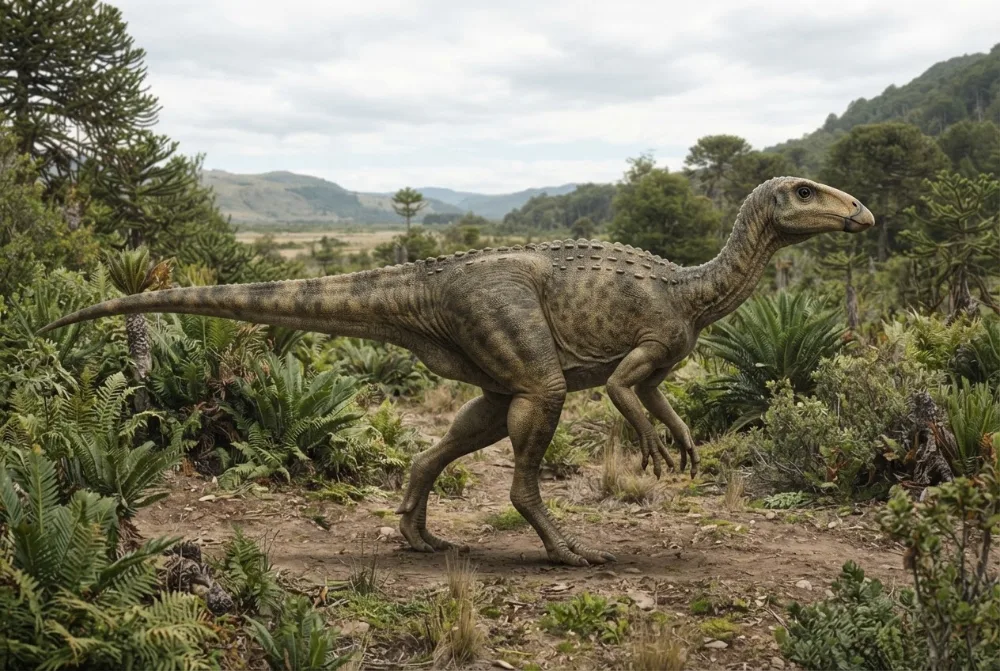
Talenkauen had smooth, oval plates along its ribcage. These plates were very thin, only about 3 millimeters thick, and may have helped with breathing, like similar structures in birds.1
Unlike many other plant-eating dinosaurs, Talenkauen still had teeth in the front of its beak and a first toe. More advanced relatives lost these features.1
A tiny baby Talenkauen was found with an adult. The baby had already hatched and eaten food, because its teeth showed wear. This is one of the few baby ornithopod fossils found in the southern hemisphere.1
Talenkauen lived alongside giant dinosaurs like Dreadnoughtus and Puertasaurus, which were huge long-necked plant-eaters, and the predator Orkoraptor.1
The plates on Talenkauen's ribs were too thin and small to be useful for defense, so scientists think they had another job, like helping the dinosaur breathe.1
Dipotso tse botswang haholo ka Talenkauen
?How big was Talenkauen?
About 4 meters (13 feet) long, maybe up to 4.7 meters (15 feet) and 300 kilograms (660 pounds).1
?What did Talenkauen eat?
It ate plants, using its beak and teeth to chew leaves and other vegetation.1
?Did Talenkauen have feathers?
No one knows for sure. No fossils of feathers have been found with Talenkauen, and it is not closely related to feathered dinosaurs.1
?When did Talenkauen live?
It lived during the Late Cretaceous period, about 72 to 66 million years ago.1
Mosenyi wa ditshomo
Tshomo: Some people think Talenkauen's rib plates were armor for protection.
Nnete: Scientists think the plates were more like uncinate processes, which help with breathing, not armor.1
Bakeng sa ditsebi tsa didinosaure
- Lebitso la saense
- Talenkauen
- E rehilwe ke
- Novas et al. 20042
- Sehlopha
- Dija-dimela tse nang le melomo
- Lelapa / leloko
- Elasmaria2
- Tlhophiso
- Ornithischia > Ornithopoda > Iguanodontia2
- Dilemo tsa mafika
- dilemo tse dimilione tse 84 ho isa ho 72 (Campanian)2
- Dibopeho tsa mafika
- Cerro Fortaleza2
- Dinaha
- Argentina2
- Direkoto tsa difosili
- 2 ho The Paleobiology Database2
- Ho sibollwa
- Talenkauen was found in February 2000 on Los Hornos Hill near Viedma Lake in Argentina. It was named and described by Fernando Novas and colleagues in 2004.1
- E sa ntse e phehwa kgang
- Scientists debate whether the rib plates of Talenkauen are related to the uncinate processes of birds and other animals, or if they are a different feature.1
Moo dintlha di tswang teng
- Talenkauen (en.wikipedia.org)
- Talenkauen in The Paleobiology Database (CC BY 4.0): dilemo, dibaka, dibopeho tsa mafika, tlhophiso.
Ntlha e nngwe le e nngwe leqepheng lena e na le nomoro e supang mohlodi wa yona. Haeba re fositse ho hong, re kopa tshwarelo, re balatedi ba didinosaure, ha re koranta ya saense. Re bolelle ho [email protected] mme re tla e lokisa.
 Rex o lapile! Dino Wiki ke projeke ya ntate bakeng sa mora wa hae ya ratang didinosaure, ke mahala, ha ho dipapatso, ha ho disebedi. Batho ba baholo ba ka fepa Rex seneke ho thusa hore e dule e le inthaneteng.Fepa Rex
 Iguanodon
 Tenontosaurus
 Thescelosaurus
 Zalmoxes
 Camptosaurus
 Rhabdodon
 Tyrannosaurus
 Triceratops
 Velociraptor
 Spinosaurus
 Ankylosaurus
 Parasaurolophus