 Kwisi: O dinosaure efe?
 Ntwa ya didinosaure
 Peiso ya didinosaure
 Dipapadi tse nyane tsa didinosaure
 Albamo ya ditikara
 Manane a TOP a didinosaure
 Nkgethele!
Tarchia
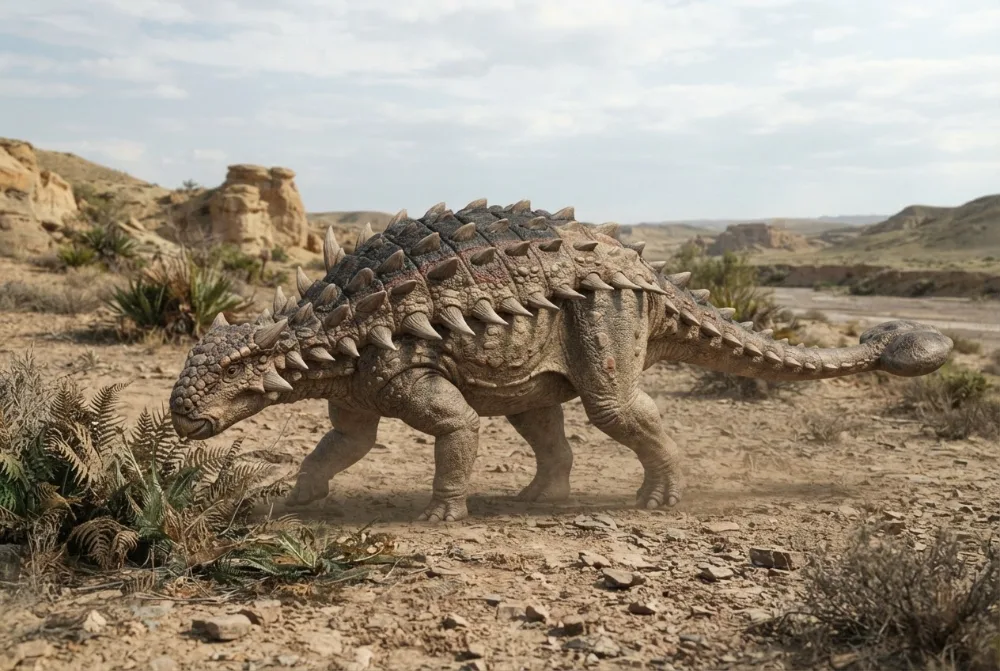
Tarchia was a tank-like dinosaur covered in bony armour and armed with a heavy club at the end of its tail. It lived in the deserts of Mongolia near the end of the Age of Dinosaurs. Despite its tough appearance, it was a gentle plant-eater.1
E phetse neng?
E ne e le kgolo hakae?
E ne e le telele hakae?
E ne e phahame hakae?
kakanyo
E ne e le boima hakae?

 telele jwaloka dintja tse 6 ho tloha nkong ho isa mohatleng🍌telele jwaloka dibanana tse 33 di behilwe ka molaboima jwaloka dintja tse 150🍉boima jwaloka mahapu a 600🎒boima jwaloka ditlelase tse feletseng tse 4 tsa bana ba sekolo🐻❄️boima jwaloka dibere tse tshweu tse 7🏃e ne e ka matha dimitara tse 100 ka metsotswana e 26 (motho ya lebelo ka ho fetisisa o hloka 9,6)
Tarchia e ne e le kgolo hakae ha e bapiswa le WENA?
Ke dipalo feela ho browser ya hao. Ha ho letho le bolokwang kapa le romelwang kae kapa kae.
E ne e le lebelo hakae?


Dintlha tse monate
Tarchia's name means 'brainy one' because its skull had a relatively large brain case compared to other ankylosaurs.1
It is the youngest known Asian ankylosaurid dinosaur, living right at the end of the Cretaceous Period.1
The tail club of Tarchia was made of fused vertebrae and could be swung as a weapon against predators.1
Fossils of Tarchia have been found in ancient desert environments with dunes and seasonal streams.1
Scientists think Tarchia may have relied on hindgut fermentation to digest tough plants, similar to modern cows.1
Three species of Tarchia are known: T. kielanae, T. teresae, and T. tumanovae.1
Dipotso tse botswang haholo ka Tarchia
?How big was Tarchia?
About 5.5 to 6 metres long and weighed up to 2.5 to 3 metric tons. Some specimens may have been up to 6.7 metres long.12
?What did Tarchia eat?
It was a herbivore that ate low-growing plants. It had a broad muzzle and was a selective feeder, probably eating ground-level plants.12
?Did Tarchia have any predators?
Yes. Tarbosaurus, a large meat-eating dinosaur related to Tyrannosaurus, hunted Tarchia. Tooth marks from Tarbosaurus have been found on a Tarchia skull.21
?How did Tarchia defend itself?
It had a heavy bony club at the end of its tail that it could swing at attackers. Its body was also covered in bony armour called osteoderms.21
Mosenyi wa ditshomo
Tshomo: Tarchia was a slow, stupid dinosaur.
Nnete: Tarchia had a relatively large brain for an ankylosaur, and its tail club shows it could defend itself actively.1
Bakeng sa ditsebi tsa didinosaure
- Lebitso la saense
- Tarchia
- E rehilwe ke
- Maryanska 19773
- Sehlopha
- Didinosaure tse nang le sesireletsi
- Lelapa / leloko
- Ankylosauridae3
- Tlhophiso
- Ornithischia > Ankylosauria > Ankylosauridae > Thyreophora3
- Dilemo tsa mafika
- dilemo tse dimilione tse 84 ho isa ho 66 (Campanian / Maastrichtian)3
- Dibopeho tsa mafika
- Nemegt, Baruungoyot3
- Dinaha
- Mongolia3
- Direkoto tsa difosili
- 4 ho The Paleobiology Database3
- Ho sibollwa
- Tarchia was named in 1977 by Polish paleontologist Teresa Maryańska based on a skull found by a Polish-Mongolian expedition in 1970 near Khulsan, Mongolia.1
- E sa ntse e phehwa kgang
- Scientists still debate whether some fossils belong to Tarchia or to its close relative Saichania.1
Moo dintlha di tswang teng
- Tarchia (en.wikipedia.org)
- Tarchia | Natural History Museum (nhm.ac.uk)
- Tarchia in The Paleobiology Database (CC BY 4.0): dilemo, dibaka, dibopeho tsa mafika, tlhophiso.
Ntlha e nngwe le e nngwe leqepheng lena e na le nomoro e supang mohlodi wa yona. Haeba re fositse ho hong, re kopa tshwarelo, re balatedi ba didinosaure, ha re koranta ya saense. Re bolelle ho [email protected] mme re tla e lokisa.
 Rex o lapile! Dino Wiki ke projeke ya ntate bakeng sa mora wa hae ya ratang didinosaure, ke mahala, ha ho dipapatso, ha ho disebedi. Batho ba baholo ba ka fepa Rex seneke ho thusa hore e dule e le inthaneteng.Fepa Rex
 Ankylosaurus
 Sauropelta
 Pinacosaurus
 Scutellosaurus
 Struthiosaurus
 Euoplocephalus
 Tyrannosaurus
 Triceratops
 Velociraptor
 Spinosaurus
 Parasaurolophus
 Pteranodon