 Kwisi: O dinosaure efe?
 Ntwa ya didinosaure
 Peiso ya didinosaure
 Dipapadi tse nyane tsa didinosaure
 Albamo ya ditikara
 Manane a TOP a didinosaure
 Nkgethele!
Udanoceratops
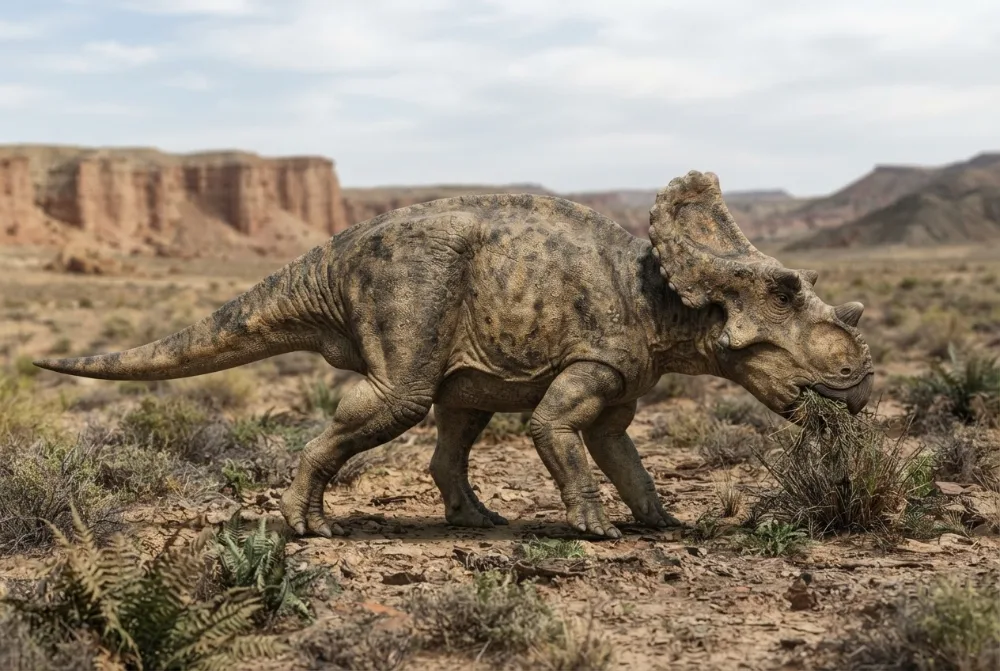
Udanoceratops was a big, plant-eating dinosaur that lived in the Gobi Desert of Mongolia. It had a powerful beak and strong jaws that could bite through tough plants, maybe even bone! This dinosaur was one of the largest of its family, the leptoceratopsids.12
E phetse neng?
E ne e le kgolo hakae?
E ne e le telele hakae?
E ne e phahame hakae?
kakanyo
E ne e le boima hakae?
 telele jwaloka dintja tse 4 ho tloha nkong ho isa mohatleng🍌telele jwaloka dibanana tse 22 di behilwe ka mola🍉boima jwaloka mahapu a 140🧸boima jwaloka bana ba kereshe ba 37🎒boima jwaloka bana ba sekolo ba 22🏃e ne e ka matha dimitara tse 100 ka metsotswana e 12 (motho ya lebelo ka ho fetisisa o hloka 9,6)
Udanoceratops e ne e le kgolo hakae ha e bapiswa le WENA?
Ke dipalo feela ho browser ya hao. Ha ho letho le bolokwang kapa le romelwang kae kapa kae.
E ne e le lebelo hakae?


Dintlha tse monate
Udanoceratops is the largest known leptoceratopsid, reaching about 4 meters (13 feet) long and weighing around 700 kilograms (1,500 pounds).1
Its skull was deep and robust, with a smooth snout that had no horns or bumps, unlike many other horned dinosaurs.1
The lower jaw of Udanoceratops was very strong, and scientists think it could bite with enough force to possibly break bone.1
Its tail was tall and flattened from side to side, which some scientists once thought meant it lived in water, but now they think it helped the dinosaur walk on soft sand.1
Udanoceratops lived in the Gobi Desert during the Late Cretaceous, about 75 to 71 million years ago, alongside dinosaurs like Protoceratops and Velociraptor.1
The only known fossil of Udanoceratops was discovered by a joint Soviet-Mongolian expedition in the 1980s, and its bones were found inside hard calcium carbonate rocks.1
The species name, Udanoceratops tschizhovi, honors D. O. Tschizhov, a colleague of the scientist who first described it.1
Dipotso tse botswang haholo ka Udanoceratops
?How big was Udanoceratops?
About 4 metres (13 feet) long and 700 kilograms (1,500 pounds). It was the largest known leptoceratopsid.12
?Did Udanoceratops have horns?
No, its snout was completely smooth with no horns or bumps, unlike many other horned dinosaurs.1
?What did Udanoceratops eat?
It was a herbivore, eating tough plants. Its powerful beak and strong jaws were used for shearing vegetation.12
?Could Udanoceratops swim?
Probably not. Scientists once thought it might be semi-aquatic because of its tall tail, but now they think that shape helped it walk on soft sand.1
?When did Udanoceratops live?
It lived during the Late Cretaceous period, about 81 to 71 million years ago.2
Mosenyi wa ditshomo
Tshomo: Some people think Udanoceratops was a small dinosaur like other leptoceratopsids.
Nnete: Udanoceratops was actually the largest known leptoceratopsid, reaching about 4 meters long.1
Bakeng sa ditsebi tsa didinosaure
- Lebitso la saense
- Udanoceratops
- E rehilwe ke
- Kurzanov 19923
- Sehlopha
- Didinosaure tse dinaka
- Lelapa / leloko
- Leptoceratopsidae3
- Tlhophiso
- Ornithischia > Ceratopsia3
- Dilemo tsa mafika
- dilemo tse dimilione tse 84 ho isa ho 72 (Campanian)3
- Dibopeho tsa mafika
- Djadokhta3
- Dinaha
- Mongolia3
- Direkoto tsa difosili
- 1 ho The Paleobiology Database3
- Ho sibollwa
- Udanoceratops was named by Russian paleontologist Sergei Kurzanov in 1992. The fossils were found in the 1980s during a joint Soviet-Mongolian expedition at the Udan-Sayr locality in Mongolia.12
- E sa ntse e phehwa kgang
- Scientists are still debating whether Udanoceratops could walk on two legs or only on all fours, and whether it lived partly in water.1
Moo dintlha di tswang teng
- Udanoceratops (en.wikipedia.org)
- Udanoceratops | Natural History Museum (nhm.ac.uk)
- Udanoceratops in The Paleobiology Database (CC BY 4.0): dilemo, dibaka, dibopeho tsa mafika, tlhophiso.
Ntlha e nngwe le e nngwe leqepheng lena e na le nomoro e supang mohlodi wa yona. Haeba re fositse ho hong, re kopa tshwarelo, re balatedi ba didinosaure, ha re koranta ya saense. Re bolelle ho [email protected] mme re tla e lokisa.
 Rex o lapile! Dino Wiki ke projeke ya ntate bakeng sa mora wa hae ya ratang didinosaure, ke mahala, ha ho dipapatso, ha ho disebedi. Batho ba baholo ba ka fepa Rex seneke ho thusa hore e dule e le inthaneteng.Fepa Rex
 Triceratops
 Protoceratops
 Ojoceratops
 Tatankaceratops
 Psittacosaurus
 Centrosaurus
 Tyrannosaurus
 Velociraptor
 Spinosaurus
 Ankylosaurus
 Parasaurolophus
 Pteranodon