 Kwisi: O dinosaure efe?
 Ntwa ya didinosaure
 Peiso ya didinosaure
 Dipapadi tse nyane tsa didinosaure
 Albamo ya ditikara
 Manane a TOP a didinosaure
 Nkgethele!
Wannanosaurus
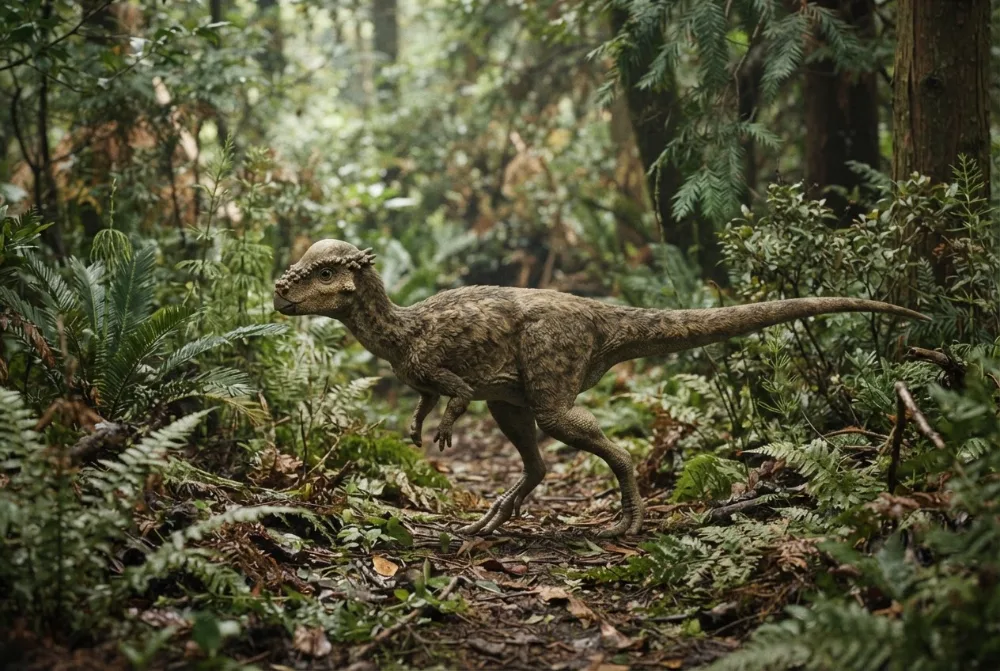
Wannanosaurus was a tiny dome-headed dinosaur that lived about 70 million years ago in what is now China. It had a flat skull instead of a big dome, and it was one of the smallest pachycephalosaurs ever found.12
E phetse neng?
E ne e le kgolo hakae?
E ne e le telele hakae?
E ne e le boima hakae?
 e batla e le boima jwaloka katse ya lapeng🍌boima jwaloka dibanana tse 25🏃e ne e ka matha dimitara tse 100 ka metsotswana e 15 (motho ya lebelo ka ho fetisisa o hloka 9,6)
Wannanosaurus e ne e le kgolo hakae ha e bapiswa le WENA?
Ke dipalo feela ho browser ya hao. Ha ho letho le bolokwang kapa le romelwang kae kapa kae.
E ne e le lebelo hakae?


Dintlha tse monate
Wannanosaurus had a completely flat skull roof with large openings called supratemporal fenestrae, unlike later dome-headed relatives.2
Its femur was only about 8 centimeters (3.1 inches) long, making it one of the smallest pachycephalosaurs.1
The skull bones were fused together, showing that this tiny dinosaur was an adult when it died.1
It had a long lower jaw with small, denticulated (serrated) teeth, good for chewing plants.2
Wannanosaurus lived in the Late Cretaceous period, about 72 to 69 million years ago.1
Its forelimbs were short, with the humerus only half the length of the femur or less.2
Dipotso tse botswang haholo ka Wannanosaurus
?How big was Wannanosaurus?
It was very small, about 60 centimetres (2.0 feet) long. Its thigh bone was only about 8 centimetres (3.1 inches) long.1
?Did Wannanosaurus have a dome on its head?
No, it had a flat skull roof with large openings, unlike later dome-headed pachycephalosaurs. That is why scientists consider it a primitive member of the group.1
?What did Wannanosaurus eat?
It was probably herbivorous or omnivorous, eating low-growing plants and maybe insects. Its small, serrated teeth were good for chewing plants.1
?When did Wannanosaurus live?
It lived about 70 million years ago, during the Late Cretaceous period (Maastrichtian age).1
?Where was Wannanosaurus found?
Its fossils were discovered in Anhui, China, in the Xiaoyan Formation. The name means 'Wannan lizard' after the region.1
?Is Wannanosaurus a dinosaur?
Yes, it is a dinosaur. It belongs to the group Pachycephalosauria, which are dome-headed dinosaurs, even though its own skull was flat.1
Bakeng sa ditsebi tsa didinosaure
- Lebitso la saense
- Wannanosaurus
- E rehilwe ke
- Hou 19774
- Sehlopha
- Dihlooho tse chitja
- Lelapa / leloko
- Pachycephalosauria4
- Tlhophiso
- Ornithischia > Pachycephalosauria4
- Dilemo tsa mafika
- dilemo tse dimilione tse 72 ho isa ho 66 (Maastrichtian)4
- Dibopeho tsa mafika
- Xiaoyan4
- Dinaha
- Tjhaena4
- Direkoto tsa difosili
- 1 ho The Paleobiology Database4
- Ho sibollwa
- Wannanosaurus was named by Chinese paleontologist Hou Lian-Hai in 1977, based on a partial skeleton found in red sandstones of the Xiaoyan Formation in Anhui, China.21
- E sa ntse e phehwa kgang
- Scientists are not sure if Wannanosaurus was a very primitive pachycephalosaur or if it was closely related to other flat-headed forms like Homalocephale.12
Moo dintlha di tswang teng
- Wannanosaurus (en.wikipedia.org)
- A primitive pachycephalosaurid from the Cretaceous of Anhui, China, Wannanosaurus yansiensis gen. et sp. nov (naturalhistory.si.edu)
- Wannanosaurus yansiensis | Dinosaur Database by DinoAnimals.com (dinoanimals.com)
- Wannanosaurus in The Paleobiology Database (CC BY 4.0): dilemo, dibaka, dibopeho tsa mafika, tlhophiso.
Ntlha e nngwe le e nngwe leqepheng lena e na le nomoro e supang mohlodi wa yona. Haeba re fositse ho hong, re kopa tshwarelo, re balatedi ba didinosaure, ha re koranta ya saense. Re bolelle ho [email protected] mme re tla e lokisa.
 Rex o lapile! Dino Wiki ke projeke ya ntate bakeng sa mora wa hae ya ratang didinosaure, ke mahala, ha ho dipapatso, ha ho disebedi. Batho ba baholo ba ka fepa Rex seneke ho thusa hore e dule e le inthaneteng.Fepa Rex
 Pachycephalosaurus
 Stegoceras
 Prenocephale
 Sphaerotholus
 Foraminacephale
 Brontotholus
 Tyrannosaurus
 Triceratops
 Velociraptor
 Spinosaurus
 Ankylosaurus
 Parasaurolophus