 Kwisi: O dinosaure efe?
 Ntwa ya didinosaure
 Peiso ya didinosaure
 Dipapadi tse nyane tsa didinosaure
 Albamo ya ditikara
 Manane a TOP a didinosaure
 Nkgethele!
Xenoceratops
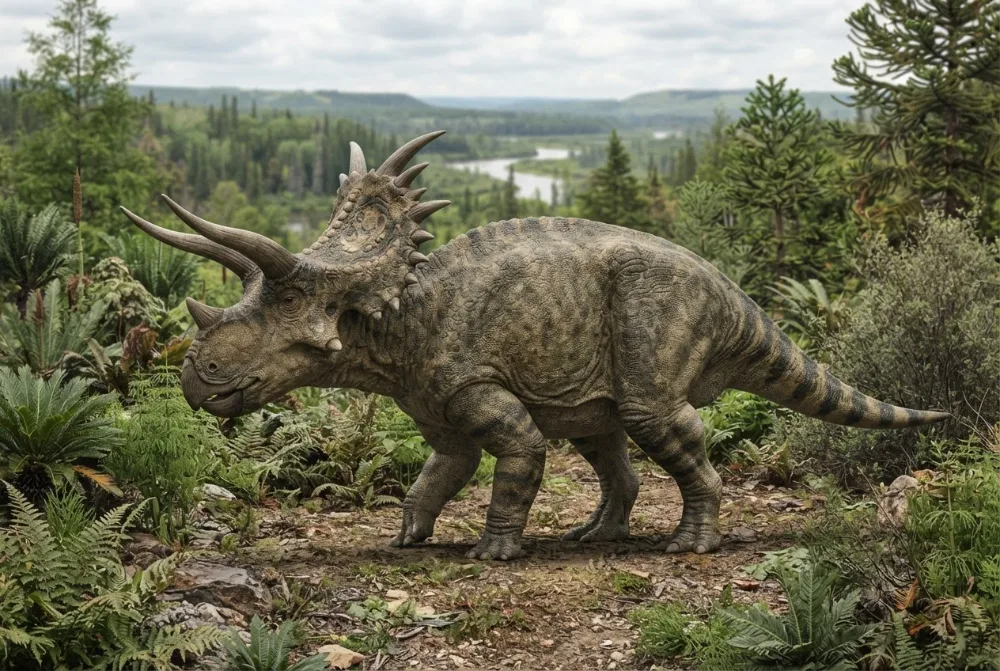
Xenoceratops was an early horned dinosaur that lived in Canada about 78 million years ago. It had a big frill on its head with spikes and two long horns above its eyes, making it look a bit like an alien. It was one of the oldest large horned dinosaurs ever found in North America.1
E phetse neng?
E ne e le kgolo hakae?
E ne e le telele hakae?
E ne e phahame hakae?
kakanyo
E ne e le boima hakae?

 telele jwaloka dintja tse 6 ho tloha nkong ho isa mohatleng🍌telele jwaloka dibanana tse 33 di behilwe ka molaboima jwaloka dintja tse 90🍉boima jwaloka mahapu a 360🧸boima jwaloka bana ba kereshe ba 95🎒boima jwaloka bana ba sekolo ba 56🐻❄️boima jwaloka dibere tse tshweu tse 4🏃e ne e ka matha dimitara tse 100 ka metsotswana e 11 (motho ya lebelo ka ho fetisisa o hloka 9,6)
Xenoceratops e ne e le kgolo hakae ha e bapiswa le WENA?
Ke dipalo feela ho browser ya hao. Ha ho letho le bolokwang kapa le romelwang kae kapa kae.
E ne e le lebelo hakae?


Dintlha tse monate
Xenoceratops is the oldest known ceratopsid dinosaur from Canada, living about 78 million years ago.2
Its name means 'alien horned face' because it was found in rocks that had not yielded horned dinosaur fossils before.2
The fossils were collected in 1958 by paleontologist Wann Langston Jr., but they sat in a museum for decades before scientists realized they belonged to a new species.1
Unlike Triceratops, Xenoceratops had spikes on its frill in addition to the two long brow horns.1
Xenoceratops was about 6 metres long and weighed more than 2 tons, about as heavy as a large rhinoceros.1
It lived in a subtropical environment in Alberta, which at that time had no snow or frost.1
Scientists think Xenoceratops is the most primitive centrosaurine, meaning it branched off early in the evolution of this group of horned dinosaurs.2
Mosenyi wa ditshomo
Tshomo: Xenoceratops is just a small, unimportant dinosaur.
Nnete: Xenoceratops is important because it is the oldest known large horned dinosaur from Canada, and it shows that horned dinosaurs evolved their fancy frills and horns very early.1
Bakeng sa ditsebi tsa didinosaure
- Lebitso la saense
- Xenoceratops
- E rehilwe ke
- Ryan et al. 20123
- Sehlopha
- Didinosaure tse dinaka
- Lelapa / leloko
- Ceratopsidae3
- Tlhophiso
- Ornithischia > Ceratopsia > Ceratopsidae3
- Dilemo tsa mafika
- dilemo tse dimilione tse 84 ho isa ho 72 (Campanian)3
- Dibopeho tsa mafika
- Foremost3
- Dinaha
- Kanada3
- Direkoto tsa difosili
- 1 ho The Paleobiology Database3
- Ho sibollwa
- Xenoceratops was named in 2012 by Michael Ryan and colleagues. The fossils were originally collected in 1958 by Wann Langston Jr. from a bone bed in the Foremost Formation of Alberta, Canada, and later rediscovered in the Canadian Museum of Nature.2
- E sa ntse e phehwa kgang
- Scientists are not sure exactly what the complete skull of Xenoceratops looked like, because only parts of the frill and horns have been found.2
Moo dintlha di tswang teng
- Two-Ton "Alien" Horned Dinosaur Found, "Different From Every Other" | National Geographic (nationalgeographic.com)
- cdnsciencepub.com (cdnsciencepub.com)
- Xenoceratops in The Paleobiology Database (CC BY 4.0): dilemo, dibaka, dibopeho tsa mafika, tlhophiso.
Ntlha e nngwe le e nngwe leqepheng lena e na le nomoro e supang mohlodi wa yona. Haeba re fositse ho hong, re kopa tshwarelo, re balatedi ba didinosaure, ha re koranta ya saense. Re bolelle ho [email protected] mme re tla e lokisa.
 Rex o lapile! Dino Wiki ke projeke ya ntate bakeng sa mora wa hae ya ratang didinosaure, ke mahala, ha ho dipapatso, ha ho disebedi. Batho ba baholo ba ka fepa Rex seneke ho thusa hore e dule e le inthaneteng.Fepa Rex
 Triceratops
 Protoceratops
 Ojoceratops
 Tatankaceratops
 Psittacosaurus
 Centrosaurus
 Tyrannosaurus
 Velociraptor
 Spinosaurus
 Ankylosaurus
 Parasaurolophus
 Pteranodon