 O dino efe? Kwisi
 Ntwa ya didino
 Peiso ya didino
 Metshamekwana ya didino
 Alebamo ya disetikara
 Manane a TOP a didino
 Ngakgamatsa!
Aegirosaurus
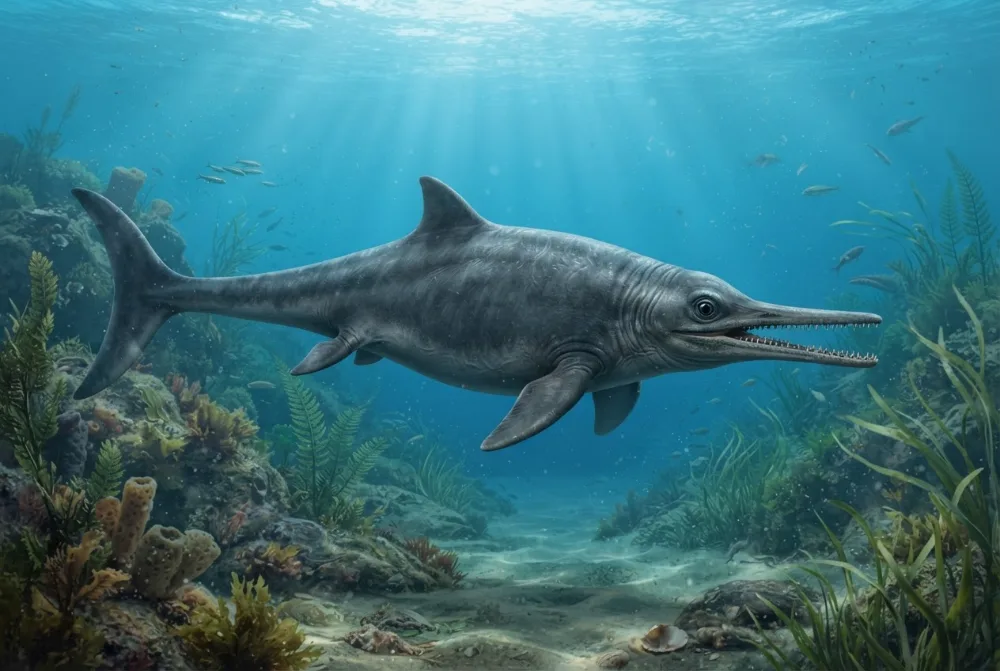
Aegirosaurus was a sleek, dolphin-like marine reptile that swam in the warm seas of Europe during the time of the dinosaurs. It had a long, slender snout packed with tiny, sharp teeth for catching fish and squid.1
E tshetse leng?
E ne e le kgolo go le kae?
E ne e le telele go le kae?
 telele jaaka dikatse tsa mo gae di le 4 go tswa kwa nkong go ya kwa mogatleng🍌telele jaaka dibanana di le 11 di latelana🏊e ne e ka thuma boleele jwa letamo le legolo la go thuma (50 m) mo metsotswaneng e le 4.4
Aegirosaurus e ne e le kgolo go le kae fa e bapisiwa le WENA?
Ke dipalo fela mo sebatling sa gago. Ga go sepe se se bolokwang kgotsa se se romelwang gope.
E ne e le bonako go le kae?


Dintlha tse di monate
Aegirosaurus had a very long snout that made up 62 to 73 percent of its lower jaw length.1
Its front flippers were narrow and elongated, but its hind flippers were wide because of extra soft tissue.1
Aegirosaurus had a crescent-shaped tail fin, like a fish, to help it swim fast.1
Fossils of Aegirosaurus show skin impressions, including what might be tiny scales on the upper part of its tail fin.1
This ichthyosaur lived from the Late Jurassic to the Early Cretaceous, about 149 to 133 million years ago.3
Aegirosaurus is one of the few ichthyosaurs known from the Valanginian stage of the Early Cretaceous.1
Dipotso tse di botswang thata ka ga Aegirosaurus
?How big was Aegirosaurus?
Aegirosaurus was a medium sized ichthyosaur. The largest known specimen was about 2 metres (6.6 ft) long, and a complete skeleton is 1.77 metres (5.8 ft) long.1
?What did Aegirosaurus eat?
Aegirosaurus ate small fish and squid. Its long, slender snout was packed with tiny, sharp teeth, and its tooth wear suggests it was a generalist feeder.1
?When did Aegirosaurus live?
Aegirosaurus lived from the Late Jurassic to the Early Cretaceous, about 149 to 133 million years ago.1
?Where was Aegirosaurus found?
Fossils of Aegirosaurus have been found in Germany and France. Its remains were discovered in the Solnhofen limestone of Bavaria, Germany, and in southeastern France.1
Mothubi wa ditlhamane
Tlhamane: Aegirosaurus was a dinosaur.
Boammaaruri: Aegirosaurus was an ichthyosaur, a marine reptile that lived in the sea, not a dinosaur. Dinosaurs lived on land.1
Ya baitseanape ba didino
- Leina la saense
- Aegirosaurus
- Leina le neilwe ke
- Bardet and Fernandez 20003
- Setlhopha
- Diikhithiosoro
- Lelapa / clade
- Ophthalmosauridae3
- Thulaganyo
- Ichthyosauria > Ichthyosauromorpha3
- Bogolo jwa matlapa
- 149 go ya go 133 dimilione tsa dingwaga (Tithonian / Valanginian)3
- Dibopego tsa matlapa
- Solnhofen3
- Dinaga
- Jeremane, Fora3
- Direkoto tsa difosili
- 3 mo The Paleobiology Database3
- Go fitlhelwa
- The first fossil was named Ichthyosaurus leptospondylus by Wagner in 1853. In 2000, scientists Bardet and Fernández gave it the new genus name Aegirosaurus after studying a nearly complete skeleton with soft tissue impressions.12
- Go sa ntse go ganetsanwa
- Scientists are not sure whether Aegirosaurus had scales on its tail fin, because only one fossil shows possible scale impressions.1
Kwa dintlha di tswang teng
- Aegirosaurus (en.wikipedia.org)
- A new ichthyosaur from the Upper Jurassic lithographic limestones of Bavaria | Journal of Paleontology | Cambridge Core (cambridge.org)
- Aegirosaurus in The Paleobiology Database (CC BY 4.0): dingwaga, mafelo, dibopego tsa matlapa, thulaganyo.
Ntlha nngwe le nngwe mo tsebeng eno e na le nomoro e e supang motswedi wa yona. Fa re dirile phoso, maitshwarelo, re barati ba didino, ga re lokwalodikgang lwa saense. Re bolelele kwa [email protected] mme re tla e baakanya.
 Rex o tshwerwe ke tlala! Dino Wiki ke porojeke ya rre e a e diretseng morwawe yo o ratang didino, ke mahala, ga e na dipapatso e bile ga e na dilatedi. Batho ba bagolo ba ka fepa Rex senyamo go thusa gore e nne mo inthaneteng.Fepa Rex
 Ichthyosaurus
 Platypterygius
 Stenopterygius
 Khudiakovia
 Ophthalmosaurus
 Chonespondylus
 Stegosaurus
 Iguanodon
 Archaeopteryx
 Giganotosaurus
 Microraptor
 Deinonychus