 O dino efe? Kwisi
 Ntwa ya didino
 Peiso ya didino
 Metshamekwana ya didino
 Alebamo ya disetikara
 Manane a TOP a didino
 Ngakgamatsa!
E tshetse leng?

E ne e le kgolo go le kae?
E ne e le telele go le kae?
E ne e le kwa godimo go le kae?
E ne e le bokete go le kae?
 telele jaaka dikoloi di le 2.5 di emisitswe mo moleng🍌telele jaaka dibanana di le 61 di latelana
 e ka nna bokete jaaka tlou🍉bokete jaaka magapu a le 1000🎒bokete jaaka diphaposiborutelo tse di tletseng bana di le 6🐻❄️bokete jaaka dibere tse ditshweu di le 11🏃e ne e ka taboga dimetara di le 100 mo metsotswaneng e le 15 (motho yo o bonako go gaisa o tlhoka 9,6)
Iguanodon e ne e le kgolo go le kae fa e bapisiwa le WENA?
Ke dipalo fela mo sebatling sa gago. Ga go sepe se se bolokwang kgotsa se se romelwang gope.
E ne e le bonako go le kae?


Dintlha tse di monate
Iguanodon was named in 1825 by Gideon Mantell after he found teeth that looked like iguana teeth.1
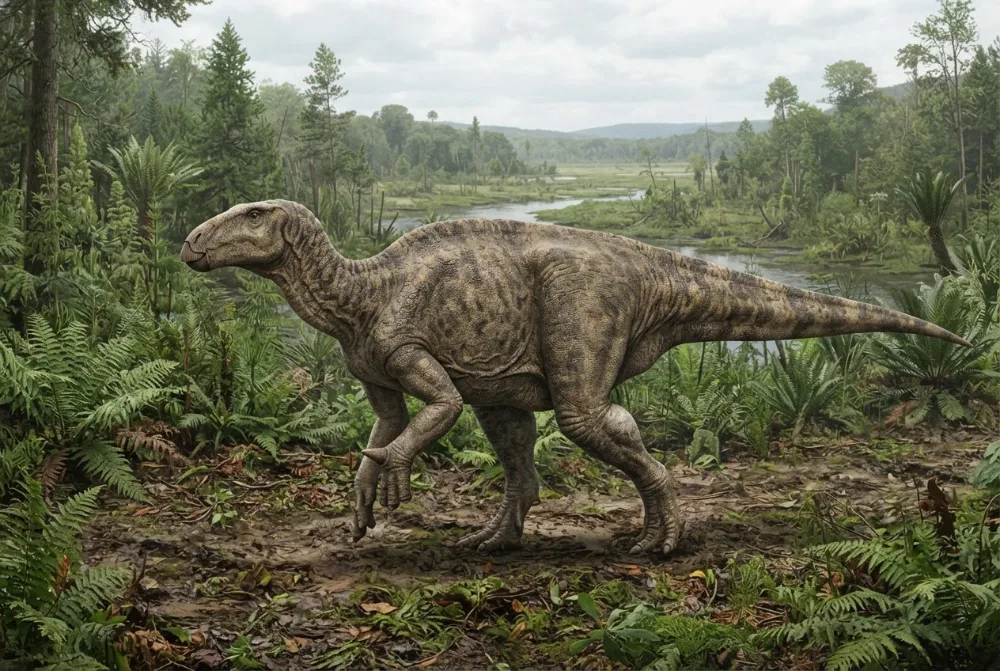
Its thumb had a big, sharp spike that scientists think was used for defense against predators.1
Iguanodon had a flexible little finger that could grasp objects, unlike its other fingers which were more like hooves.1
When Iguanodon closed its mouth, the bones in its upper jaw would bow out, making the teeth grind against each other like a chewing motion.1
The front of Iguanodon's mouth had no teeth, just a bony beak covered with a hard material for cropping plants.1
Iguanodon could reach food from ground level up to 4 to 5 metres (13 to 16 feet) high, so it ate both low plants and tree leaves.1
In 1878, many complete Iguanodon skeletons were found in a coal mine in Bernissart, Belgium, which helped scientists understand the dinosaur much better.1
Dipotso tse di botswang thata ka ga Iguanodon
?How big was Iguanodon?
Iguanodon was about 9 to 11 metres (30 to 36 feet) long and weighed around 4.5 metric tons (5 short tons).1
?What did Iguanodon eat?
Iguanodon was a plant-eater. It used its beak to snip leaves and its cheek teeth to grind tough plants like cycads.34
?Did Iguanodon have a thumb spike?
Yes, Iguanodon had a large, sharp spike on each thumb. It may have been used for defense or for breaking into fruits and seeds.35
?Could Iguanodon walk on two legs?
Yes, Iguanodon could walk on two legs or on all fours. It was one of the few dinosaurs that could do both.34
?When did Iguanodon live?
Iguanodon lived during the Early Cretaceous period, about 126 to 122 million years ago.1
?Who discovered Iguanodon?
Iguanodon was named by Gideon Mantell in 1825 after teeth were found in Sussex, England. His wife Mary Ann Mantell is often credited with finding the first teeth.51
?Was Iguanodon a dinosaur?
Yes, Iguanodon was a dinosaur. It was one of the first dinosaurs ever named, after Megalosaurus.1
?How fast could Iguanodon run?
Up to about 24 km/h (15 mph) on two legs, about as fast as a grown-up riding a bike. Most of the time it walked much slower.4
Mothubi wa ditlhamane
Tlhamane: Iguanodon was a slow, clumsy dinosaur that always walked on four legs.
Boammaaruri: Iguanodon could walk on two legs or all fours, and it was probably quite agile for its size.2
Ya baitseanape ba didino
- Leina la saense
- Iguanodon
- Leina le neilwe ke
- Mantell 18256
- Setlhopha
- Dija-dimela tse di nang le melomo
- Lelapa / clade
- Ankylopollexia6
- Thulaganyo
- Ornithischia > Ornithopoda > Iguanodontia6
- Bogolo jwa matlapa
- 155 go ya go 66 dimilione tsa dingwaga (Kimmeridgian / Maastrichtian)6
- Dibopego tsa matlapa
- Arcillas de Morella, Weald Clay, Wessex6
- Dinaga
- Bogosi jo bo Kopaneng, Sepania, Jeremane, Fora, Potokale, Belejiamo6
- Direkoto tsa difosili
- 133 mo The Paleobiology Database6
- E itsiwe gape e le
- Heterosaurus, Iguanosaurus, Struthopus, Therosaurus (maina a bogologolo jaanong a balwa jaaka phologolo e le nngwe)6
- Go fitlhelwa
- Iguanodon was first named by Gideon Mantell in 1825 based on fossil teeth found in Sussex, England. Later, in 1878, many complete skeletons were discovered in a Belgian coal mine and studied by Louis Dollo.1
- Go sa ntse go ganetsanwa
- Scientists still debate exactly what plants Iguanodon ate. Some think it ate horsetails, cycads, and conifers, while others link it to the spread of flowering plants.1
Kwa dintlha di tswang teng
- Iguanodon (en.wikipedia.org)
- Iguanodon | Diet, Habitat & Extinction (britannica.com)
- Iguanodon | National Geographic Kids (kids.nationalgeographic.com)
- enchantedlearning.com (enchantedlearning.com)
- Iguanodon: the teeth that led to a dinosaur discovery | Natural History Museum (nhm.ac.uk)
- Iguanodon in The Paleobiology Database (CC BY 4.0): dingwaga, mafelo, dibopego tsa matlapa, thulaganyo.
Ntlha nngwe le nngwe mo tsebeng eno e na le nomoro e e supang motswedi wa yona. Fa re dirile phoso, maitshwarelo, re barati ba didino, ga re lokwalodikgang lwa saense. Re bolelele kwa [email protected] mme re tla e baakanya.
 Rex o tshwerwe ke tlala! Dino Wiki ke porojeke ya rre e a e diretseng morwawe yo o ratang didino, ke mahala, ga e na dipapatso e bile ga e na dilatedi. Batho ba bagolo ba ka fepa Rex senyamo go thusa gore e nne mo inthaneteng.Fepa Rex
 Tenontosaurus
 Thescelosaurus
 Zalmoxes
 Camptosaurus
 Rhabdodon
 Nanosaurus
 Stegosaurus
 Archaeopteryx
 Giganotosaurus
 Microraptor
 Deinonychus
 Baryonyx