 O dino efe? Kwisi
 Ntwa ya didino
 Peiso ya didino
 Metshamekwana ya didino
 Alebamo ya disetikara
 Manane a TOP a didino
 Ngakgamatsa!
Alaskacephale
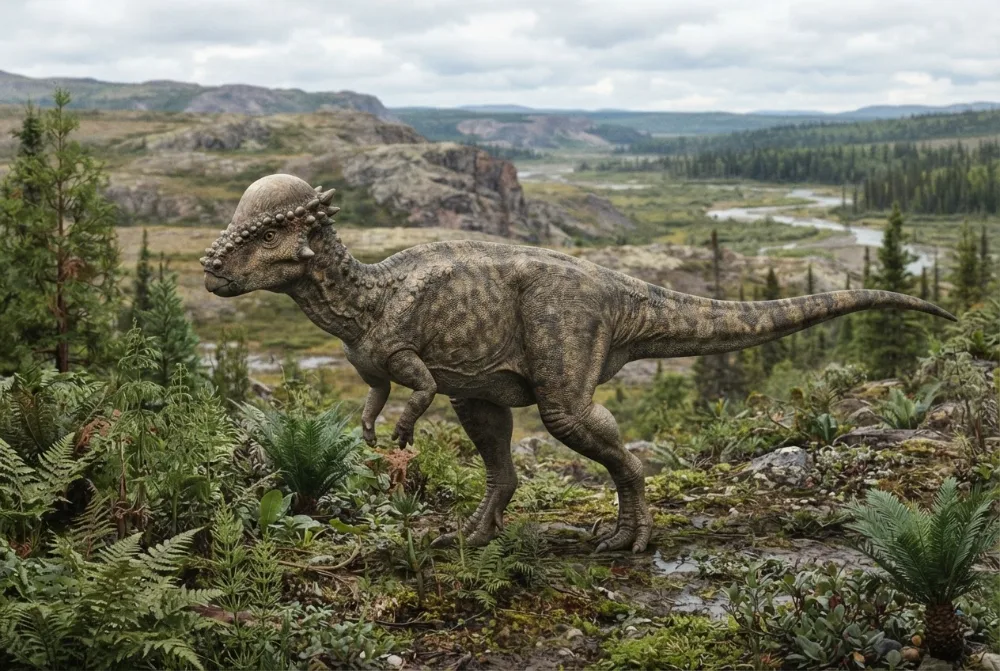
Alaskacephale was a small, dome-headed dinosaur that lived in the cold Arctic of ancient Alaska. It had a thick, bony skull with two rows of bumps along the back of its head. This plant-eater was one of the few dinosaurs that lived near the North Pole.1
E tshetse leng?
E ne e le kgolo go le kae?
E ne e le telele go le kae?
E ne e le bokete go le kae?
 telele jaaka dikatse tsa mo gae di le 3 go tswa kwa nkong go ya kwa mogatleng🍌telele jaaka dibanana di le 8 di latelana🍌bokete jaaka dibanana di le 83🏃e ne e ka taboga dimetara di le 100 mo metsotswaneng e le 11 (motho yo o bonako go gaisa o tlhoka 9,6)
Alaskacephale e ne e le kgolo go le kae fa e bapisiwa le WENA?
Ke dipalo fela mo sebatling sa gago. Ga go sepe se se bolokwang kgotsa se se romelwang gope.
E ne e le bonako go le kae?


Dintlha tse di monate
Alaskacephale lived about 70 to 69 million years ago, during the Maastrichtian stage of the Late Cretaceous.1
Only one fossil of Alaskacephale has been found: a piece of skull bone called a squamosal.1
The skull had two rows of bony bumps that helped scientists tell it apart from other dome-headed dinosaurs.1
Alaskacephale lived in a cold Arctic environment with winter darkness for 120 days and temperatures as low as -2°C (28°F).1
It shared its home with other dinosaurs like the horned Pachyrhinosaurus, the duck-billed Edmontosaurus, and the tyrannosaur Nanuqsaurus.1
Alaskacephale was about half the size of its relative Pachycephalosaurus, making it one of the smaller pachycephalosaurs.1
Dipotso tse di botswang thata ka ga Alaskacephale
?How big was Alaskacephale?
About 1.5 metres long and 10 kilograms, based on a similarly sized relative. It was one of the smaller pachycephalosaurs.1
?What did Alaskacephale eat?
It was a plant-eater, like all dome-headed dinosaurs.1
?When did Alaskacephale live?
It lived about 72 to 71 million years ago, during the Late Cretaceous (Maastrichtian stage).1
?Is Alaskacephale a dinosaur?
Yes, it is a dome-headed dinosaur (a pachycephalosaur).1
?Why did Alaskacephale have a thick skull?
The thick, bony dome on its skull might have been used for head-butting or for display, but scientists are not sure.1
?Did Alaskacephale have feathers?
Nobody knows for sure. No fossil feathers have been found with Alaskacephale, and it is not known if pachycephalosaurs had feathers.1
Ya baitseanape ba didino
- Leina la saense
- Alaskacephale
- Leina le neilwe ke
- Sullivan 20062
- Setlhopha
- Ditlhogo-dikgolokwe
- Lelapa / clade
- Pachycephalosauridae2
- Thulaganyo
- Ornithischia > Pachycephalosauria2
- Bogolo jwa matlapa
- 72 go ya go 66 dimilione tsa dingwaga (Maastrichtian)2
- Dibopego tsa matlapa
- Prince Creek2
- Dinaga
- Amerika2
- Direkoto tsa difosili
- 1 mo The Paleobiology Database2
- Go fitlhelwa
- The only fossil was found in 1999 by a University of Alaska expedition on the Colville River. It was named Alaskacephale gangloffi in 2006 by paleontologist Robert Sullivan, honoring the earlier researcher Roland Gangloff.1
- Go sa ntse go ganetsanwa
- Scientists are not sure exactly how big Alaskacephale was, because only a skull fragment has been found.1
Kwa dintlha di tswang teng
- Alaskacephale (en.wikipedia.org)
- Alaskacephale in The Paleobiology Database (CC BY 4.0): dingwaga, mafelo, dibopego tsa matlapa, thulaganyo.
Ntlha nngwe le nngwe mo tsebeng eno e na le nomoro e e supang motswedi wa yona. Fa re dirile phoso, maitshwarelo, re barati ba didino, ga re lokwalodikgang lwa saense. Re bolelele kwa [email protected] mme re tla e baakanya.
 Rex o tshwerwe ke tlala! Dino Wiki ke porojeke ya rre e a e diretseng morwawe yo o ratang didino, ke mahala, ga e na dipapatso e bile ga e na dilatedi. Batho ba bagolo ba ka fepa Rex senyamo go thusa gore e nne mo inthaneteng.Fepa Rex
 Pachycephalosaurus
 Stegoceras
 Prenocephale
 Sphaerotholus
 Foraminacephale
 Brontotholus
 Tyrannosaurus
 Triceratops
 Velociraptor
 Spinosaurus
 Ankylosaurus
 Parasaurolophus