 O dino efe? Kwisi
 Ntwa ya didino
 Peiso ya didino
 Metshamekwana ya didino
 Alebamo ya disetikara
 Manane a TOP a didino
 Ngakgamatsa!
E tshetse leng?

E ne e le kgolo go le kae?
E ne e le telele go le kae?
E ne e le kwa godimo go le kae?
kakanyo
E ne e le bokete go le kae?
 telele jaaka dintšwa di le 6 go tswa kwa nkong go ya kwa mogatleng🍌telele jaaka dibanana di le 33 di latelana🍉bokete jaaka magapu a le 140🧸bokete jaaka bana ba kreše ba le 37🎒bokete jaaka bana ba sekolo ba le 22🏃e ne e ka taboga dimetara di le 100 mo metsotswaneng e le 8.6 (motho yo o bonako go gaisa o tlhoka 9,6)
Alioramus e ne e le kgolo go le kae fa e bapisiwa le WENA?
Ke dipalo fela mo sebatling sa gago. Ga go sepe se se bolokwang kgotsa se se romelwang gope.
E ne e le bonako go le kae?


Dintlha tse di monate
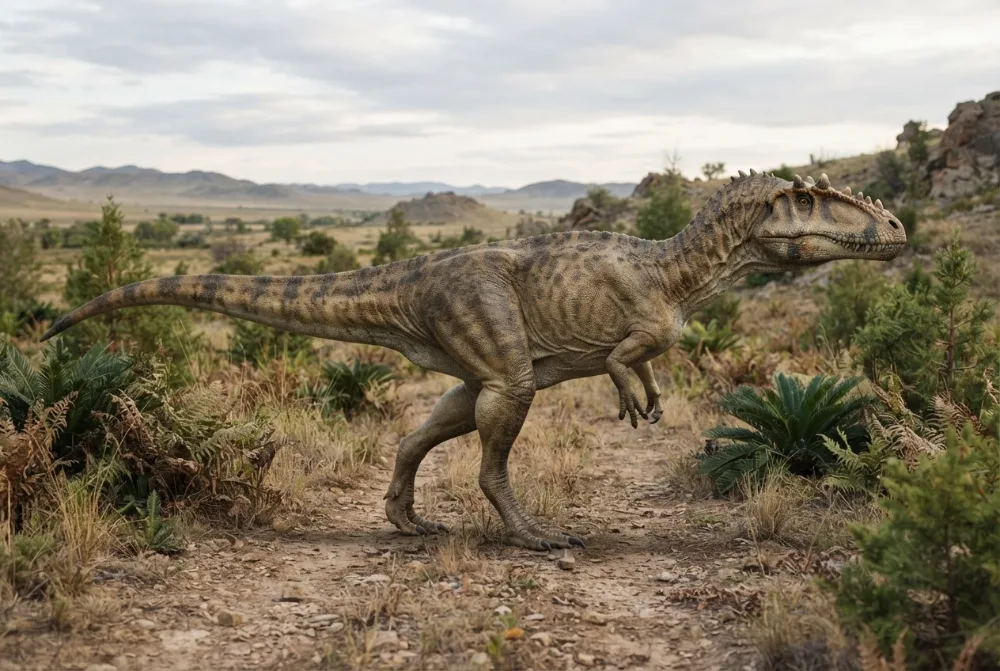
Alioramus had a long, low snout, unlike the deep, powerful skulls of most other tyrannosaurs.2
Its skull was decorated with eight separate horns, more than any other known tyrannosaur.2
One nearly complete skeleton belonged to a nine-year-old animal, but it was still smaller than other tyrannosaurs of the same age.2
Alioramus is closely related to the giant Tarbosaurus and Tyrannosaurus, even though it was much smaller and lighter.2
The name Alioramus means 'other branch', because scientists thought it was a different line of evolution.1
Dipotso tse di botswang thata ka ga Alioramus
?How big was Alioramus?
Alioramus was about 5 to 6 metres (16 to 20 feet) long and weighed around 385 to 700 kilograms (849 to 1,500 pounds), depending on the species and estimate. It was significantly smaller than a T. rex.341
?What did Alioramus eat?
Alioramus was a carnivore that ate meat. It had sharp teeth and probably hunted small prey, since its skull was not built for bone-crushing like larger tyrannosaurs.34
?How fast could Alioramus run?
The sources do not give a specific speed for Alioramus. It probably relied on speed and agility to hunt, but no exact running speed is known.4
?Why did Alioramus have horns on its head?
Alioramus had a row of five bony crests along the top of its snout, which may have been used for display or to attract mates. These crests were more than 1 cm (0.39 in) tall.3
?Is Alioramus a dinosaur?
Yes, Alioramus is a dinosaur. It is a genus of tyrannosaurid theropod dinosaurs from the Late Cretaceous period.31
Ya baitseanape ba didino
- Leina la saense
- Alioramus
- Leina le neilwe ke
- Kurzanov 19765
- Setlhopha
- Ditiranosoro
- Lelapa / clade
- Tyrannosauridae5
- Thulaganyo
- Theropoda > Tyrannosauroidea > Tyrannosauridae5
- Bogolo jwa matlapa
- 72 go ya go 66 dimilione tsa dingwaga (Maastrichtian)5
- Dibopego tsa matlapa
- Beds of Nogon Tsav, Nemegt5
- Dinaga
- Mongolia, Tšhaena5
- Direkoto tsa difosili
- 3 mo The Paleobiology Database5
- Go fitlhelwa
- Alioramus was named by Soviet paleontologist Sergei Kurzanov in 1976, based on fossils from the Nogon Tsav locality in Mongolia.5
- Go sa ntse go ganetsanwa
- Scientists still debate whether Alioramus is a juvenile of another tyrannosaur or a distinct, smaller adult species.2
Kwa dintlha di tswang teng
- Alioramus | Natural History Museum (nhm.ac.uk)
- pnas.org (pnas.org)
- Alioramus (en.wikipedia.org)
- Dinosaur - Alioramus altai - The Australian Museum (australian.museum)
- Alioramus in The Paleobiology Database (CC BY 4.0): dingwaga, mafelo, dibopego tsa matlapa, thulaganyo.
Ntlha nngwe le nngwe mo tsebeng eno e na le nomoro e e supang motswedi wa yona. Fa re dirile phoso, maitshwarelo, re barati ba didino, ga re lokwalodikgang lwa saense. Re bolelele kwa [email protected] mme re tla e baakanya.
 Rex o tshwerwe ke tlala! Dino Wiki ke porojeke ya rre e a e diretseng morwawe yo o ratang didino, ke mahala, ga e na dipapatso e bile ga e na dilatedi. Batho ba bagolo ba ka fepa Rex senyamo go thusa gore e nne mo inthaneteng.Fepa Rex
 Tyrannosaurus
 Tarbosaurus
 Albertosaurus
 Daspletosaurus
 Gorgosaurus
 Alectrosaurus
 Triceratops
 Velociraptor
 Spinosaurus
 Ankylosaurus
 Parasaurolophus
 Pteranodon