 O dino efe? Kwisi
 Ntwa ya didino
 Peiso ya didino
 Metshamekwana ya didino
 Alebamo ya disetikara
 Manane a TOP a didino
 Ngakgamatsa!
Aristonectes
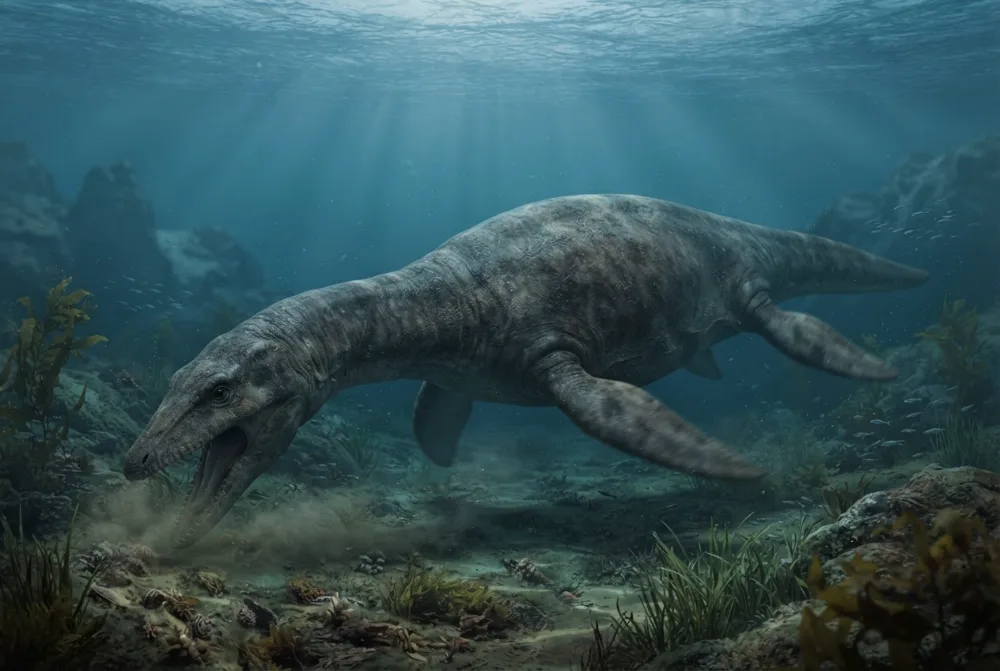
Aristonectes was a huge marine reptile that swam in the seas near Antarctica and South America at the end of the Age of Dinosaurs. It had a big head, a short neck, and a body shaped a bit like a whale. It used its wide mouth to suck up food from the seafloor, just like a gray whale does today.1
E tshetse leng?
E ne e le kgolo go le kae?
E ne e le telele go le kae?
E ne e le bokete go le kae?

 telele jaaka dikoloi di le 2.5 di emisitswe mo moleng🍌telele jaaka dibanana di le 66 di latelanabokete jaaka dikoloi di le 9🍉bokete jaaka magapu a le 2700🎒bokete jaaka diphaposiborutelo tse di tletseng bana di le 17🐻❄️bokete jaaka dibere tse ditshweu di le 30🏊e ne e ka thuma boleele jwa letamo le legolo la go thuma (50 m) mo metsotswaneng e le 8.6
Aristonectes e ne e le kgolo go le kae fa e bapisiwa le WENA?
Ke dipalo fela mo sebatling sa gago. Ga go sepe se se bolokwang kgotsa se se romelwang gope.
E ne e le bonako go le kae?


Dintlha tse di monate
Aristonectes is one of the biggest and heaviest plesiosaurs ever found. One Antarctic specimen may have weighed as much as 13.5 metric tons (about 15 tons), as heavy as a large school bus.1
Unlike most plesiosaurs, which had very long necks, Aristonectes had a short neck and a big, bulky skull. Scientists put it in a special group called Aristonectinae because of this.1
Aristonectes probably migrated between Patagonia and Antarctica, just like many whales do today. Its fossils are found in both places.1
The first fossils of Aristonectes were discovered in Argentina in 1941, but scientists had a hard time studying them because the bones were not well prepared. It took decades to figure out what kind of plesiosaur it was.1
Aristonectes had a mouth that could open very wide, letting it gulp a huge amount of water and food at once. It fed by mixing prey with sediment from the seafloor, a method called benthic suction feeding.1
Like other plesiosaurs, Aristonectes probably swallowed stones called gastroliths. These may have helped grind up food in its stomach or helped control its buoyancy in the water.1
Dipotso tse di botswang thata ka ga Aristonectes
?How big was Aristonectes?
Aristonectes was huge, measuring more than 10 metres (33 feet) long. One Antarctic specimen may have reached 11 to 11.9 metres (36 to 39 feet) and weighed 10.7 to 13.5 metric tons (11.8 to 14.9 short tons).12
?What did Aristonectes eat?
Aristonectes likely ate crustaceans and small fish, based on its small teeth. It fed by sucking up prey and sediment from the seafloor, like a gray whale.13
?Was Aristonectes a dinosaur?
No, Aristonectes was a plesiosaur, a marine reptile that lived alongside the dinosaurs. It was not a dinosaur.1
?Where did Aristonectes live?
Aristonectes lived in the seas near Patagonia and Antarctica during the Late Cretaceous. Its fossils have been found in Chile, Argentina, and Antarctica.1
?Could Aristonectes swim?
Yes, Aristonectes was a strong swimmer, using its large paddle-like limbs to move through the water. Its name means 'best swimmer'.1
Ya baitseanape ba didino
- Leina la saense
- Aristonectes
- Leina le neilwe ke
- Cabrera 19414
- Setlhopha
- Dipleisiosoro
- Lelapa / clade
- Elasmosauridae4
- Thulaganyo
- Plesiosauria > Elasmosauridae > Sauropterygia4
- Bogolo jwa matlapa
- 84 go ya go 66 dimilione tsa dingwaga (Campanian / Maastrichtian)4
- Dibopego tsa matlapa
- Quiriquina, López de Bertodano, Lopez de Bertodano4
- Dinaga
- Tšhile, Antaretika, Arejentina4
- Direkoto tsa difosili
- 12 mo The Paleobiology Database4
- E itsiwe gape e le
- Turneria (maina a bogologolo jaanong a balwa jaaka phologolo e le nngwe)4
- Go fitlhelwa
- Aristonectes was named by Argentine paleontologist Ángel Cabrera in 1941, based on fossils found in Chubut, Argentina. The first species named was Aristonectes parvidens.14
- Go sa ntse go ganetsanwa
- Scientists are still debating exactly how Aristonectes is related to other plesiosaurs. For a long time it was thought to be a cryptoclidid, but now most agree it is an elasmosaurid.1
Kwa dintlha di tswang teng
- Aristonectes (en.wikipedia.org)
- A giant elasmosaurid (Sauropterygia; Plesiosauria) from Antarctica: New information on elasmosaurid body size diversity and aristonectine evolutionary scenarios (sciencedirect.com)
- Fossil 'sea monster' found in Antarctica was the heaviest of its kind | National Geographic (nationalgeographic.com)
- Aristonectes in The Paleobiology Database (CC BY 4.0): dingwaga, mafelo, dibopego tsa matlapa, thulaganyo.
Ntlha nngwe le nngwe mo tsebeng eno e na le nomoro e e supang motswedi wa yona. Fa re dirile phoso, maitshwarelo, re barati ba didino, ga re lokwalodikgang lwa saense. Re bolelele kwa [email protected] mme re tla e baakanya.
 Rex o tshwerwe ke tlala! Dino Wiki ke porojeke ya rre e a e diretseng morwawe yo o ratang didino, ke mahala, ga e na dipapatso e bile ga e na dilatedi. Batho ba bagolo ba ka fepa Rex senyamo go thusa gore e nne mo inthaneteng.Fepa Rex
 Elasmosaurus
 Pliosaurus
 Plesiosaurus
 Cimoliasaurus
 Colymbosaurus
 Trinacromerum
 Tyrannosaurus
 Triceratops
 Velociraptor
 Spinosaurus
 Ankylosaurus
 Parasaurolophus