 O dino efe? Kwisi
 Ntwa ya didino
 Peiso ya didino
 Metshamekwana ya didino
 Alebamo ya disetikara
 Manane a TOP a didino
 Ngakgamatsa!
Arthropterygius
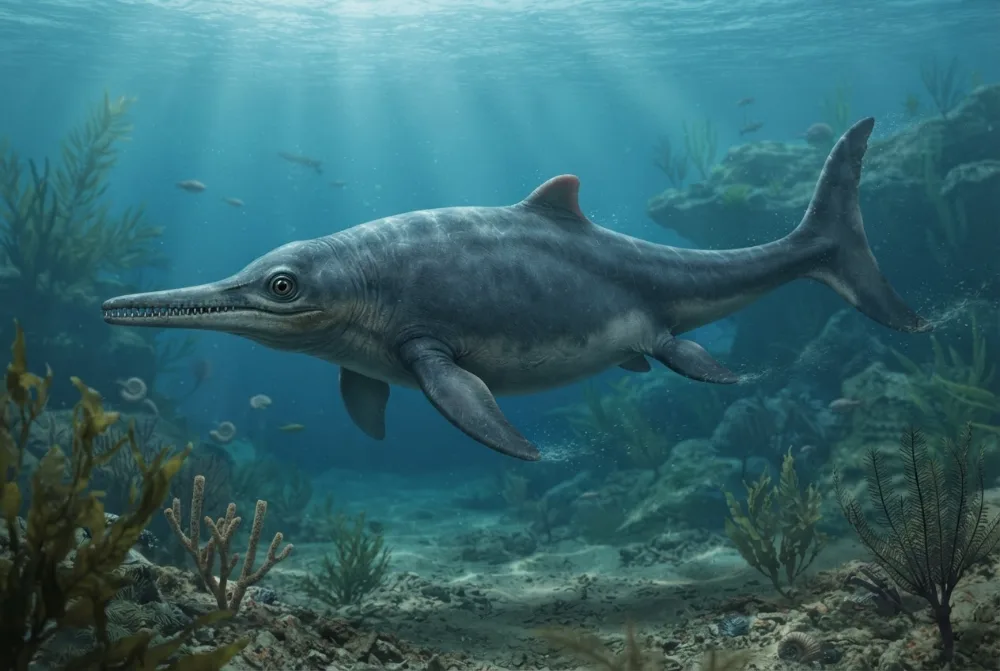
Arthropterygius was a large, fish-shaped marine reptile that swam in the oceans during the late Jurassic period. It had a long snout and strong flippers, and it was a fast hunter of fish and squid.13
E tshetse leng?
E ne e le kgolo go le kae?
E ne e le telele go le kae?
 telele jaaka dintšwa di le 5 go tswa kwa nkong go ya kwa mogatleng🍌telele jaaka dibanana di le 28 di latelana🏊e ne e ka thuma boleele jwa letamo le legolo la go thuma (50 m) mo metsotswaneng e le 3.9
Arthropterygius e ne e le kgolo go le kae fa e bapisiwa le WENA?
Ke dipalo fela mo sebatling sa gago. Ga go sepe se se bolokwang kgotsa se se romelwang gope.
E ne e le bonako go le kae?


Dintlha tse di monate
Arthropterygius had a special opening for the internal carotid artery on the back of its braincase, a feature unique among ichthyosaurs.2
Fossils of Arthropterygius have been found in both the Northern and Southern Hemispheres, showing it lived in warm and cold seas.12
One specimen from Svalbard, Norway, was about 3.8 to 4.3 metres (12 to 14 feet) long and was probably an adult.1
The name Arthropterygius means 'wing fin', referring to the shape of its flippers.1
Arthropterygius lived in shallow seas with methane seeps, where the seafloor was about 150 metres (490 feet) deep and had little oxygen.1
It belonged to a group called ophthalmosaurids, which were the last surviving ichthyosaurs before they went extinct.1
Dipotso tse di botswang thata ka ga Arthropterygius
?How big was Arthropterygius?
Arthropterygius was a relatively large ichthyosaur, with all species measuring between 3 and 5 metres (9.8 to 16.4 feet) long.1
?What did Arthropterygius eat?
It was a fast hunter of fish and squid, using its long snout and strong flippers to catch prey.1
?Was Arthropterygius a dinosaur?
No, Arthropterygius was an ichthyosaur, a type of marine reptile that lived in the oceans, not a dinosaur.1
?Where did Arthropterygius live?
Fossils of Arthropterygius have been found in Canada, Norway, Russia, and Argentina, showing it lived in both warm and cold seas across the Northern and Southern Hemispheres.1
Ya baitseanape ba didino
- Leina la saense
- Arthropterygius
- Leina le neilwe ke
- Maxwell 20103
- Setlhopha
- Diikhithiosoro
- Lelapa / clade
- Ophthalmosauridae3
- Thulaganyo
- Ichthyosauria > Ichthyosauromorpha3
- Bogolo jwa matlapa
- 162 go ya go 143 dimilione tsa dingwaga (Oxfordian / Tithonian)3
- Dibopego tsa matlapa
- Ringnes, Agardhfjellet, Vaca Muerta3
- Dinaga
- Khanata, Noreweye, Arejentina, Rašia3
- Direkoto tsa difosili
- 8 mo The Paleobiology Database3
- Go fitlhelwa
- The first fossils of Arthropterygius were found on Melville Island, Canada, and were originally named Ophthalmosaurus chrisorum in 1993. In 2010, scientist Erin Maxwell gave them a new genus name, Arthropterygius.13
- Go sa ntse go ganetsanwa
- Scientists are not sure if Arthropterygius lived into the earliest Cretaceous period, or if it went extinct at the end of the Jurassic.1
Kwa dintlha di tswang teng
- Arthropterygius (en.wikipedia.org)
- Original article The genus Arthropterygius Maxwell (Ichthyosauria: Ophthalmosauridae) in the Late Jurassic of the Neuquén Basin, Argentina ☆ (sciencedirect.com)
- Arthropterygius in The Paleobiology Database (CC BY 4.0): dingwaga, mafelo, dibopego tsa matlapa, thulaganyo.
Ntlha nngwe le nngwe mo tsebeng eno e na le nomoro e e supang motswedi wa yona. Fa re dirile phoso, maitshwarelo, re barati ba didino, ga re lokwalodikgang lwa saense. Re bolelele kwa [email protected] mme re tla e baakanya.
 Rex o tshwerwe ke tlala! Dino Wiki ke porojeke ya rre e a e diretseng morwawe yo o ratang didino, ke mahala, ga e na dipapatso e bile ga e na dilatedi. Batho ba bagolo ba ka fepa Rex senyamo go thusa gore e nne mo inthaneteng.Fepa Rex
 Ichthyosaurus
 Platypterygius
 Stenopterygius
 Khudiakovia
 Ophthalmosaurus
 Chonespondylus
 Brachiosaurus
 Diplodocus
 Allosaurus
 Brontosaurus
 Compsognathus
 Camarasaurus