 O dino efe? Kwisi
 Ntwa ya didino
 Peiso ya didino
 Metshamekwana ya didino
 Alebamo ya disetikara
 Manane a TOP a didino
 Ngakgamatsa!
Baryonyx
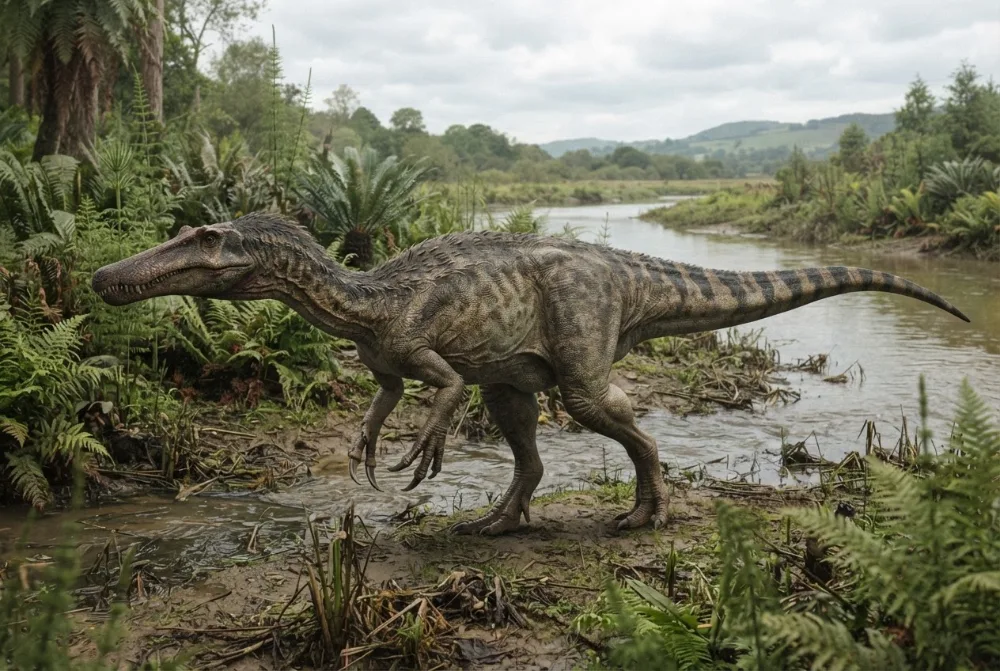
Baryonyx was a big, fish-eating dinosaur with a long snout like a crocodile and a huge claw on each hand. It lived about 130 to 125 million years ago in what is now England and other parts of Europe. It was one of the first dinosaurs shown to eat fish!1
E tshetse leng?
E ne e le kgolo go le kae?
E ne e le telele go le kae?
E ne e le kwa godimo go le kae?
E ne e le bokete go le kae?
 telele jaaka dikoloi di le 2 di emisitswe mo moleng🍌telele jaaka dibanana di le 56 di latelana
 bokete jaaka dintšwa di le 100🍉bokete jaaka magapu a le 400🎒bokete jaaka diphaposiborutelo tse di tletseng bana di le 2.5🐻❄️bokete jaaka dibere tse ditshweu di le 4🏃e ne e ka taboga dimetara di le 100 mo metsotswaneng e le 14 (motho yo o bonako go gaisa o tlhoka 9,6)
Baryonyx e ne e le kgolo go le kae fa e bapisiwa le WENA?
Ke dipalo fela mo sebatling sa gago. Ga go sepe se se bolokwang kgotsa se se romelwang gope.
E ne e le bonako go le kae?


Dintlha tse di monate
Baryonyx had a huge claw on its first finger, about 30 centimeters (12 inches) long, which it may have used to catch fish.1
Its snout was long and narrow, like a crocodile's, with many small, serrated teeth, perfect for gripping slippery fish.1
The first Baryonyx skeleton was found in 1983 in a clay pit in Surrey, England, by an amateur fossil collector named William Walker.1
Baryonyx was the first theropod dinosaur proven to eat fish, because fish scales were found in its stomach area.1
It lived in a warm, swampy environment with rivers and lakes, alongside other dinosaurs like Iguanodon and small sauropods.1
Some scientists think Baryonyx may have waded in water like a heron, using its long snout to snap up fish.1
Baryonyx also had a notch in its upper jaw, similar to a gharial, which helped it hold onto wriggling prey.1
Dipotso tse di botswang thata ka ga Baryonyx
?How big was Baryonyx?
About 7.5 to 10 metres (25 to 33 feet) long and weighed 1.2 to 2 metric tons (1.3 to 2.2 short tons).12
?What did Baryonyx eat?
It mainly ate fish, but also scavenged and ate young Iguanodon. Fish scales and bones were found in its stomach.12
?Did Baryonyx have feathers?
Nobody knows for sure. No feathers have been found with Baryonyx fossils, but some related dinosaurs may have had simple feathers.1
?Could Baryonyx swim?
It may have waded in shallow water and was probably a good swimmer, like a crocodile. It lived in a swampy environment.12
?Was Baryonyx bigger than T. rex?
No, Baryonyx was smaller. T. rex was about 12 metres (40 feet) long and weighed over 8 metric tons, while Baryonyx was up to 10 metres (33 feet) and 2 metric tons.1
?Why did Baryonyx have a big claw?
It used its 31-centimetre (12-inch) claw to catch fish and tear apart prey. The claw was on its thumb.12
?When did Baryonyx live?
It lived during the Early Cretaceous period, about 130 to 125 million years ago.12
?Where was Baryonyx found?
The first skeleton was found in 1983 in a clay pit in Surrey, England. Fossils have also been found in Spain.12
?Is Baryonyx a dinosaur?
Yes, Baryonyx is a theropod dinosaur. It is not a marine reptile or pterosaur.12
?How fast could Baryonyx run?
Scientists do not know its exact speed, but as a large theropod it probably ran at a moderate pace, maybe 25 to 40 km/h (15 to 25 mph).1
Mothubi wa ditlhamane
Tlhamane: Baryonyx was a slow, clumsy dinosaur that only ate fish.
Boammaaruri: While it ate fish, Baryonyx was also an active predator and scavenger, and it could probably move well on land.1
Ya baitseanape ba didino
- Leina la saense
- Baryonyx
- Leina le neilwe ke
- Charig and Milner 19863
- Setlhopha
- Dispinosoro
- Lelapa / clade
- Spinosauridae3
- Thulaganyo
- Theropoda > Spinosauridae3
- Bogolo jwa matlapa
- 139 go ya go 110 dimilione tsa dingwaga (Berriasian / Albian)3
- Dibopego tsa matlapa
- Pinilla de los Moros, Weald Clay, Wessex3
- Dinaga
- Sepania, Bogosi jo bo Kopaneng, Potokale, Tunisia3
- Direkoto tsa difosili
- 12 mo The Paleobiology Database3
- Go fitlhelwa
- The first Baryonyx skeleton was discovered in 1983 by amateur fossil collector William J. Walker in a clay pit in Surrey, England. It was named by Alan J. Charig and Angela C. Milner in 1986.1
- Go sa ntse go ganetsanwa
- Scientists still debate whether Baryonyx mainly hunted fish or also scavenged on land, and whether some fossils from other places really belong to this genus.1
Kwa dintlha di tswang teng
- Baryonyx (en.wikipedia.org)
- Baryonyx | Natural History Museum (nhm.ac.uk)
- Baryonyx in The Paleobiology Database (CC BY 4.0): dingwaga, mafelo, dibopego tsa matlapa, thulaganyo.
Ntlha nngwe le nngwe mo tsebeng eno e na le nomoro e e supang motswedi wa yona. Fa re dirile phoso, maitshwarelo, re barati ba didino, ga re lokwalodikgang lwa saense. Re bolelele kwa [email protected] mme re tla e baakanya.
 Rex o tshwerwe ke tlala! Dino Wiki ke porojeke ya rre e a e diretseng morwawe yo o ratang didino, ke mahala, ga e na dipapatso e bile ga e na dilatedi. Batho ba bagolo ba ka fepa Rex senyamo go thusa gore e nne mo inthaneteng.Fepa Rex
 Spinosaurus
 Suchomimus
 Angaturama
 Camarillasaurus
 Ceratosuchops
 Iberospinus
 Stegosaurus
 Iguanodon
 Archaeopteryx
 Giganotosaurus
 Microraptor
 Deinonychus