 O dino efe? Kwisi
 Ntwa ya didino
 Peiso ya didino
 Metshamekwana ya didino
 Alebamo ya disetikara
 Manane a TOP a didino
 Ngakgamatsa!
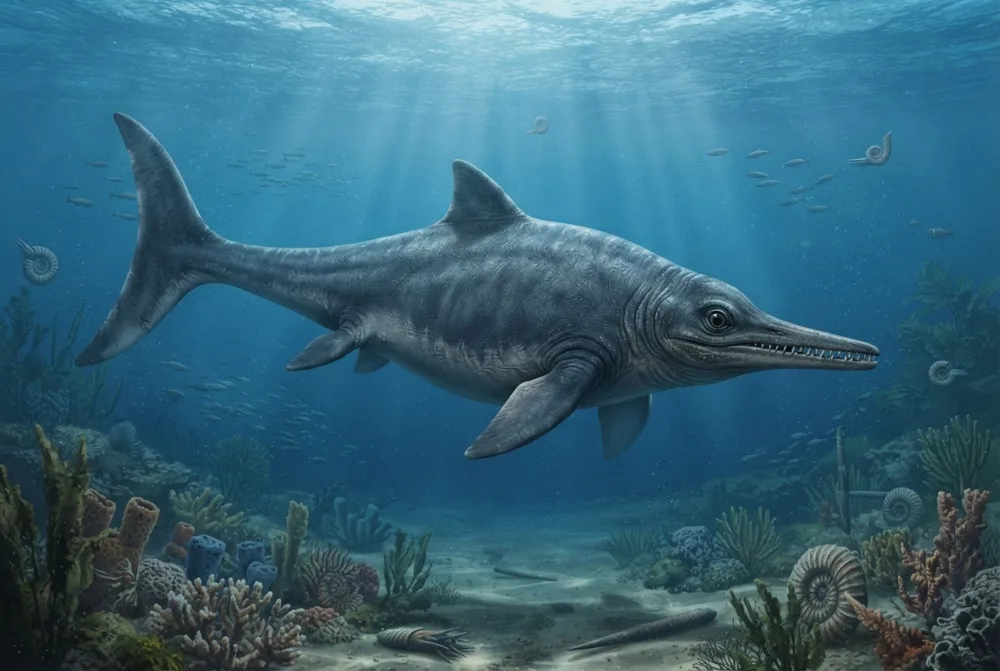
Brachypterygius
Brachypterygius was a fast-swimming marine reptile that lived in the Late Jurassic seas. It looked a bit like a dolphin but was a reptile, not a fish or a dinosaur. Its short, wide front flippers helped it steer through the water.1
E tshetse leng?
E ne e le kgolo go le kae?
E ne e le telele go le kae?
 telele jaaka dintšwa di le 4 go tswa kwa nkong go ya kwa mogatleng🍌telele jaaka dibanana di le 22 di latelana🏊e ne e ka thuma boleele jwa letamo le legolo la go thuma (50 m) mo metsotswaneng e le 3.8
Brachypterygius e ne e le kgolo go le kae fa e bapisiwa le WENA?
Ke dipalo fela mo sebatling sa gago. Ga go sepe se se bolokwang kgotsa se se romelwang gope.
E ne e le bonako go le kae?


Dintlha tse di monate
Brachypterygius had a short, wide front flipper with up to six fingers, and some fingers had as many as 16 bones.1
Its skull was between 0.5 and 1.2 metres long, about the size of a big dog's head.1
The first fossil of Brachypterygius was just a single right front flipper, found in England.1
Brachypterygius lived during the Kimmeridgian and Tithonian ages, about 154 to 143 million years ago.3
It is closely related to other ichthyosaurs like Platypterygius and Caypullisaurus.1
Scientists once thought Brachypterygius was the same as another ichthyosaur called Grendelius, but now many think they are different.1
Dipotso tse di botswang thata ka ga Brachypterygius
?How big was Brachypterygius?
Brachypterygius was a medium sized ichthyosaur, with a body length up to 4 metres (13 ft) and a skull length of 0.5 to 1.2 metres (1.6 to 3.9 ft).1
?Was Brachypterygius a dinosaur?
No, Brachypterygius was an ichthyosaur, a marine reptile that lived in the sea. It was not a dinosaur, even though it lived at the same time as dinosaurs.1
?What did Brachypterygius eat?
Scientists think Brachypterygius hunted in sunlit waters for slower prey like fish that swam in shoals. Its teeth were larger and more robust than those of some other ichthyosaurs.2
Ya baitseanape ba didino
- Leina la saense
- Brachypterygius
- Leina le neilwe ke
- Huene 19223
- Setlhopha
- Diikhithiosoro
- Lelapa / clade
- Ophthalmosauridae3
- Thulaganyo
- Ichthyosauria > Ichthyosauromorpha3
- Bogolo jwa matlapa
- 155 go ya go 143 dimilione tsa dingwaga (Kimmeridgian / Tithonian)3
- Dibopego tsa matlapa
- Kimmeridge Clay, Agardhfjellet3
- Dinaga
- Bogosi jo bo Kopaneng, Rašia, Noreweye3
- Direkoto tsa difosili
- 6 mo The Paleobiology Database3
- E itsiwe gape e le
- Ochevia, Otschevia (maina a bogologolo jaanong a balwa jaaka phologolo e le nngwe)3
- Go fitlhelwa
- The first fossil, a right front flipper, was described as Ichthyosaurus extremus by Boulenger in 1904. In 1922, Friedrich von Huene gave it the new name Brachypterygius because of its short, wide flipper.1
- Go sa ntse go ganetsanwa
- Scientists still debate whether the species Grendelius mordax is the same as Brachypterygius extremus or a separate animal.1
Kwa dintlha di tswang teng
- Brachypterygius (en.wikipedia.org)
- Brachypterygius (prehistoric-wildlife.com)
- Brachypterygius in The Paleobiology Database (CC BY 4.0): dingwaga, mafelo, dibopego tsa matlapa, thulaganyo.
Ntlha nngwe le nngwe mo tsebeng eno e na le nomoro e e supang motswedi wa yona. Fa re dirile phoso, maitshwarelo, re barati ba didino, ga re lokwalodikgang lwa saense. Re bolelele kwa [email protected] mme re tla e baakanya.
 Rex o tshwerwe ke tlala! Dino Wiki ke porojeke ya rre e a e diretseng morwawe yo o ratang didino, ke mahala, ga e na dipapatso e bile ga e na dilatedi. Batho ba bagolo ba ka fepa Rex senyamo go thusa gore e nne mo inthaneteng.Fepa Rex
 Ichthyosaurus
 Platypterygius
 Stenopterygius
 Khudiakovia
 Ophthalmosaurus
 Chonespondylus
 Brachiosaurus
 Diplodocus
 Allosaurus
 Brontosaurus
 Compsognathus
 Camarasaurus