 O dino efe? Kwisi
 Ntwa ya didino
 Peiso ya didino
 Metshamekwana ya didino
 Alebamo ya disetikara
 Manane a TOP a didino
 Ngakgamatsa!
Djupedalia
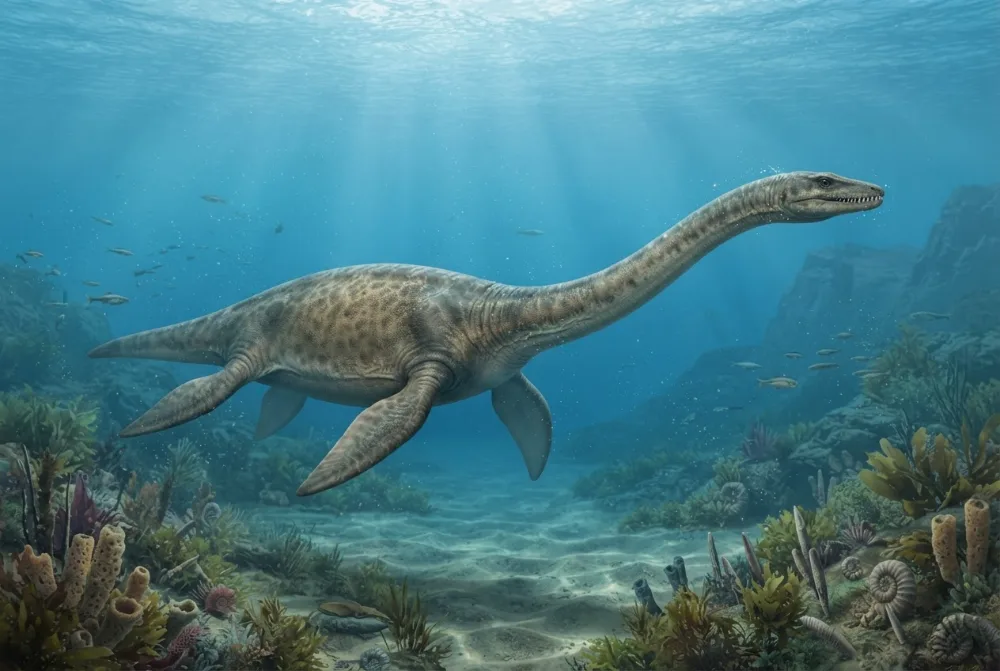
Djupedalia was a long-necked marine reptile that swam in the warm, shallow seas near Svalbard, Norway, about 150 million years ago. It was not a dinosaur, but a plesiosaur, a type of ocean predator. With its small head and long neck, it likely snapped up fish and squid while paddling through the water.42
E tshetse leng?
E ne e le kgolo go le kae?
E ne e le telele go le kae?
 telele jaaka dintšwa di le 6 go tswa kwa nkong go ya kwa mogatleng🍌telele jaaka dibanana di le 33 di latelana🏊e ne e ka thuma boleele jwa letamo le legolo la go thuma (50 m) mo metsotswaneng e le 6.7
Djupedalia e ne e le kgolo go le kae fa e bapisiwa le WENA?
Ke dipalo fela mo sebatling sa gago. Ga go sepe se se bolokwang kgotsa se se romelwang gope.
E ne e le bonako go le kae?


Dintlha tse di monate
Djupedalia is known from a single juvenile skeleton that is one of the most complete marine reptile fossils ever found in Spitsbergen.2
Its neck bones were special: the neural spines (the parts that stick up from the vertebrae) were shifted far back, and the postzygapophyses (the joints that connect vertebrae) were very long.2
Djupedalia had femora (thigh bones) that were longer than its humeri (upper arm bones), which is unusual for plesiosaurs.2
The fossil was found about 20 metres below a rock layer called the Dorsoplanites bed, which is full of ammonite shells.2
Djupedalia lived during the Tithonian age, about 150 to 145 million years ago, in the Late Jurassic period.1
Mothubi wa ditlhamane
Tlhamane: Some people might think Djupedalia was a dinosaur because it lived in the sea and had a long neck.
Boammaaruri: Djupedalia was a plesiosaur, a marine reptile, not a dinosaur. Dinosaurs lived on land, while plesiosaurs swam in the ocean.4
Ya baitseanape ba didino
- Leina la saense
- Djupedalia
- Leina le neilwe ke
- Knutsen et al. 20124
- Setlhopha
- Dipleisiosoro
- Lelapa / clade
- Cryptoclididae4
- Thulaganyo
- Plesiosauria > Sauropterygia4
- Bogolo jwa matlapa
- 149 go ya go 143 dimilione tsa dingwaga (Tithonian)4
- Dibopego tsa matlapa
- Agardhfjellet4
- Dinaga
- Noreweye4
- Direkoto tsa difosili
- 1 mo The Paleobiology Database4
- Go fitlhelwa
- Djupedalia was named in 2012 by Espen M. Knutsen, Patrick S. Druckenmiller, and Jørn H. Hurum. The fossil was excavated in the summer of 2009 by the University of Oslo Natural History Museum from the Slottsmøya Member near Janusfjellet mountain.2
- Go sa ntse go ganetsanwa
- Scientists are still debating exactly how Djupedalia is related to other plesiosaurs, since it shares features with several different groups from England and other places.2
Kwa dintlha di tswang teng
- Djupedalia (en.wikipedia.org)
- A new plesiosauroid (Reptilia: Sauropterygia) from the Agardhfjellet Formation (Middle Volgian) of central Spitsbergen, Norway (foreninger.uio.no)
- PaleoCodex :: Djupedalia (paleocodex.com)
- Djupedalia in The Paleobiology Database (CC BY 4.0): dingwaga, mafelo, dibopego tsa matlapa, thulaganyo.
Ntlha nngwe le nngwe mo tsebeng eno e na le nomoro e e supang motswedi wa yona. Fa re dirile phoso, maitshwarelo, re barati ba didino, ga re lokwalodikgang lwa saense. Re bolelele kwa [email protected] mme re tla e baakanya.
 Rex o tshwerwe ke tlala! Dino Wiki ke porojeke ya rre e a e diretseng morwawe yo o ratang didino, ke mahala, ga e na dipapatso e bile ga e na dilatedi. Batho ba bagolo ba ka fepa Rex senyamo go thusa gore e nne mo inthaneteng.Fepa Rex
 Elasmosaurus
 Pliosaurus
 Plesiosaurus
 Cimoliasaurus
 Colymbosaurus
 Trinacromerum
 Brachiosaurus
 Diplodocus
 Allosaurus
 Brontosaurus
 Compsognathus
 Camarasaurus