 O dino efe? Kwisi
 Ntwa ya didino
 Peiso ya didino
 Metshamekwana ya didino
 Alebamo ya disetikara
 Manane a TOP a didino
 Ngakgamatsa!
Edmontonia
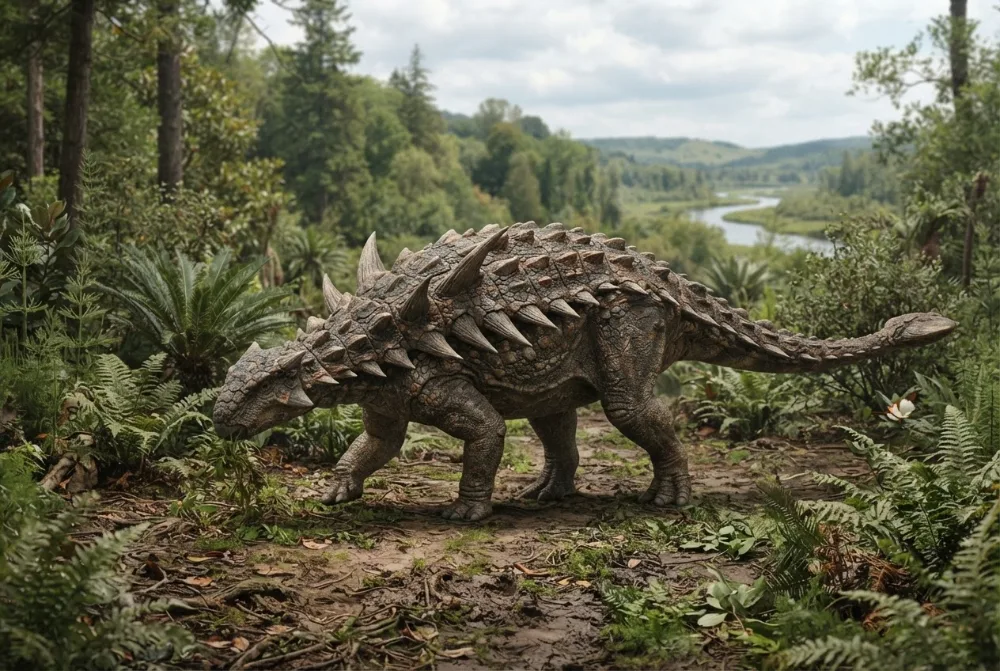
Edmontonia was a tank-like dinosaur covered in bony plates and sharp spikes. It walked on four legs and munched on low-growing plants. This nodosaurid dinosaur lived in western North America near the end of the Age of Dinosaurs.1
E tshetse leng?
E ne e le kgolo go le kae?
E ne e le telele go le kae?
E ne e le kwa godimo go le kae?
E ne e le bokete go le kae?

 telele jaaka dintšwa di le 7 go tswa kwa nkong go ya kwa mogatleng🍌telele jaaka dibanana di le 37 di latelanabokete jaaka dintšwa di le 150🍉bokete jaaka magapu a le 600🎒bokete jaaka diphaposiborutelo tse di tletseng bana di le 4🐻❄️bokete jaaka dibere tse ditshweu di le 7🏃e ne e ka taboga dimetara di le 100 mo metsotswaneng e le 28 (motho yo o bonako go gaisa o tlhoka 9,6)
Edmontonia e ne e le kgolo go le kae fa e bapisiwa le WENA?
Ke dipalo fela mo sebatling sa gago. Ga go sepe se se bolokwang kgotsa se se romelwang gope.
E ne e le bonako go le kae?


Dintlha tse di monate
Edmontonia had four huge spikes sticking out from each shoulder, the largest of any nodosaurid. These spikes could have been used to fight other Edmontonia or to stab attacking predators.1
Its back and head were covered with small, oval bony plates that had a ridge down the middle. Its neck and shoulders were protected by three half-rings made of large keeled plates.1
Edmontonia lived alongside many other giant plant-eaters like the duck-billed dinosaurs Gryposaurus and Corythosaurus, and the horned dinosaurs Centrosaurus and Chasmosaurus.1
The only large predators that lived with Edmontonia were the tyrannosaurids Gorgosaurus and Daspletosaurus.1
Scientists think Edmontonia might have crouched down to protect its soft belly from predators, making it hard for a predator to flip it over.1
One species of Edmontonia, E. rugosidens, lived about 76.5 to 75 million years ago. The other species, E. longiceps, lived about 72 million years ago.1
Dipotso tse di botswang thata ka ga Edmontonia
?How big was Edmontonia?
Edmontonia was about 6 to 6.6 metres (20 to 22 ft) long and weighed around 3 tonnes (about 6,600 lb).15
?What did Edmontonia eat?
Edmontonia was an herbivore that ate low-growing plants like ferns and cycads. Its small teeth and weak jaws suggest it processed food differently than modern mammals.156
?Did Edmontonia have armor?
Yes, Edmontonia was covered in small oval bony plates on its back and head, and had three half-rings of large keeled plates protecting its neck and shoulders. It also had four huge spikes on each shoulder.15
?How fast could Edmontonia run?
No source gives a speed for Edmontonia, but its heavy armor and short, thick legs suggest it was slow-moving, like a tank.15
?Was Edmontonia bigger than T. rex?
No, Edmontonia was much smaller. T. rex could be over 12 metres (40 ft) long, while Edmontonia was only about 6 to 6.6 metres (20 to 22 ft) long.1
?When did Edmontonia live?
Edmontonia lived during the Late Cretaceous Period, about 76.5 to 68 million years ago.16
?Where was Edmontonia found?
Edmontonia fossils have been found in western North America, especially in Alberta, Canada, and also in the Talkeetna Mountains near Denali National Park in Alaska.15
?Could Edmontonia swim?
No source says Edmontonia could swim. Its heavy armor and short legs probably kept it on land.1
Mothubi wa ditlhamane
Tlhamane: Edmontonia could swing its tail like a club to defend itself.
Boammaaruri: Edmontonia was a nodosaurid, not an ankylosaurid. Nodosaurids did not have a tail club. Instead, Edmontonia relied on its shoulder spikes and body armor for protection.1
Ya baitseanape ba didino
- Leina la saense
- Edmontonia
- Leina le neilwe ke
- Sternberg 19287
- Setlhopha
- Didino tse di nang le thebe
- Lelapa / clade
- Nodosauridae7
- Thulaganyo
- Ornithischia > Ankylosauria > Nodosauridae > Thyreophora7
- Bogolo jwa matlapa
- 84 go ya go 66 dimilione tsa dingwaga (Campanian / Maastrichtian)7
- Dibopego tsa matlapa
- Judith River, Aguja, Hell Creek7
- Dinaga
- Amerika, Khanata7
- Direkoto tsa difosili
- 16 mo The Paleobiology Database7
- E itsiwe gape e le
- Chassternbergia, Denversaurus (maina a bogologolo jaanong a balwa jaaka phologolo e le nngwe)7
- Go fitlhelwa
- Edmontonia was named by Charles M. Sternberg in 1928. The first fossils, including a skull and much of the skeleton, were found near Morrin, Alberta, Canada in 1924 by George Paterson.1
- Go sa ntse go ganetsanwa
- Scientists still debate whether the fossils called Denversaurus and Chassternbergia are really separate dinosaurs or just different species of Edmontonia.2
Kwa dintlha di tswang teng
- Edmontonia (en.wikipedia.org)
- PBDB Taxon (paleobiodb.org)
- EDMONTONIA - DinoChecker dinosaur archive (dinochecker.com)
- Edmontonia | Dino Tail - Dinosaur Encyclopedia (dino-tail.com)
- Edmontonia - Denali National Park & Preserve (U.S. National Park Service) (nps.gov)
- enchantedlearning.com (enchantedlearning.com)
- Edmontonia in The Paleobiology Database (CC BY 4.0): dingwaga, mafelo, dibopego tsa matlapa, thulaganyo.
Ntlha nngwe le nngwe mo tsebeng eno e na le nomoro e e supang motswedi wa yona. Fa re dirile phoso, maitshwarelo, re barati ba didino, ga re lokwalodikgang lwa saense. Re bolelele kwa [email protected] mme re tla e baakanya.
 Rex o tshwerwe ke tlala! Dino Wiki ke porojeke ya rre e a e diretseng morwawe yo o ratang didino, ke mahala, ga e na dipapatso e bile ga e na dilatedi. Batho ba bagolo ba ka fepa Rex senyamo go thusa gore e nne mo inthaneteng.Fepa Rex
 Ankylosaurus
 Sauropelta
 Pinacosaurus
 Scutellosaurus
 Struthiosaurus
 Euoplocephalus
 Tyrannosaurus
 Triceratops
 Velociraptor
 Spinosaurus
 Parasaurolophus
 Pteranodon