 O dino efe? Kwisi
 Ntwa ya didino
 Peiso ya didino
 Metshamekwana ya didino
 Alebamo ya disetikara
 Manane a TOP a didino
 Ngakgamatsa!
E tshetse leng?

E ne e le kgolo go le kae?
E ne e le telele go le kae?
E ne e le kwa godimo go le kae?
E ne e le bokete go le kae?
 telele jaaka dikatse tsa mo gae di le 2 go tswa kwa nkong go ya kwa mogatleng🍌telele jaaka dibanana di le 6 di latelanae ka nna bokete jaaka katse ya mo gae🍌bokete jaaka dibanana di le 56🪑nnye mo e ka tsamayang ka fa tlase ga setulo⚽e ne e ka fofa go kgabaganya lebala lotlhe la kgwele ya dinao mo metsotswaneng e le 8.4
Enantiornis e ne e le kgolo go le kae fa e bapisiwa le WENA?
Ke dipalo fela mo sebatling sa gago. Ga go sepe se se bolokwang kgotsa se se romelwang gope.
E ne e le bonako go le kae?


Dintlha tse di monate
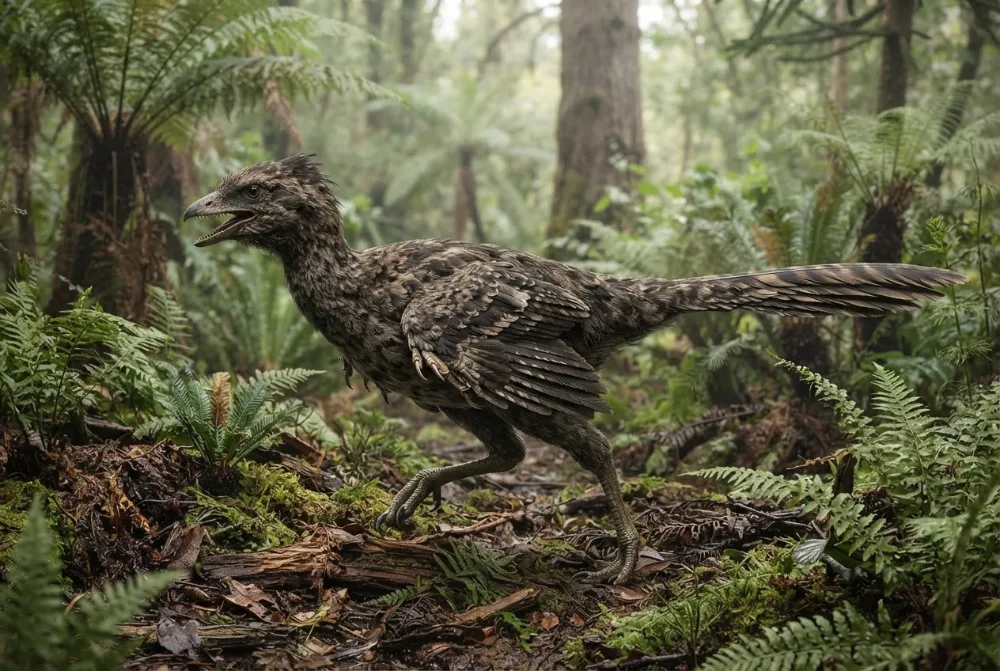
Enantiornis is one of the earliest known birds, living from about 94 to 66 million years ago.4
It had a special shoulder joint that worked differently from modern birds, which is why it is called an 'opposite bird'.1
Fossils of Enantiornis have been found in both South America and Central Asia, showing it lived in warm, wet environments.4
This bird was about the size of a crow, with a wingspan of roughly half a meter.2
Enantiornis had teeth in its beak, which helped it catch and eat prey.1
It lived on the ground and could fly, but probably spent a lot of time walking or running.4
Dipotso tse di botswang thata ka ga Enantiornis
?How big was Enantiornis?
About 78.5 cm long, with a wingspan of roughly 1.2 m, and it weighed around 6.75 kg. That is larger than a herring gull or a crow.3
?Did Enantiornis have teeth?
Yes, Enantiornis had teeth in its beak, which helped it catch and eat prey.3
?When did Enantiornis live?
Enantiornis lived during the Late Cretaceous, from about 94 to 66 million years ago.3
?Where were Enantiornis fossils found?
Fossils of Enantiornis have been found in Argentina (South America) and also in Central Asia.3
Ya baitseanape ba didino
- Leina la saense
- Enantiornis
- Leina le neilwe ke
- Walker 19814
- Setlhopha
- Dinonyane tsa ntlha
- Lelapa / clade
- Euenantiornithes4
- Thulaganyo
- Theropoda > Avialae4
- Bogolo jwa matlapa
- 94 go ya go 66 dimilione tsa dingwaga (Turonian / Maastrichtian)4
- Dibopego tsa matlapa
- Lecho, Bissekty4
- Dinaga
- Arejentina, Uzbekistan4
- Direkoto tsa difosili
- 4 mo The Paleobiology Database4
- Go fitlhelwa
- Enantiornis was named by Cyril Walker in 1981 based on fossils found in Argentina. The first species described was Enantiornis leali.42
- Go sa ntse go ganetsanwa
- Scientists are still debating exactly how Enantiornis is related to other ancient birds, because its skeleton is different from both modern birds and other extinct groups.4
Kwa dintlha di tswang teng
- Enantiornis Walker 1981 - Encyclopedia of Life (eol.org)
- PBDB Taxon (paleobiodb.org)
- Enantiornis (Wikipedia) (Wikipedia)
- Enantiornis in The Paleobiology Database (CC BY 4.0): dingwaga, mafelo, dibopego tsa matlapa, thulaganyo.
Ntlha nngwe le nngwe mo tsebeng eno e na le nomoro e e supang motswedi wa yona. Fa re dirile phoso, maitshwarelo, re barati ba didino, ga re lokwalodikgang lwa saense. Re bolelele kwa [email protected] mme re tla e baakanya.
 Rex o tshwerwe ke tlala! Dino Wiki ke porojeke ya rre e a e diretseng morwawe yo o ratang didino, ke mahala, ga e na dipapatso e bile ga e na dilatedi. Batho ba bagolo ba ka fepa Rex senyamo go thusa gore e nne mo inthaneteng.Fepa Rex
 Archaeopteryx
 Hesperornis
 Ichthyornis
 Baptornis
 Jurapteryx
 Gobipteryx
 Tyrannosaurus
 Triceratops
 Velociraptor
 Spinosaurus
 Ankylosaurus
 Parasaurolophus