 O dino efe? Kwisi
 Ntwa ya didino
 Peiso ya didino
 Metshamekwana ya didino
 Alebamo ya disetikara
 Manane a TOP a didino
 Ngakgamatsa!
Germanodactylus
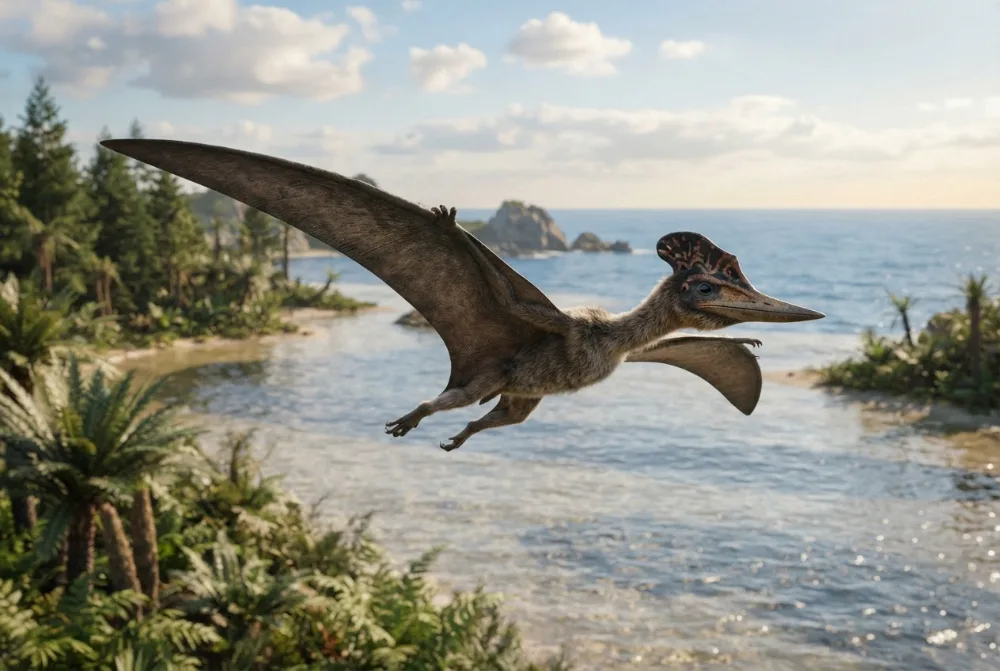
Germanodactylus was a small pterosaur that flew over warm lagoons during the Late Jurassic. It had a pointed beak and a fancy crest on its head, which may have been used to attract mates.1
E tshetse leng?
E ne e le kgolo go le kae?
Diphuka tsa yona di ne di namegile go le kae?
 telele jaaka dikatse tsa mo gae di le 2 go tswa kwa nkong go ya kwa mogatleng⚽e ne e ka fofa go kgabaganya lebala lotlhe la kgwele ya dinao mo metsotswaneng e le 10
Germanodactylus e ne e le kgolo go le kae fa e bapisiwa le WENA?
Ke dipalo fela mo sebatling sa gago. Ga go sepe se se bolokwang kgotsa se se romelwang gope.
E ne e le bonako go le kae?


Dintlha tse di monate
Germanodactylus had a head crest with a bony part and a soft-tissue part that more than doubled its height. The soft part was probably made of skin-like material.1
Its skull was about 13 centimeters (5.1 inches) long for G. cristatus, and 21 centimeters (8.3 inches) for G. rhamphastinus.1
Germanodactylus had sharp teeth, with about 13 teeth in each side of the upper jaw for G. cristatus, and 16 for G. rhamphastinus.1
For a long time, scientists thought Germanodactylus was just a species of Pterodactylus, but it got its own genus in 1964.1
Some scientists think the two species of Germanodactylus might not be closely related, and one might belong to a different group.1
Germanodactylus lived about 150 to 148 million years ago, during the Late Jurassic period.1
Dipotso tse di botswang thata ka ga Germanodactylus
?Was Germanodactylus a dinosaur?
No, Germanodactylus was a pterosaur, a flying reptile that lived during the time of dinosaurs, but it is not a dinosaur.1
?How big was Germanodactylus?
Germanodactylus was about the size of a raven. G. cristatus had a wingspan of about 0.98 meters (3.2 feet), and G. rhamphastinus was a bit larger with a wingspan of 1.08 meters (3.5 feet).1
?What did Germanodactylus eat?
Scientists are not sure exactly what it ate, but its sharp teeth suggest it may have eaten fish or other small animals.1
?Why did Germanodactylus have a crest?
The crest may have been used to attract mates, like a peacock's tail. It had a bony part and a soft part that more than doubled its height.1
Mothubi wa ditlhamane
Tlhamane: Germanodactylus was a dinosaur.
Boammaaruri: Germanodactylus was a pterosaur, a flying reptile that is not a dinosaur.1
Ya baitseanape ba didino
- Leina la saense
- Germanodactylus
- Leina le neilwe ke
- Young 19642
- Setlhopha
- Digagabi tse di fofang
- Lelapa / clade
- Lophocratia2
- Thulaganyo
- Pterosauria > Pterodactyloidea2
- Bogolo jwa matlapa
- 155 go ya go 145 dimilione tsa dingwaga (Kimmeridgian / Tithonian)2
- Dibopego tsa matlapa
- Solnhofen, Kimmeridge Clay, Altmühltal2
- Dinaga
- Jeremane, Bogosi jo bo Kopaneng2
- Direkoto tsa difosili
- 5 mo The Paleobiology Database2
- Go fitlhelwa
- The first specimen was found in the Solnhofen Limestone of Germany and was named Pterodactylus cristatus by Carl Wiman in 1925. Yang Zhongjian gave it its own genus, Germanodactylus, in 1964.1
- Go sa ntse go ganetsanwa
- Scientists still debate whether the two species of Germanodactylus belong in the same genus, or if one should be moved to a new genus.1
Kwa dintlha di tswang teng
- Germanodactylus (en.wikipedia.org)
- Germanodactylus in The Paleobiology Database (CC BY 4.0): dingwaga, mafelo, dibopego tsa matlapa, thulaganyo.
Ntlha nngwe le nngwe mo tsebeng eno e na le nomoro e e supang motswedi wa yona. Fa re dirile phoso, maitshwarelo, re barati ba didino, ga re lokwalodikgang lwa saense. Re bolelele kwa [email protected] mme re tla e baakanya.
 Rex o tshwerwe ke tlala! Dino Wiki ke porojeke ya rre e a e diretseng morwawe yo o ratang didino, ke mahala, ga e na dipapatso e bile ga e na dilatedi. Batho ba bagolo ba ka fepa Rex senyamo go thusa gore e nne mo inthaneteng.Fepa Rex
 Pteranodon
 Quetzalcoatlus
 Dorygnathus
 Rhamphorhynchus
 Anhanguera
 Pterodactylus
 Brachiosaurus
 Diplodocus
 Allosaurus
 Brontosaurus
 Compsognathus
 Camarasaurus