 O dino efe? Kwisi
 Ntwa ya didino
 Peiso ya didino
 Metshamekwana ya didino
 Alebamo ya disetikara
 Manane a TOP a didino
 Ngakgamatsa!
Giraffatitan
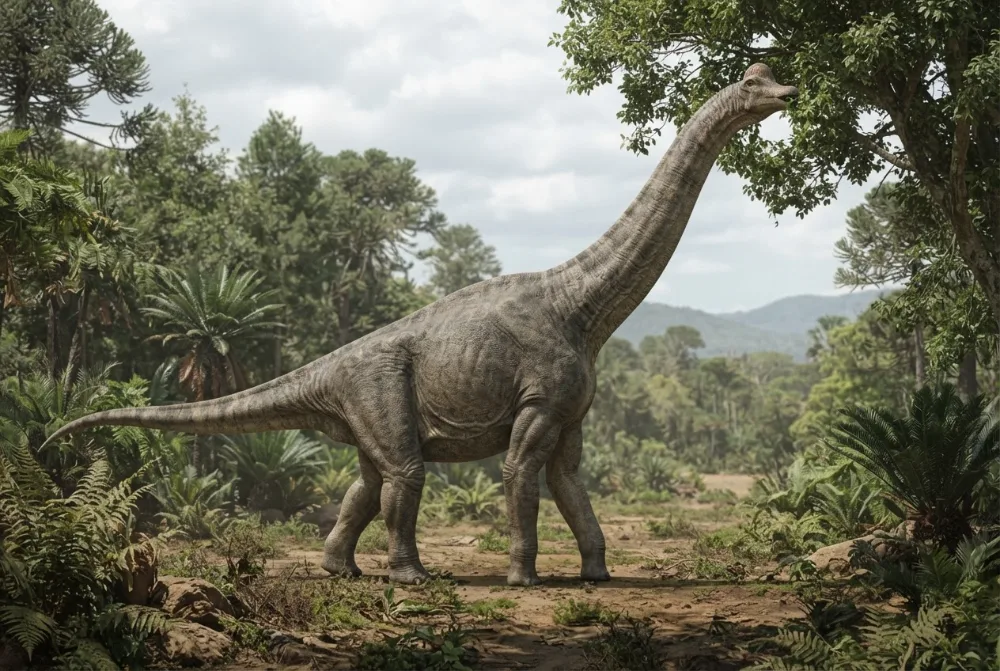
Giraffatitan was a giant, long-necked plant-eater that lived in what is now Tanzania. It had a giraffe-like shape with very long front legs and a tall skull. This dinosaur could reach high into the trees to munch on leaves that other dinosaurs couldn't reach.1
E tshetse leng?
E ne e le kgolo go le kae?
E ne e le telele go le kae?
E ne e le kwa godimo go le kae?
E ne e le bokete go le kae?

 telele jaaka dikoloi di le 6 di emisitswe mo moleng🍌telele jaaka dibanana di le 140 di latelana🍉bokete jaaka magapu a le 9600🦒kwa godimo jaaka dithutlwa di le 3 di eme e nngwe mo godimo ga e nngwe🎒bokete jaaka diphaposiborutelo tse di tletseng bana di le 60🐻❄️bokete jaaka dibere tse ditshweu di le 110🏢kwa godimo mo e ka kgalalelang mo fensetereng ya mokato wa 6🏃e ne e ka taboga dimetara di le 100 mo metsotswaneng e le 40 (motho yo o bonako go gaisa o tlhoka 9,6)
Giraffatitan e ne e le kgolo go le kae fa e bapisiwa le WENA?
Ke dipalo fela mo sebatling sa gago. Ga go sepe se se bolokwang kgotsa se se romelwang gope.
E ne e le bonako go le kae?


Dintlha tse di monate
Giraffatitan was first thought to be an African species of Brachiosaurus, but scientists now think it is a separate genus because of many differences in its bones.1
The name Giraffatitan means 'titanic giraffe' because its long neck and sloping body reminded scientists of a giraffe.1
Most size estimates come from a subadult skeleton called HMN SII, but a larger leg bone suggests some Giraffatitan grew even bigger, up to 26 metres long.1
Its nostrils were once thought to be on top of its head, like a snorkel, but modern studies show they were near the tip of the snout.1
Giraffatitan lived about 150 to 145 million years ago, during the Late Jurassic period, in a warm, seasonal climate with forests and coastal lagoons.1
It had a very long neck that could only move up and down a little, so it probably fed on treetop leaves without swinging its head sideways much.1
Dipotso tse di botswang thata ka ga Giraffatitan
?How big was Giraffatitan?
About 23 metres (75 feet) long and 12 metres (39 feet) tall. The largest individuals may have reached 26 metres (85 feet) and weighed up to 48 tonnes (53 tons).12
?What did Giraffatitan eat?
It was a plant-eater (herbivore) that ate leaves from the tops of trees. Its long neck and chisel-like teeth helped it reach and bite off foliage that other dinosaurs couldn't.12
?When did Giraffatitan live?
It lived during the Late Jurassic Period, about 154 to 142 million years ago.2
?Where was Giraffatitan found?
Its fossils were discovered in Tanzania, Africa, at a place called Tendaguru.12
?Was Giraffatitan bigger than T. rex?
Yes, much bigger. Giraffatitan was about 23 metres long and weighed up to 48 tonnes, while T. rex was only about 12 metres long and weighed around 8 tonnes.1
?Is Giraffatitan a dinosaur?
Yes, it is a dinosaur. It is a sauropod, a group of four-legged, long-necked plant-eating dinosaurs.12
?Why did Giraffatitan have a long neck?
Its long neck helped it reach high into trees to eat leaves that other dinosaurs could not reach. Its neck could only move up and down a little, so it probably fed on treetop leaves without swinging its head sideways much.1
?Could Giraffatitan swim?
No, scientists now think it was a fully land animal. Water pressure would have made it hard to breathe if it was submerged, and its feet were too narrow for swimming.1
Mothubi wa ditlhamane
Tlhamane: Some people think Giraffatitan spent most of its time in water to support its heavy body.
Boammaaruri: Scientists now believe it was fully land-living, because water pressure would have made breathing difficult and its feet were not good for swimming.1
Ya baitseanape ba didino
- Leina la saense
- Giraffatitan
- Leina le neilwe ke
- (Paul 1988)3
- Setlhopha
- Melala-meleele
- Lelapa / clade
- Brachiosauridae3
- Thulaganyo
- Sauropodomorpha > Sauropoda > Macronaria3
- Bogolo jwa matlapa
- 162 go ya go 143 dimilione tsa dingwaga (Oxfordian / Tithonian)3
- Dibopego tsa matlapa
- Tendaguru3
- Dinaga
- Tanzania3
- Direkoto tsa difosili
- 42 mo The Paleobiology Database3
- Go fitlhelwa
- Giraffatitan was discovered in Tanzania by a German expedition led by Werner Janensch, who first named it Brachiosaurus brancai in 1914. It was later given its own genus name Giraffatitan by Gregory S. Paul in 1988.1
- Go sa ntse go ganetsanwa
- Scientists still debate whether Giraffatitan should be a separate genus from Brachiosaurus or just a close relative.1
Kwa dintlha di tswang teng
- Giraffatitan (en.wikipedia.org)
- Giraffatitan | Natural History Museum (nhm.ac.uk)
- Giraffatitan in The Paleobiology Database (CC BY 4.0): dingwaga, mafelo, dibopego tsa matlapa, thulaganyo.
Ntlha nngwe le nngwe mo tsebeng eno e na le nomoro e e supang motswedi wa yona. Fa re dirile phoso, maitshwarelo, re barati ba didino, ga re lokwalodikgang lwa saense. Re bolelele kwa [email protected] mme re tla e baakanya.
 Rex o tshwerwe ke tlala! Dino Wiki ke porojeke ya rre e a e diretseng morwawe yo o ratang didino, ke mahala, ga e na dipapatso e bile ga e na dilatedi. Batho ba bagolo ba ka fepa Rex senyamo go thusa gore e nne mo inthaneteng.Fepa Rex
 Brachiosaurus
 Diplodocus
 Brontosaurus
 Argentinosaurus
 Camarasaurus
 Morosaurus
 Allosaurus
 Compsognathus
 Camptosaurus
 Nanosaurus
 Rhamphorhynchus
 Ceratosaurus