 O dino efe? Kwisi
 Ntwa ya didino
 Peiso ya didino
 Metshamekwana ya didino
 Alebamo ya disetikara
 Manane a TOP a didino
 Ngakgamatsa!
Gongshuilong
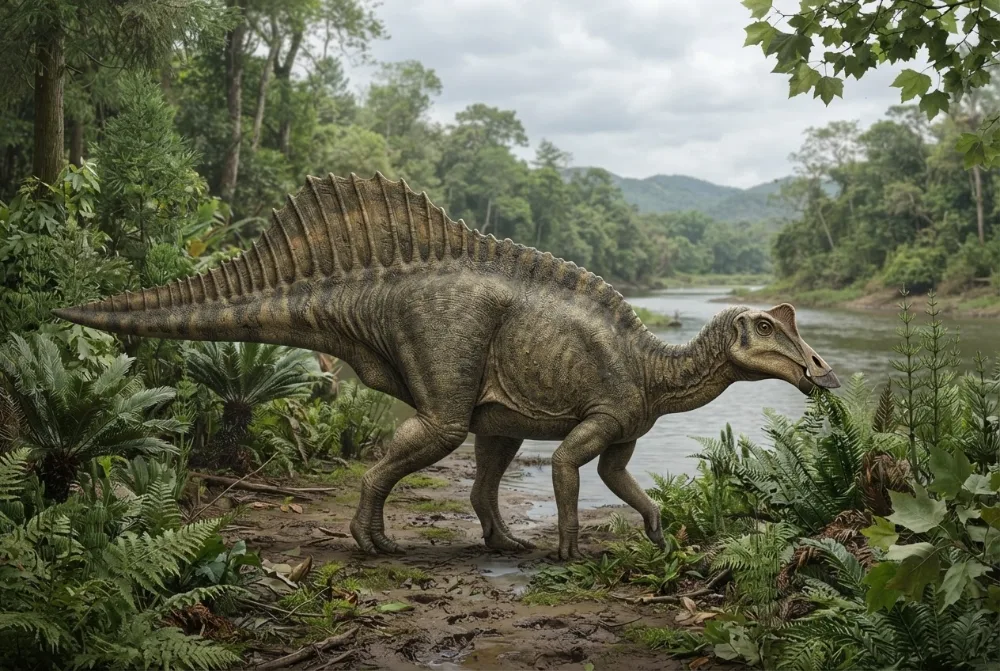
Gongshuilong was a duck-billed dinosaur that lived in China near the end of the Age of Dinosaurs. It had a tall, sail-like tail made of extra-long bones, which made it look really cool. This plant-eater is special because it is the first named hadrosaur from South China!1
E tshetse leng?
E ne e le kgolo go le kae?
E ne e le telele go le kae?
E ne e le kwa godimo go le kae?
kakanyo
 telele jaaka dintšwa di le 7 go tswa kwa nkong go ya kwa mogatleng🍌telele jaaka dibanana di le 39 di latelana🏃e ne e ka taboga dimetara di le 100 mo metsotswaneng e le 13 (motho yo o bonako go gaisa o tlhoka 9,6)
Gongshuilong e ne e le kgolo go le kae fa e bapisiwa le WENA?
Ke dipalo fela mo sebatling sa gago. Ga go sepe se se bolokwang kgotsa se se romelwang gope.
E ne e le bonako go le kae?


Dintlha tse di monate
Gongshuilong's tail bones were super long, making the tail look like a sail. The neural spines were 8.5 times as tall as the bones they attached to, which is unique among all iguanodontian dinosaurs.1
It was a medium-sized hadrosaur, about 7 metres (23 feet) long, which is about as long as a small school bus.1
Gongshuilong is the second brachylophosaurin found in Asia, after Wulagasaurus. Most of its close relatives lived in North America, so it helps show that this group might have started in Asia.1
The fossils were found in a bonebed with at least two individuals, because scientists found two left lower jaws, two shoulder blades, and two shin bones of different sizes.1
Its name, Gongshuilong, comes from the Gong River near where it was found, and 'long' means dragon in Chinese.1
The species name 'fanwei' refers to the sail-like tail, because 'fan' means sail in Chinese.1
Dipotso tse di botswang thata ka ga Gongshuilong
?What did Gongshuilong eat?
Gongshuilong was a plant-eater, like other duck-billed dinosaurs. It used its beak and many teeth to chew plants.1
?How big was Gongshuilong?
Gongshuilong was a medium sized hadrosaur, about 7 metres (23 feet) long, roughly the length of a small school bus.1
?When did Gongshuilong live?
Gongshuilong lived during the Late Cretaceous period, specifically in the Maastrichtian age, near the end of the Age of Dinosaurs.1
Mothubi wa ditlhamane
Tlhamane: Some people think all duck-billed dinosaurs lived in North America.
Boammaaruri: Gongshuilong shows that duck-billed dinosaurs also lived in Asia, and it is the first named hadrosaur from South China.1
Ya baitseanape ba didino
- Leina la saense
- Gongshuilong
- Leina le neilwe ke
- Yao et al. 20263
- Setlhopha
- Melomo-pidipidi
- Lelapa / clade
- Hadrosauridae3
- Thulaganyo
- Ornithischia > Ornithopoda > Iguanodontia > Hadrosauridae3
- Bogolo jwa matlapa
- 72 go ya go 66 dimilione tsa dingwaga (Maastrichtian)3
- Dibopego tsa matlapa
- Lianhe3
- Dinaga
- Tšhaena3
- Direkoto tsa difosili
- 1 mo The Paleobiology Database3
- Go fitlhelwa
- In March 2021, construction workers found a bonebed in Ganzhou, China. Scientists from the Jiangxi Geological Survey and Exploration Institute dug out the fossils in two blocks, and in 2026 Han Yao and colleagues named the new species Gongshuilong fanwei.12
- Go sa ntse go ganetsanwa
- Scientists are still debating exactly how Gongshuilong is related to other brachylophosaurins, because the family tree shows a polytomy, meaning the relationships are not fully resolved.1
Kwa dintlha di tswang teng
- Gongshuilong (en.wikipedia.org)
- MorphoBank V4 (beta.morphobank.org)
- Gongshuilong in The Paleobiology Database (CC BY 4.0): dingwaga, mafelo, dibopego tsa matlapa, thulaganyo.
Ntlha nngwe le nngwe mo tsebeng eno e na le nomoro e e supang motswedi wa yona. Fa re dirile phoso, maitshwarelo, re barati ba didino, ga re lokwalodikgang lwa saense. Re bolelele kwa [email protected] mme re tla e baakanya.
 Rex o tshwerwe ke tlala! Dino Wiki ke porojeke ya rre e a e diretseng morwawe yo o ratang didino, ke mahala, ga e na dipapatso e bile ga e na dilatedi. Batho ba bagolo ba ka fepa Rex senyamo go thusa gore e nne mo inthaneteng.Fepa Rex
 Parasaurolophus
 Edmontosaurus
 Saurolophus
 Hypacrosaurus
 Corythosaurus
 Kritosaurus
 Tyrannosaurus
 Triceratops
 Velociraptor
 Spinosaurus
 Ankylosaurus
 Pteranodon