 O dino efe? Kwisi
 Ntwa ya didino
 Peiso ya didino
 Metshamekwana ya didino
 Alebamo ya disetikara
 Manane a TOP a didino
 Ngakgamatsa!
E tshetse leng?

E ne e le kgolo go le kae?
E ne e le telele go le kae?
E ne e le bokete go le kae?
 telele jaaka dikatse tsa mo gae di le 4 go tswa kwa nkong go ya kwa mogatleng🍌telele jaaka dibanana di le 11 di latelana🍌bokete jaaka dibanana di le 76🏃e ne e ka taboga dimetara di le 100 mo metsotswaneng e le 16 (motho yo o bonako go gaisa o tlhoka 9,6)
Graciliceratops e ne e le kgolo go le kae fa e bapisiwa le WENA?
Ke dipalo fela mo sebatling sa gago. Ga go sepe se se bolokwang kgotsa se se romelwang gope.
E ne e le bonako go le kae?


Dintlha tse di monate
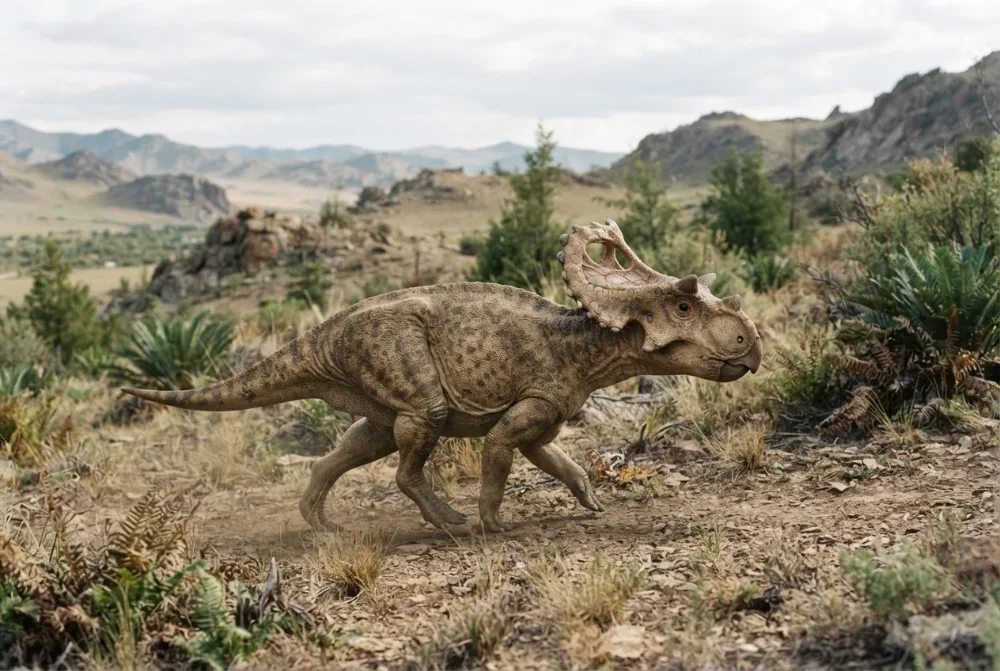
Graciliceratops had a very slender, fragile frill with large holes in it, held up by thin struts of bone.2
The only fossil found is a young animal, because its sacral vertebrae were not yet fused together.2
Its shin bone (tibia) was longer than its thigh bone (femur), which helped it run fast.2
Graciliceratops lived alongside the large dromaeosaurid Achillobator and the tyrannosauroid Khankhuuluu.2
It was a basal neoceratopsian, an early relative of later horned dinosaurs like Protoceratops.2
Dipotso tse di botswang thata ka ga Graciliceratops
?How big was Graciliceratops?
The only known fossil is a young animal about 60 cm long and weighing 2.27 to 9.1 kg. Scientists think a full-grown adult would have been around 2 m long, about the size of a small pony.21
?What did Graciliceratops eat?
It was an herbivore, eating plants. Fossil fruits found in the same area show that flowering plants grew there, so it probably ate those.21
Ya baitseanape ba didino
- Leina la saense
- Graciliceratops
- Leina le neilwe ke
- Sereno 20003
- Setlhopha
- Didino tse di nang le dinaka
- Lelapa / clade
- Neoceratopsia3
- Thulaganyo
- Ornithischia > Ceratopsia3
- Bogolo jwa matlapa
- 100 go ya go 84 dimilione tsa dingwaga (Cenomanian / Santonian)3
- Dibopego tsa matlapa
- Baynshire3
- Dinaga
- Mongolia3
- Direkoto tsa difosili
- 1 mo The Paleobiology Database3
- Go fitlhelwa
- The first fossil was found in 1971 by a Polish-Mongolian expedition. It was originally called Microceratops, but Paul Sereno gave it the new name Graciliceratops in 2000.21
- Go sa ntse go ganetsanwa
- Scientists are not sure exactly how big a fully grown Graciliceratops was, because the only known skeleton is from a juvenile.2
Kwa dintlha di tswang teng
- Graciliceratops | Natural History Museum (nhm.ac.uk)
- Graciliceratops (en.wikipedia.org)
- Graciliceratops in The Paleobiology Database (CC BY 4.0): dingwaga, mafelo, dibopego tsa matlapa, thulaganyo.
Ntlha nngwe le nngwe mo tsebeng eno e na le nomoro e e supang motswedi wa yona. Fa re dirile phoso, maitshwarelo, re barati ba didino, ga re lokwalodikgang lwa saense. Re bolelele kwa [email protected] mme re tla e baakanya.
 Rex o tshwerwe ke tlala! Dino Wiki ke porojeke ya rre e a e diretseng morwawe yo o ratang didino, ke mahala, ga e na dipapatso e bile ga e na dilatedi. Batho ba bagolo ba ka fepa Rex senyamo go thusa gore e nne mo inthaneteng.Fepa Rex
 Triceratops
 Protoceratops
 Ojoceratops
 Tatankaceratops
 Psittacosaurus
 Centrosaurus
 Tyrannosaurus
 Velociraptor
 Spinosaurus
 Ankylosaurus
 Parasaurolophus
 Pteranodon