 O dino efe? Kwisi
 Ntwa ya didino
 Peiso ya didino
 Metshamekwana ya didino
 Alebamo ya disetikara
 Manane a TOP a didino
 Ngakgamatsa!
Guidraco
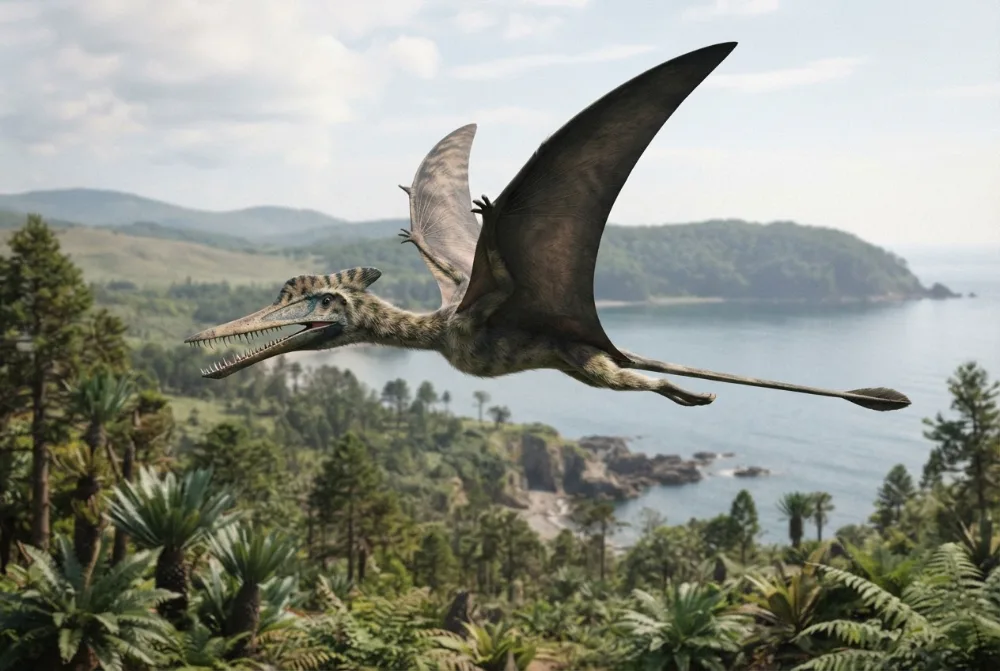
Guidraco was a flying reptile with a scary name meaning 'malicious ghost dragon'. It had a long beak full of sharp teeth that stuck out in all directions, perfect for snatching fish from the water.1
E tshetse leng?
E ne e le bonako go le kae?


Dintlha tse di monate
Guidraco had 82 teeth in its head, with the front ones being very long and sticking out far beyond the beak.1
The first tooth in the upper jaw pointed almost straight forward, like a spear.1
Guidraco lived about 120 million years ago during the Early Cretaceous period.1
Its neck vertebrae had large holes that let air sacs enter the bones, making them lighter for flight.1
Guidraco is closely related to Ludodactylus, a pterosaur from Brazil, showing that pterosaurs moved between continents.1
The only fossil found so far is a partial skeleton including a nearly complete skull and neck bones.1
Dipotso tse di botswang thata ka ga Guidraco
?How big was Guidraco?
Its skull was about 38 centimetres (15 inches) long. The rest of its body is not fully known, so its total size is an estimate.1
?What did Guidraco eat?
It ate fish. Its long, interlocking front teeth worked like a trap to grab slippery fish.1
?Where was Guidraco found?
It was found in Liaoning Province, northeast China, in the Jiufotang Formation.1
?Is Guidraco a dinosaur?
No, Guidraco is a pterosaur, a flying reptile that lived alongside dinosaurs but is not a dinosaur.1
?Why is it called Guidraco?
Its name means 'malicious ghost dragon' in Chinese and Latin. 'Gui' means ghost in Chinese, and 'draco' means dragon in Latin.1
?Did Guidraco have a crest?
Yes, it had a large, rounded crest on top of its skull, above the eye sockets. It pointed slightly forward.1
Ya baitseanape ba didino
- Leina la saense
- Guidraco
- Leina le neilwe ke
- Wang et al. 20122
- Setlhopha
- Digagabi tse di fofang
- Lelapa / clade
- Ornithocheiroidea2
- Thulaganyo
- Pterosauria > Pterodactyloidea2
- Bogolo jwa matlapa
- 121 go ya go 113 dimilione tsa dingwaga (Aptian)2
- Dibopego tsa matlapa
- Jiufotang2
- Dinaga
- Tšhaena2
- Direkoto tsa difosili
- 1 mo The Paleobiology Database2
- Go fitlhelwa
- Guidraco was named in 2012 by Wang Xiaolin, Alexander W.A. Kellner, Jiang Shunxing, and Xin Cheng. The fossil was found in the Jiufotang Formation in Liaoning, China.12
- Go sa ntse go ganetsanwa
- Scientists are not sure whether Guidraco belongs to the Anhangueridae family or the Boreopteridae family.1
Kwa dintlha di tswang teng
- Guidraco (en.wikipedia.org)
- Guidraco in The Paleobiology Database (CC BY 4.0): dingwaga, mafelo, dibopego tsa matlapa, thulaganyo.
Ntlha nngwe le nngwe mo tsebeng eno e na le nomoro e e supang motswedi wa yona. Fa re dirile phoso, maitshwarelo, re barati ba didino, ga re lokwalodikgang lwa saense. Re bolelele kwa [email protected] mme re tla e baakanya.
 Rex o tshwerwe ke tlala! Dino Wiki ke porojeke ya rre e a e diretseng morwawe yo o ratang didino, ke mahala, ga e na dipapatso e bile ga e na dilatedi. Batho ba bagolo ba ka fepa Rex senyamo go thusa gore e nne mo inthaneteng.Fepa Rex
 Pteranodon
 Quetzalcoatlus
 Dorygnathus
 Rhamphorhynchus
 Anhanguera
 Pterodactylus
 Stegosaurus
 Iguanodon
 Archaeopteryx
 Giganotosaurus
 Microraptor
 Deinonychus