 O dino efe? Kwisi
 Ntwa ya didino
 Peiso ya didino
 Metshamekwana ya didino
 Alebamo ya disetikara
 Manane a TOP a didino
 Ngakgamatsa!
Hastanectes
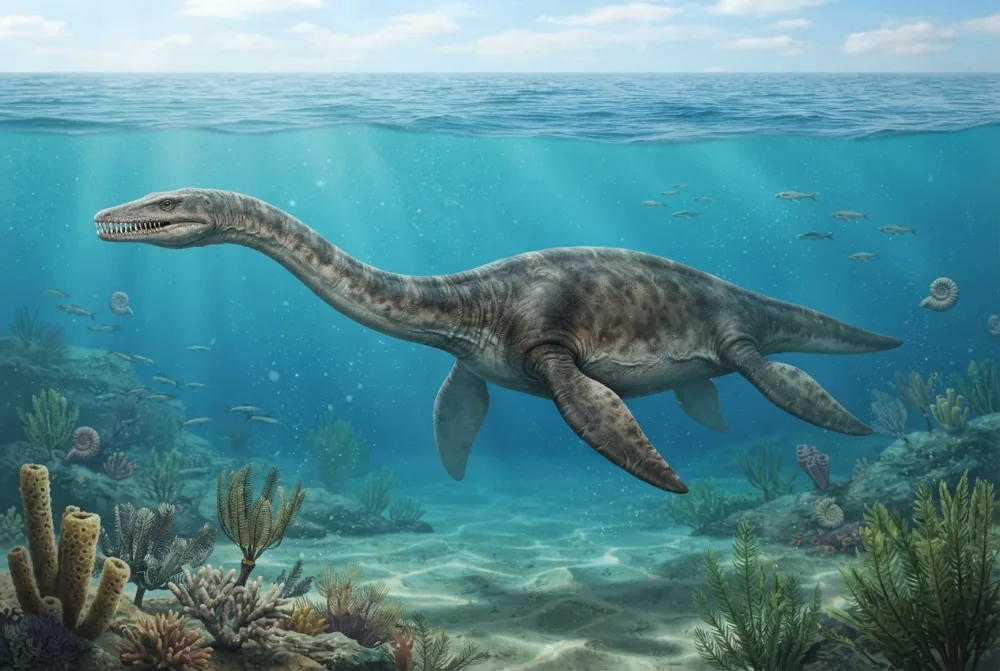
Hastanectes was a plesiosaur, a marine reptile that lived in the seas around what is now England and Germany. It had a long neck, flippers, and a mouth full of teeth to catch fish. It swam in warm, shallow waters during the Early Cretaceous period.31
E tshetse leng?
E ne e le kgolo go le kae?
E ne e le telele go le kae?
 telele jaaka dintšwa di le 5 go tswa kwa nkong go ya kwa mogatleng🍌telele jaaka dibanana di le 28 di latelana🏊e ne e ka thuma boleele jwa letamo le legolo la go thuma (50 m) mo metsotswaneng e le 6.4
Hastanectes e ne e le kgolo go le kae fa e bapisiwa le WENA?
Ke dipalo fela mo sebatling sa gago. Ga go sepe se se bolokwang kgotsa se se romelwang gope.
E ne e le bonako go le kae?


Dintlha tse di monate
Its name means 'spear swimmer' in Greek, because of its long, pointed snout.3
Hastanectes lived about 139 to 132 million years ago, during the Early Cretaceous.3
It was originally thought to be a species of Cimoliasaurus, another plesiosaur.1
Fossils of Hastanectes have been found in the Wadhurst Clay Formation of England and the Bückeberg Formation of Germany.3
Ya baitseanape ba didino
- Leina la saense
- Hastanectes
- Leina le neilwe ke
- Benson et al. 20133
- Setlhopha
- Dipleisiosoro
- Lelapa / clade
- Leptocleididae3
- Thulaganyo
- Plesiosauria > Sauropterygia3
- Bogolo jwa matlapa
- 139 go ya go 133 dimilione tsa dingwaga (Berriasian / Valanginian)3
- Dibopego tsa matlapa
- Wadhurst Clay, Bückeberg3
- Dinaga
- Bogosi jo bo Kopaneng, Jeremane3
- Direkoto tsa difosili
- 6 mo The Paleobiology Database3
- Go fitlhelwa
- Hastanectes was first named in 2013 by a team of scientists who re-examined old fossils that had been called Cimoliasaurus valdensis since 1889. The fossils came from the Wadhurst Clay of England.1
- Go sa ntse go ganetsanwa
- Scientists still debate whether Hastanectes is a leptocleidid plesiosaur or a pliosaur, because its fossils share features of both groups.31
Kwa dintlha di tswang teng
- Hastanectes (en.wikipedia.org)
- Hastanectes (nl.wikipedia.org)
- Hastanectes in The Paleobiology Database (CC BY 4.0): dingwaga, mafelo, dibopego tsa matlapa, thulaganyo.
Ntlha nngwe le nngwe mo tsebeng eno e na le nomoro e e supang motswedi wa yona. Fa re dirile phoso, maitshwarelo, re barati ba didino, ga re lokwalodikgang lwa saense. Re bolelele kwa [email protected] mme re tla e baakanya.
 Rex o tshwerwe ke tlala! Dino Wiki ke porojeke ya rre e a e diretseng morwawe yo o ratang didino, ke mahala, ga e na dipapatso e bile ga e na dilatedi. Batho ba bagolo ba ka fepa Rex senyamo go thusa gore e nne mo inthaneteng.Fepa Rex
 Elasmosaurus
 Pliosaurus
 Plesiosaurus
 Cimoliasaurus
 Colymbosaurus
 Trinacromerum
 Stegosaurus
 Iguanodon
 Archaeopteryx
 Giganotosaurus
 Microraptor
 Deinonychus