 O dino efe? Kwisi
 Ntwa ya didino
 Peiso ya didino
 Metshamekwana ya didino
 Alebamo ya disetikara
 Manane a TOP a didino
 Ngakgamatsa!
Kawanectes
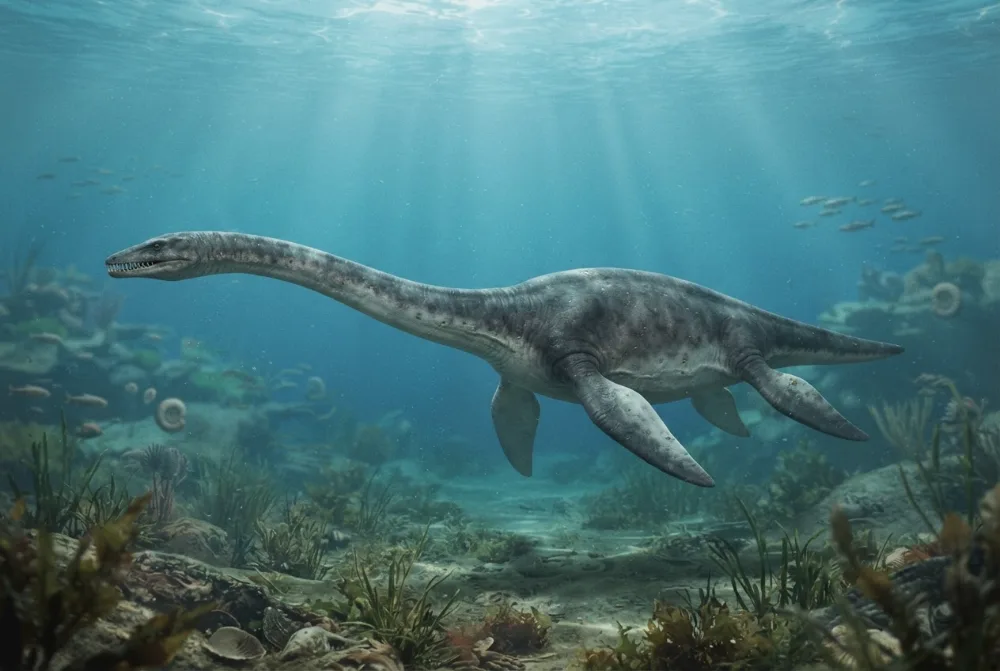
Kawanectes was a small marine reptile with a long neck that lived in the seas of Patagonia near the end of the Age of Dinosaurs. It was an elasmosaurid plesiosaur, but much smaller than its giant relatives, only about as long as a small car.1
E tshetse leng?
E ne e le kgolo go le kae?
E ne e le telele go le kae?
 telele jaaka dintšwa di le 4 go tswa kwa nkong go ya kwa mogatleng🍌telele jaaka dibanana di le 23 di latelana🏊e ne e ka thuma boleele jwa letamo le legolo la go thuma (50 m) mo metsotswaneng e le 6.2
Kawanectes e ne e le kgolo go le kae fa e bapisiwa le WENA?
Ke dipalo fela mo sebatling sa gago. Ga go sepe se se bolokwang kgotsa se se romelwang gope.
E ne e le bonako go le kae?


Dintlha tse di monate
Kawanectes is one of the smallest elasmosaurids ever found, with an adult body length of only 3.8 to 4.2 metres (12 to 14 feet).1
Its name comes from the Kawas Sea, an ancient ocean that covered Patagonia during the Late Cretaceous.1
One specimen of Kawanectes was found with 389 gastroliths, or stomach stones, which may have helped it digest food or control buoyancy.1
Kawanectes had a high humerus-to-femur length ratio of about 1.2, meaning its upper arm bone was longer than its thigh bone, which is unusual among elasmosaurids.1
Scientists think Kawanectes may have been sexually dimorphic, with females possibly larger than males.1
Kawanectes lived in a marginal marine environment, probably an estuary, not the open ocean, and it was smaller than open-ocean plesiosaurs.1
Dipotso tse di botswang thata ka ga Kawanectes
?How big was Kawanectes?
Kawanectes was about 3.8 to 4.2 metres (12 to 14 feet) long as an adult, which is small for an elasmosaurid.12
?What did Kawanectes eat?
Kawanectes likely ate small marine animals, and its jaw shape suggests it could snap its jaws shut quickly for fast bites, but not with a strong bite force.2
?Where did Kawanectes live?
Kawanectes lived in the seas of Patagonia, in what is now Argentina, during the Late Cretaceous, in a coastal or estuarine environment.12
?Was Kawanectes a dinosaur?
No, Kawanectes was a plesiosaur, a marine reptile, not a dinosaur.1
Ya baitseanape ba didino
- Leina la saense
- Kawanectes
- Leina le neilwe ke
- O'Gorman 20163
- Setlhopha
- Dipleisiosoro
- Lelapa / clade
- Elasmosauridae3
- Thulaganyo
- Plesiosauria > Elasmosauridae > Sauropterygia3
- Bogolo jwa matlapa
- 72 go ya go 66 dimilione tsa dingwaga (Maastrichtian)3
- Dibopego tsa matlapa
- La Colonia, Allen3
- Dinaga
- Arejentina3
- Direkoto tsa difosili
- 8 mo The Paleobiology Database3
- Go fitlhelwa
- Kawanectes was first named as a species of Trinacromerum in 1985 by Gasparini and Goñi, but in 2016 José P. O'Gorman gave it its own genus, Kawanectes, based on new fossils.1
- Go sa ntse go ganetsanwa
- Scientists are not sure exactly how many neck and tail vertebrae Kawanectes had, because the known fossils are incomplete.1
Kwa dintlha di tswang teng
- Kawanectes (en.wikipedia.org)
- First record of Kawanectes lafquenianum (Plesiosauria, Elasmosauridae) from the La Colonia Formation of Argentina, with comments on the mandibular morphology of elasmosaurids: Alcheringa: An Australasian Journal of Palaeontology: Vol 44 , No 1 - Get Access (tandfonline.com)
- Kawanectes in The Paleobiology Database (CC BY 4.0): dingwaga, mafelo, dibopego tsa matlapa, thulaganyo.
Ntlha nngwe le nngwe mo tsebeng eno e na le nomoro e e supang motswedi wa yona. Fa re dirile phoso, maitshwarelo, re barati ba didino, ga re lokwalodikgang lwa saense. Re bolelele kwa [email protected] mme re tla e baakanya.
 Rex o tshwerwe ke tlala! Dino Wiki ke porojeke ya rre e a e diretseng morwawe yo o ratang didino, ke mahala, ga e na dipapatso e bile ga e na dilatedi. Batho ba bagolo ba ka fepa Rex senyamo go thusa gore e nne mo inthaneteng.Fepa Rex
 Elasmosaurus
 Pliosaurus
 Plesiosaurus
 Cimoliasaurus
 Colymbosaurus
 Trinacromerum
 Tyrannosaurus
 Triceratops
 Velociraptor
 Spinosaurus
 Ankylosaurus
 Parasaurolophus