 O dino efe? Kwisi
 Ntwa ya didino
 Peiso ya didino
 Metshamekwana ya didino
 Alebamo ya disetikara
 Manane a TOP a didino
 Ngakgamatsa!
Keichousaurus
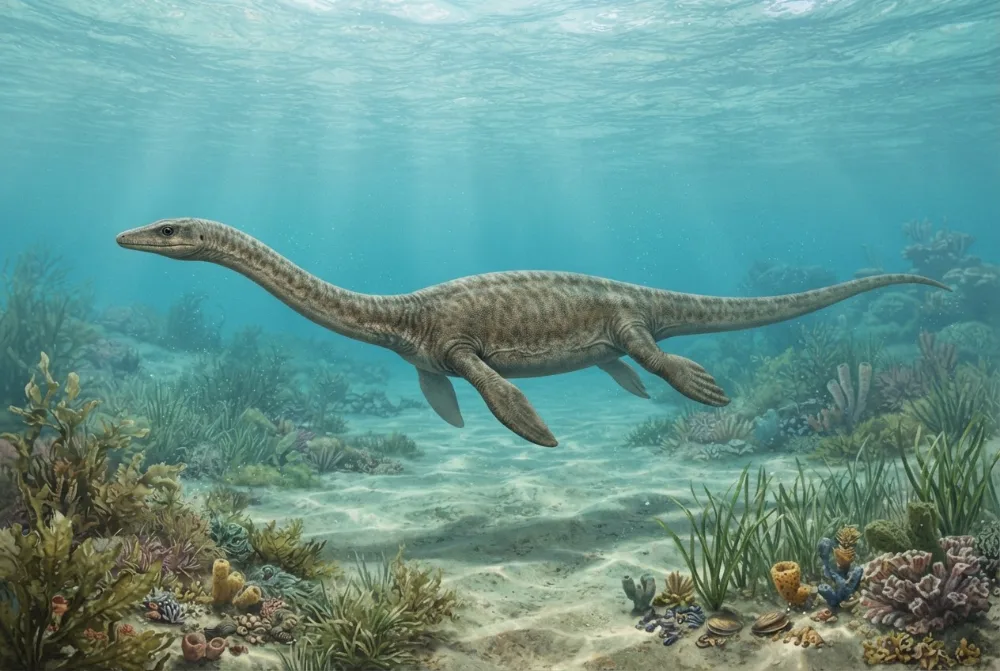
Keichousaurus was a small marine reptile that swam in warm seas during the Triassic Period. It had a long neck, a long tail, and paddle-like limbs to row through the water.1
E tshetse leng?
E ne e le kgolo go le kae?
E ne e le telele go le kae?
Keichousaurus e ne e le kgolo go le kae fa e bapisiwa le WENA?
Ke dipalo fela mo sebatling sa gago. Ga go sepe se se bolokwang kgotsa se se romelwang gope.
E ne e le bonako go le kae?


Dintlha tse di monate
Keichousaurus gave birth to live young instead of laying eggs. Baby fossils have been found inside adult females.1
This reptile had very broad ulna bones in its forelimbs, which helped make its paddles more effective for swimming.1
Males grew slightly larger than females. Mature males reached about 16 cm snout-vent length, while females reached about 15 cm.1
Keichousaurus is one of the most common sauropterygian fossils found in China. Many complete skeletons have been collected.1
It had a long, serpentine neck and a small head, similar to other pachypleurosaurs.1
Keichousaurus probably used a rowing motion with its paddle-like limbs to move through the water.1
Dipotso tse di botswang thata ka ga Keichousaurus
?Is Keichousaurus a dinosaur?
No, Keichousaurus is not a dinosaur. It is a marine reptile called a sauropterygian.1
?How big was Keichousaurus?
Keichousaurus was very small. Mature males reached about 16 cm snout-vent length, and females about 15 cm.1
?What did Keichousaurus eat?
It ate fish. It had pointed teeth and backward-curved teeth at the front of its mouth to catch and swallow prey whole.1
?Did Keichousaurus lay eggs?
No. Fossil evidence shows that Keichousaurus gave birth to live young, not eggs. Babies have been found inside adult females.143
?Could Keichousaurus swim?
Yes, it was a good swimmer. It used its paddle-like limbs to row through the water, similar to underwater flight.1
?When did Keichousaurus live?
Keichousaurus lived during the Triassic Period, from about 251 to 227 million years ago.1
Ya baitseanape ba didino
- Leina la saense
- Keichousaurus
- Leina le neilwe ke
- Young 19585
- Setlhopha
- Digagabi tsa lewatle
- Lelapa / clade
- Keichousauridae5
- Thulaganyo
- Sauropterygia5
- Bogolo jwa matlapa
- 251 go ya go 237 dimilione tsa dingwaga ()5
- Dibopego tsa matlapa
- Falang, Jialingjiang, Gejiu5
- Dinaga
- Tšhaena5
- Direkoto tsa difosili
- 7 mo The Paleobiology Database5
- Go fitlhelwa
- The first fossil of Keichousaurus was found in 1957 in Guizhou Province, China, by Hu Chengzhi. It was named by Chinese paleontologist Young Chung-chien in 1958.1
- Go sa ntse go ganetsanwa
- Scientists are not sure whether Keichousaurus was viviparous (giving birth to live young) or ovoviviparous (eggs hatching inside the mother).3
Kwa dintlha di tswang teng
- Keichousaurus (en.wikipedia.org)
- PBDB Taxon (paleobiodb.org)
- Morphology of Keichousaurus hui from the Middle Triassic of Xingyi, Guizhou Province with Comments on Its Reproduction Mode (xbna.pku.edu.cn)
- Triassic marine reptiles gave birth to live young | Nature (nature.com)
- Keichousaurus in The Paleobiology Database (CC BY 4.0): dingwaga, mafelo, dibopego tsa matlapa, thulaganyo.
Ntlha nngwe le nngwe mo tsebeng eno e na le nomoro e e supang motswedi wa yona. Fa re dirile phoso, maitshwarelo, re barati ba didino, ga re lokwalodikgang lwa saense. Re bolelele kwa [email protected] mme re tla e baakanya.
 Rex o tshwerwe ke tlala! Dino Wiki ke porojeke ya rre e a e diretseng morwawe yo o ratang didino, ke mahala, ga e na dipapatso e bile ga e na dilatedi. Batho ba bagolo ba ka fepa Rex senyamo go thusa gore e nne mo inthaneteng.Fepa Rex
 Nothosaurus
 Placodus
 Lariosaurus
 Cyamodus
 Cymatosaurus
 Proneusticosaurus
 Chonespondylus
 Cymbospondylus
 Phalarodon
 Mixosaurus
 Chaohusaurus
 Chensaurus