 O dino efe? Kwisi
 Ntwa ya didino
 Peiso ya didino
 Metshamekwana ya didino
 Alebamo ya disetikara
 Manane a TOP a didino
 Ngakgamatsa!
Placodus
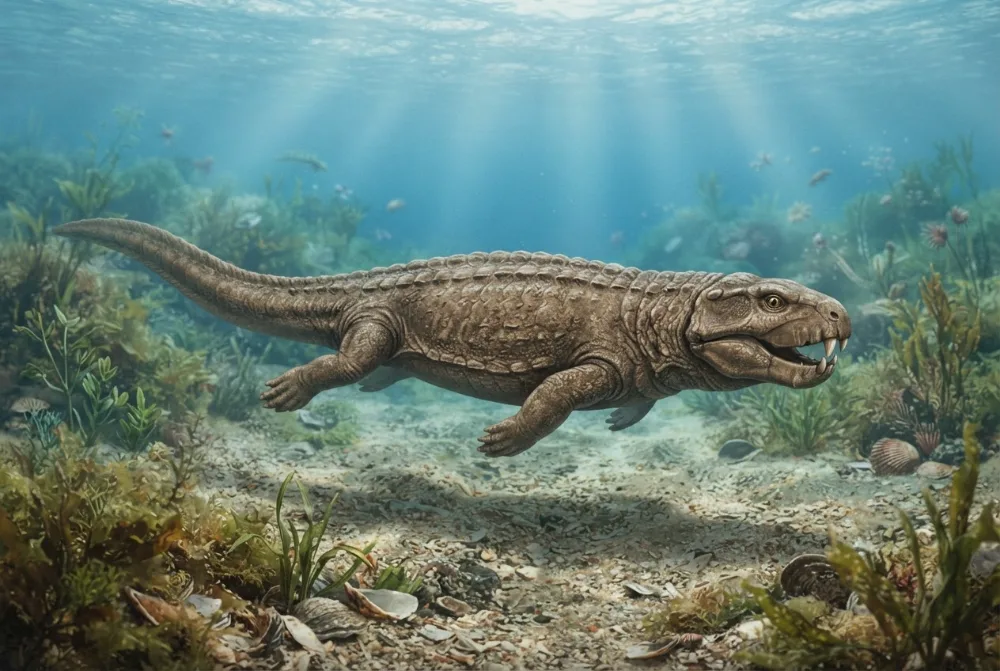
Placodus was a marine reptile that lived about 240 million years ago, during the Middle Triassic. It had a stocky body, a long tail, and a heavy skull with flat teeth for crushing shellfish. It swam in shallow seas and probably spent most of its time on the seafloor looking for food.1
E tshetse leng?
E ne e le kgolo go le kae?
E ne e le telele go le kae?
 telele jaaka dintšwa di le 3 go tswa kwa nkong go ya kwa mogatleng🍌telele jaaka dibanana di le 17 di latelana🏊e ne e ka thuma boleele jwa letamo le legolo la go thuma (50 m) mo metsotswaneng e le 11
Placodus e ne e le kgolo go le kae fa e bapisiwa le WENA?
Ke dipalo fela mo sebatling sa gago. Ga go sepe se se bolokwang kgotsa se se romelwang gope.
E ne e le bonako go le kae?


Dintlha tse di monate
Placodus had a rigid body because the bones in its spine were dovetailed together, making its trunk stiff.1
Its belly was covered with special armor made of bent, right-angled abdominal ribs, and it had a row of bony knobs above its backbone.1
Placodus was negatively buoyant, meaning it was heavy and could easily stay on the seafloor without floating up.1
Before scientists knew what Placodus looked like, its teeth were mistaken for fish teeth.1
Placodus was slow and clumsy on land because of its heavy body armor, so it probably only came ashore to lay eggs.1
Its short legs probably ended in webbed feet, and it used its flattened tail to push through the water.1
Dipotso tse di botswang thata ka ga Placodus
?How big was Placodus?
About 2.5 to 3 metres (8.2 to 9.8 ft) long.1
?What did Placodus eat?
Shellfish like bivalves, plus other hard-shelled prey such as molluscs, brachiopods and crustaceans. It used its chisel-like front teeth to pluck them from the sea floor and its broad, flat back teeth to crush their shells.1
?Was Placodus a dinosaur?
No, Placodus was a marine reptile called a placodont, not a dinosaur. It lived in the sea during the Triassic period.12
?Could Placodus swim?
Yes, it swam using its flattened tail and short legs that probably ended in webbed feet. It was not as good at swimming as later marine reptiles like plesiosaurs, but it was comfortable in the water.1
?Why did Placodus have a rigid body?
Its spine had dovetailed bones that locked together, making its trunk stiff. This helped it stay heavy on the sea floor so it could feed without floating up.1
?When did Placodus live?
About 240 million years ago, in the Middle Triassic period.1
Ya baitseanape ba didino
- Leina la saense
- Placodus
- Leina le neilwe ke
- Agassiz 18333
- Setlhopha
- Digagabi tsa lewatle
- Lelapa / clade
- Placodontidae3
- Thulaganyo
- Placodontia > Sauropterygia3
- Bogolo jwa matlapa
- 251 go ya go 227 dimilione tsa dingwaga ()3
- Dibopego tsa matlapa
- Jena, Wellenkalk, Vossenveld3
- Dinaga
- Jeremane, Iseraele, Poleke, Netherlands, Itali, Tšhaena3
- Direkoto tsa difosili
- 34 mo The Paleobiology Database3
- E itsiwe gape e le
- Anomosaurus, Crurosaurus (maina a bogologolo jaanong a balwa jaaka phologolo e le nngwe)3
- Go fitlhelwa
- Placodus was named by the Swiss naturalist Louis Agassiz in 1833. He originally thought the fossils were fish teeth.13
Kwa dintlha di tswang teng
- Placodus (en.wikipedia.org)
- Fossil Focus: Placodonts – PALAEONTOLOGY[online] (palaeontologyonline.com)
- Placodus in The Paleobiology Database (CC BY 4.0): dingwaga, mafelo, dibopego tsa matlapa, thulaganyo.
Ntlha nngwe le nngwe mo tsebeng eno e na le nomoro e e supang motswedi wa yona. Fa re dirile phoso, maitshwarelo, re barati ba didino, ga re lokwalodikgang lwa saense. Re bolelele kwa [email protected] mme re tla e baakanya.
 Rex o tshwerwe ke tlala! Dino Wiki ke porojeke ya rre e a e diretseng morwawe yo o ratang didino, ke mahala, ga e na dipapatso e bile ga e na dilatedi. Batho ba bagolo ba ka fepa Rex senyamo go thusa gore e nne mo inthaneteng.Fepa Rex
 Nothosaurus
 Lariosaurus
 Cyamodus
 Cymatosaurus
 Proneusticosaurus
 Simosaurus
 Chonespondylus
 Cymbospondylus
 Phalarodon
 Mixosaurus
 Chaohusaurus
 Chensaurus