 O dino efe? Kwisi
 Ntwa ya didino
 Peiso ya didino
 Metshamekwana ya didino
 Alebamo ya disetikara
 Manane a TOP a didino
 Ngakgamatsa!
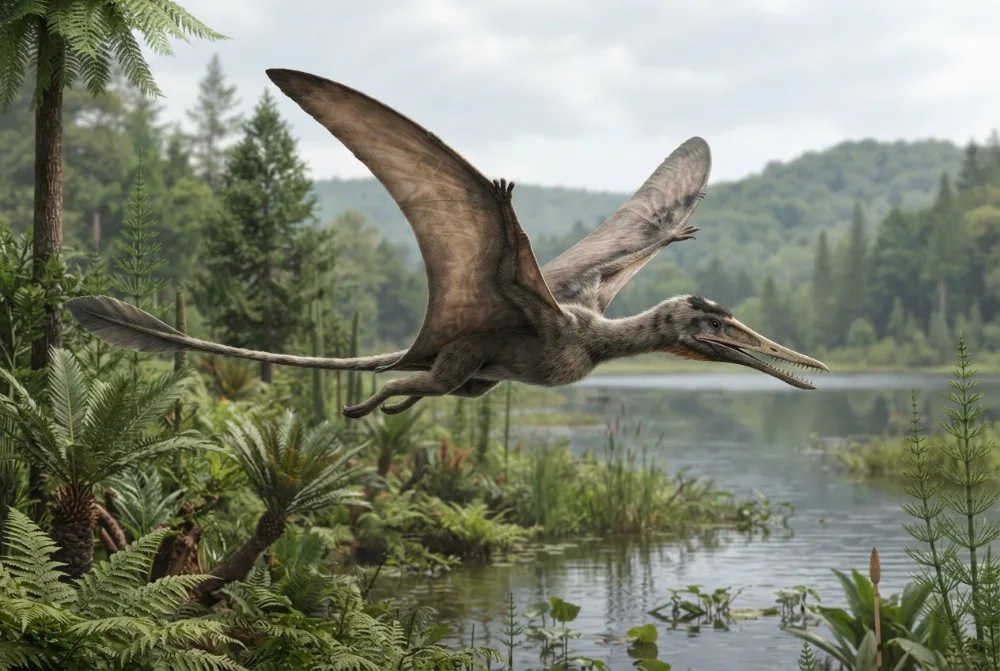
Kunpengopterus
Kunpengopterus was a flying reptile that lived in what is now China during the Jurassic Period. It had a long tail and a head like a bird, and it ate fish.23
E tshetse leng?
E ne e le kgolo go le kae?
E ne e le bokete go le kae?
Kunpengopterus e ne e le kgolo go le kae fa e bapisiwa le WENA?
Ke dipalo fela mo sebatling sa gago. Ga go sepe se se bolokwang kgotsa se se romelwang gope.
E ne e le bonako go le kae?


Dintlha tse di monate
Kunpengopterus sinensis is known from two nearly complete skeletons, one adult and one juvenile, found with fossilized vomit pellets nearby.3
The vomit pellets contain scales of palaeonisciform fish, proving that Kunpengopterus ate fish and could vomit indigestible parts.3
Both the adult and juvenile Kunpengopterus had similar teeth and could fly soon after hatching, like some other pterosaurs.3
The name Kunpengopterus comes from Chinese mythology: the Kun was a giant fish that could turn into the Peng, a huge bird.1
Kunpengopterus lived between about 168 and 152 million years ago, during the Late Jurassic Period.2
The type specimen of Kunpengopterus sinensis is an almost complete skeleton with a full skull and lower jaws.1
Dipotso tse di botswang thata ka ga Kunpengopterus
?How big was Kunpengopterus?
Its head was about 10.7 centimetres (4.2 inches) long. The whole body was small, like a modern bird.1
?Did Kunpengopterus have feathers?
No, it did not have feathers. It had pycnofibers, which are thin, hair-like fibers, on its body.4
?What did Kunpengopterus eat?
It ate fish, especially palaeonisciform fish. Scientists know this because fossilized vomit pellets containing fish scales were found with its skeletons.5
?Could Kunpengopterus fly?
Yes, it could fly. Even young Kunpengopterus could fly soon after hatching, just like adults.5
Ya baitseanape ba didino
- Leina la saense
- Kunpengopterus
- Leina le neilwe ke
- Wang et al. 20106
- Setlhopha
- Digagabi tse di fofang
- Lelapa / clade
- Wukongopteridae6
- Thulaganyo
- Pterosauria6
- Bogolo jwa matlapa
- 168 go ya go 152 dimilione tsa dingwaga (Bathonian / Kimmeridgian)6
- Dibopego tsa matlapa
- Tiaojishan6
- Dinaga
- Tšhaena6
- Direkoto tsa difosili
- 2 mo The Paleobiology Database6
- Go fitlhelwa
- Kunpengopterus sinensis was named by Wang Xiaolin and colleagues in 2010, based on a fossil found in the Tiaojishan Formation of Liaoning, China.12
- Go sa ntse go ganetsanwa
- Scientists are not sure about the exact age of the rocks that contain Kunpengopterus fossils, which may be from the Middle or Late Jurassic.1
Kwa dintlha di tswang teng
- Kunpengopterus (en.wikipedia.org)
- PBDB Taxon (paleobiodb.org)
- Two emetolite-pterosaur associations from the Late Jurassic of China: showing the first evidence for antiperistalsis in (royalsocietypublishing.org)
- New long-tailed pterosaurs (Wukongopteridae) from western Liaoning, China (dinodata.de)
- Two emetolite-pterosaur associations from the Late Jurassic of China: showing the first evidence for antiperistalsis in pterosaurs (pmc.ncbi.nlm.nih.gov)
- Kunpengopterus in The Paleobiology Database (CC BY 4.0): dingwaga, mafelo, dibopego tsa matlapa, thulaganyo.
Ntlha nngwe le nngwe mo tsebeng eno e na le nomoro e e supang motswedi wa yona. Fa re dirile phoso, maitshwarelo, re barati ba didino, ga re lokwalodikgang lwa saense. Re bolelele kwa [email protected] mme re tla e baakanya.
 Rex o tshwerwe ke tlala! Dino Wiki ke porojeke ya rre e a e diretseng morwawe yo o ratang didino, ke mahala, ga e na dipapatso e bile ga e na dilatedi. Batho ba bagolo ba ka fepa Rex senyamo go thusa gore e nne mo inthaneteng.Fepa Rex
 Pteranodon
 Quetzalcoatlus
 Dorygnathus
 Rhamphorhynchus
 Anhanguera
 Pterodactylus
 Brachiosaurus
 Diplodocus
 Allosaurus
 Brontosaurus
 Compsognathus
 Camarasaurus