 O dino efe? Kwisi
 Ntwa ya didino
 Peiso ya didino
 Metshamekwana ya didino
 Alebamo ya disetikara
 Manane a TOP a didino
 Ngakgamatsa!
Leivanectes
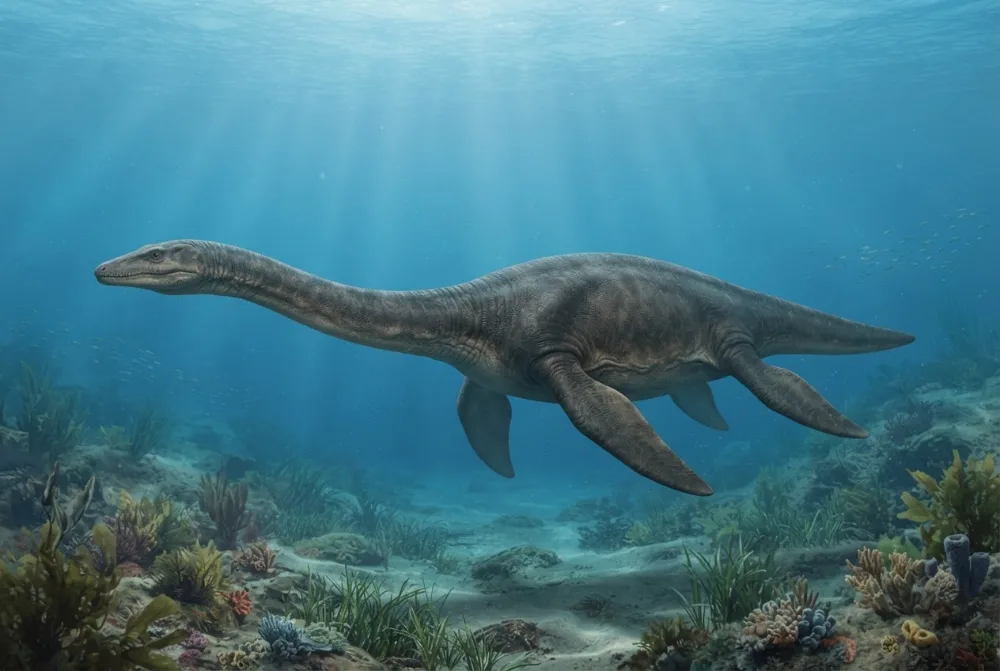
Leivanectes was a long-necked marine reptile that swam in the warm seas of Colombia about 115 million years ago. It was a plesiosaur, not a dinosaur, and it used its strong flippers to paddle through the water. This ocean hunter had a special short jaw with big teeth for catching large fish.12
E tshetse leng?
E ne e le bonako go le kae?


Dintlha tse di monate
Leivanectes had fewer and larger teeth than any other known elasmosaurid plesiosaur. It only had 3 teeth in the front of its lower jaw, while a similar plesiosaur called Callawayasaurus had 5.2
This plesiosaur lived during the Aptian stage of the Early Cretaceous, between about 119 and 113 million years ago.1
Leivanectes was named in 2019 by a team of scientists from Argentina and Colombia, including María Páramo-Fonseca and José O'Gorman.12
Its short jaw and big teeth suggest Leivanectes ate larger prey than other long-necked elasmosaurids, which usually ate small fish.2
Leivanectes is only known from a partial skull and lower jaw, so scientists are not sure how big its body was.2
Ya baitseanape ba didino
- Leina la saense
- Leivanectes
- Leina le neilwe ke
- Páramo-Fonseca et al. 20193
- Setlhopha
- Dipleisiosoro
- Lelapa / clade
- Elasmosauridae3
- Thulaganyo
- Plesiosauria > Elasmosauridae > Sauropterygia3
- Bogolo jwa matlapa
- 120 go ya go 113 dimilione tsa dingwaga (Aptian)3
- Dibopego tsa matlapa
- Paja3
- Dinaga
- Kolombia3
- Direkoto tsa difosili
- 1 mo The Paleobiology Database3
- Go fitlhelwa
- Leivanectes was discovered in the Paja Formation of Villa de Leiva, Colombia, and named in 2019 by Páramo-Fonseca and colleagues. The species name bernardoi honors a local person named Bernardo.12
- Go sa ntse go ganetsanwa
- Scientists are not sure how long Leivanectes' neck was, because only its skull has been found. It might have had a shorter neck than other elasmosaurids.2
Kwa dintlha di tswang teng
- PBDB Taxon (paleobiodb.org)
- A new late Aptian elasmosaurid from the Paja Formation, Villa de Leiva, Colombia (explore.openaire.eu)
- Leivanectes in The Paleobiology Database (CC BY 4.0): dingwaga, mafelo, dibopego tsa matlapa, thulaganyo.
Ntlha nngwe le nngwe mo tsebeng eno e na le nomoro e e supang motswedi wa yona. Fa re dirile phoso, maitshwarelo, re barati ba didino, ga re lokwalodikgang lwa saense. Re bolelele kwa [email protected] mme re tla e baakanya.
 Rex o tshwerwe ke tlala! Dino Wiki ke porojeke ya rre e a e diretseng morwawe yo o ratang didino, ke mahala, ga e na dipapatso e bile ga e na dilatedi. Batho ba bagolo ba ka fepa Rex senyamo go thusa gore e nne mo inthaneteng.Fepa Rex
 Elasmosaurus
 Pliosaurus
 Plesiosaurus
 Cimoliasaurus
 Colymbosaurus
 Trinacromerum
 Stegosaurus
 Iguanodon
 Archaeopteryx
 Giganotosaurus
 Microraptor
 Deinonychus