 O dino efe? Kwisi
 Ntwa ya didino
 Peiso ya didino
 Metshamekwana ya didino
 Alebamo ya disetikara
 Manane a TOP a didino
 Ngakgamatsa!
Leptocleidus
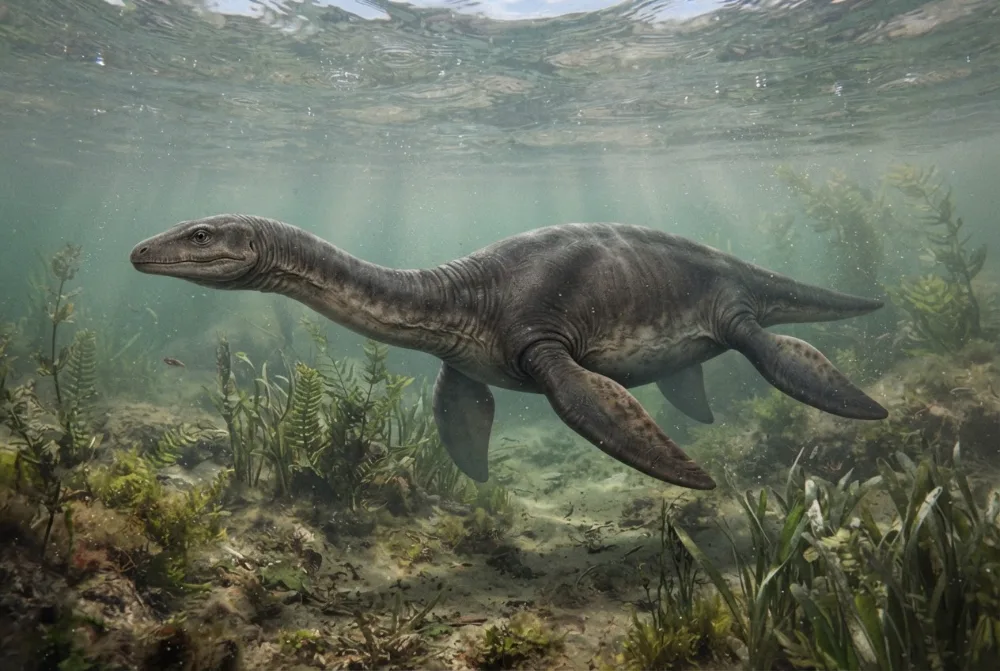
Leptocleidus was a small plesiosaur that swam in shallow seas and rivers during the Early Cretaceous. It had a long neck, a short body, and four flippers to paddle through the water. Unlike many other plesiosaurs, it lived in lagoons and even brackish or fresh water.1
E tshetse leng?
E ne e le kgolo go le kae?
E ne e le telele go le kae?
 telele jaaka dintšwa di le 3 go tswa kwa nkong go ya kwa mogatleng🍌telele jaaka dibanana di le 17 di latelana🏊e ne e ka thuma boleele jwa letamo le legolo la go thuma (50 m) mo metsotswaneng e le 6.4
Leptocleidus e ne e le kgolo go le kae fa e bapisiwa le WENA?
Ke dipalo fela mo sebatling sa gago. Ga go sepe se se bolokwang kgotsa se se romelwang gope.
E ne e le bonako go le kae?


Dintlha tse di monate
Leptocleidus had about 21 teeth on each side of its upper jaw and around 35 teeth on each side of its lower jaw.1
Its skull was triangle-shaped with a crest running from the tip of the nose to the nasal region.1
Unlike many plesiosaurs, Leptocleidus lived in shallow lagoons and may have entered brackish or fresh water, like river mouths.1
Scientists think Leptocleidus moved into fresh water to escape larger plesiosaurs and pliosaurs.1
The name Leptocleidus comes from Greek words meaning 'slender clavicle', referring to its thin collarbone.1
Leptocleidus had large clavicles and interclavicle bones but small shoulder blades, similar to the early Jurassic Rhomaleosaurus.1
A specimen from the Isle of Wight, once thought to be Leptocleidus, was later named a separate genus, Vectocleidus, in 2012.1
Dipotso tse di botswang thata ka ga Leptocleidus
?How big was Leptocleidus?
Leptocleidus was small for a plesiosaur, measuring up to 3 metres (9.8 feet) long. One species, Leptocleidus superstes, was even smaller at about 1.5 metres (5 feet).13
?Was Leptocleidus a dinosaur?
No, Leptocleidus was not a dinosaur. It was a plesiosaur, a type of extinct marine reptile that lived in the sea.13
Ya baitseanape ba didino
- Leina la saense
- Leptocleidus
- Leina le neilwe ke
- Andrews 19224
- Setlhopha
- Dipleisiosoro
- Lelapa / clade
- Leptocleididae4
- Thulaganyo
- Plesiosauria > Sauropterygia4
- Bogolo jwa matlapa
- 143 go ya go 100 dimilione tsa dingwaga (Berriasian / Albian)4
- Dibopego tsa matlapa
- Murderong Shale, Bulldog Shale, Weald Clay4
- Dinaga
- Ositerelia, Bogosi jo bo Kopaneng, Aforika Borwa4
- Direkoto tsa difosili
- 7 mo The Paleobiology Database4
- E itsiwe gape e le
- Peyerus (maina a bogologolo jaanong a balwa jaaka phologolo e le nngwe)4
- Go fitlhelwa
- Leptocleidus was named by Charles William Andrews in 1922 based on a partial skeleton and skull from the Weald Clay of Berwick, Sussex, England.41
- Go sa ntse go ganetsanwa
- Scientists debate whether Leptocleidus belongs within the group Rhomaleosauridae or in its own separate clade called Leptocleididae.2
Kwa dintlha di tswang teng
- Leptocleidus (en.wikipedia.org)
- Reassessment of the Lower Cretaceous (Barremian) pliosauroid Leptocleidus superstes Andrews, 1922 and other plesiosaur remains from the nonmarine Wealden succession of southern England | Zoological Journal of the Linnean Society | Oxford Academic (academic.oup.com)
- Leptocleidus Facts for Kids (kids.kiddle.co)
- Leptocleidus in The Paleobiology Database (CC BY 4.0): dingwaga, mafelo, dibopego tsa matlapa, thulaganyo.
Ntlha nngwe le nngwe mo tsebeng eno e na le nomoro e e supang motswedi wa yona. Fa re dirile phoso, maitshwarelo, re barati ba didino, ga re lokwalodikgang lwa saense. Re bolelele kwa [email protected] mme re tla e baakanya.
 Rex o tshwerwe ke tlala! Dino Wiki ke porojeke ya rre e a e diretseng morwawe yo o ratang didino, ke mahala, ga e na dipapatso e bile ga e na dilatedi. Batho ba bagolo ba ka fepa Rex senyamo go thusa gore e nne mo inthaneteng.Fepa Rex
 Elasmosaurus
 Pliosaurus
 Plesiosaurus
 Cimoliasaurus
 Colymbosaurus
 Trinacromerum
 Stegosaurus
 Iguanodon
 Archaeopteryx
 Giganotosaurus
 Microraptor
 Deinonychus