 O dino efe? Kwisi
 Ntwa ya didino
 Peiso ya didino
 Metshamekwana ya didino
 Alebamo ya disetikara
 Manane a TOP a didino
 Ngakgamatsa!
Luskhan
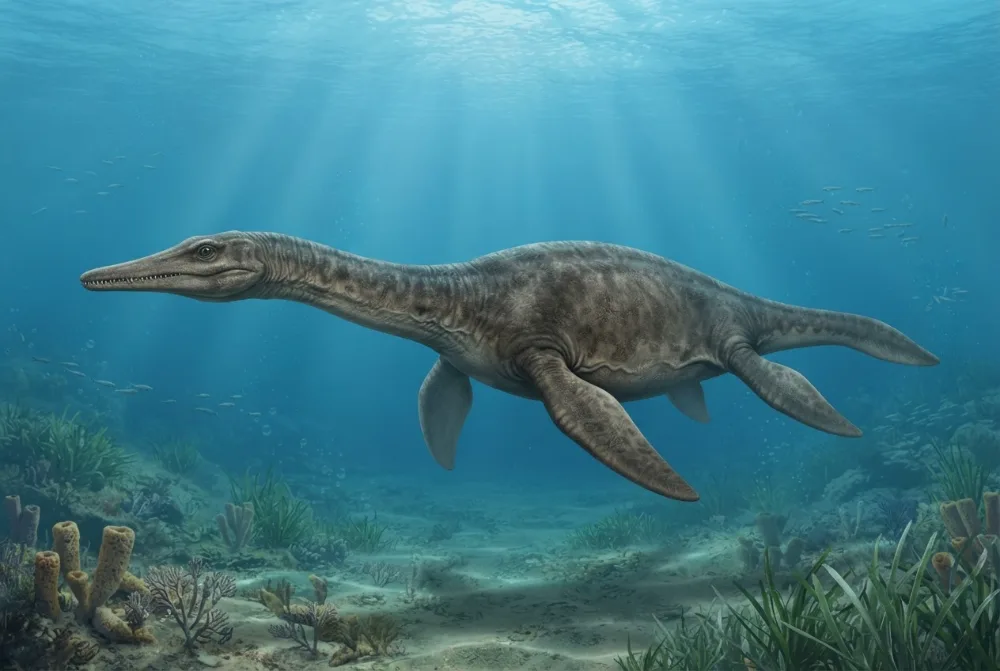
Luskhan was a plesiosaur, a marine reptile that lived in the ancient seas of what is now Russia. It had a long, slender snout and small teeth, perfect for catching soft, squishy prey like squid. Unlike many other pliosaurs, Luskhan was not a giant apex predator but a specialized hunter of small animals.12
E tshetse leng?
E ne e le kgolo go le kae?
E ne e le telele go le kae?
 telele jaaka dintšwa di le 6 go tswa kwa nkong go ya kwa mogatleng🍌telele jaaka dibanana di le 36 di latelana🏊e ne e ka thuma boleele jwa letamo le legolo la go thuma (50 m) mo metsotswaneng e le 6.9
Luskhan e ne e le kgolo go le kae fa e bapisiwa le WENA?
Ke dipalo fela mo sebatling sa gago. Ga go sepe se se bolokwang kgotsa se se romelwang gope.
E ne e le bonako go le kae?


Dintlha tse di monate
Luskhan is known from a nearly complete, three-dimensionally preserved skeleton, which is rare for pliosaurids.12
Its name comes from Mongolian and Turkic mythology: 'luus' means water spirit and 'khan' means chief.1
Luskhan lived about 128 million years ago, during the Hauterivian stage of the Early Cretaceous.1
Unlike most other pliosaurs, Luskhan had a long, slender snout and small teeth, similar to the distantly related polycotylid plesiosaurs.12
Luskhan evolved its fish-eating features independently from polycotylids, more than 10 million years later.1
The only known specimen was discovered in 2002 by Russian paleontologist Gleb N. Uspensky on the banks of the Volga River.1
Dipotso tse di botswang thata ka ga Luskhan
?How big was Luskhan?
Luskhan was about 6.5 metres (21 feet) long, which is roughly the length of a large boat.1
?What did Luskhan eat?
Luskhan ate small, soft prey like squid. Its slender snout and small teeth were perfect for catching soft animals, not large prey.13
?Was Luskhan a dinosaur?
No, Luskhan was a plesiosaur, a marine reptile that lived in the sea. It was not a dinosaur.1
Ya baitseanape ba didino
- Leina la saense
- Luskhan
- Leina le neilwe ke
- Fischer et al. 20174
- Setlhopha
- Dipleisiosoro
- Lelapa / clade
- Pliosauridae4
- Thulaganyo
- Plesiosauria > Pliosauridae > Sauropterygia4
- Bogolo jwa matlapa
- 133 go ya go 126 dimilione tsa dingwaga (Hauterivian)4
- Dinaga
- Rašia4
- Direkoto tsa difosili
- 1 mo The Paleobiology Database4
- Go fitlhelwa
- Luskhan was named in 2017 by a team led by Valentin Fischer, based on a skeleton found in 2002 by Gleb N. Uspensky in western Russia.14
- Go sa ntse go ganetsanwa
- Scientists are not sure exactly how large Luskhan grew, because no complete length estimate has been published.1
Kwa dintlha di tswang teng
- Luskhan (en.wikipedia.org)
- Anatomy and relationships of the bizarre Early Cretaceous pliosaurid Luskhan itilensis | Zoological Journal of the Linnean Society | Oxford Academic (academic.oup.com)
- Plasticity and Convergence in the Evolution of Short-Necked Plesiosaurs: Current Biology (cell.com)
- Luskhan in The Paleobiology Database (CC BY 4.0): dingwaga, mafelo, dibopego tsa matlapa, thulaganyo.
Ntlha nngwe le nngwe mo tsebeng eno e na le nomoro e e supang motswedi wa yona. Fa re dirile phoso, maitshwarelo, re barati ba didino, ga re lokwalodikgang lwa saense. Re bolelele kwa [email protected] mme re tla e baakanya.
 Rex o tshwerwe ke tlala! Dino Wiki ke porojeke ya rre e a e diretseng morwawe yo o ratang didino, ke mahala, ga e na dipapatso e bile ga e na dilatedi. Batho ba bagolo ba ka fepa Rex senyamo go thusa gore e nne mo inthaneteng.Fepa Rex
 Elasmosaurus
 Pliosaurus
 Plesiosaurus
 Cimoliasaurus
 Colymbosaurus
 Trinacromerum
 Stegosaurus
 Iguanodon
 Archaeopteryx
 Giganotosaurus
 Microraptor
 Deinonychus