 O dino efe? Kwisi
 Ntwa ya didino
 Peiso ya didino
 Metshamekwana ya didino
 Alebamo ya disetikara
 Manane a TOP a didino
 Ngakgamatsa!
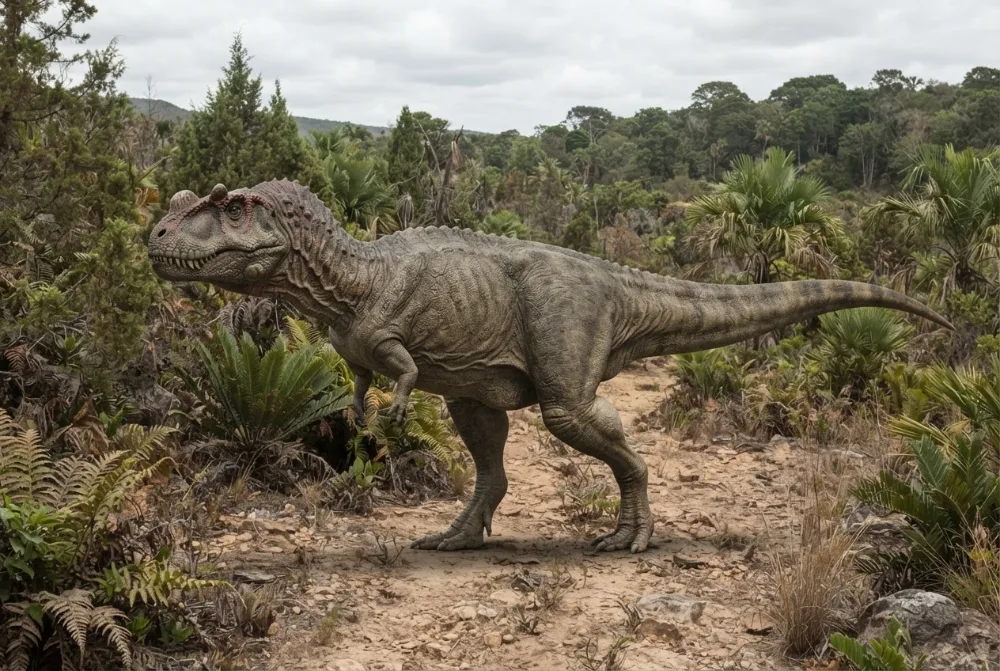
Majungasaurus
Majungasaurus was a meat-eating dinosaur that lived on the island of Madagascar near the end of the Age of Dinosaurs. It was the top predator in its home, and scientists have even found evidence that it sometimes ate other Majungasaurus!12
E tshetse leng?
E ne e le kgolo go le kae?
E ne e le telele go le kae?
E ne e le kwa godimo go le kae?
kakanyo
E ne e le bokete go le kae?
 telele jaaka dintšwa di le 7 go tswa kwa nkong go ya kwa mogatleng🍌telele jaaka dibanana di le 39 di latelana🍉bokete jaaka magapu a le 220🧸bokete jaaka bana ba kreše ba le 58🎒bokete jaaka bana ba sekolo ba le 34🐻❄️bokete jaaka dibere tse ditshweu di le 2.5🏃e ne e ka taboga dimetara di le 100 mo metsotswaneng e le 9.7 (motho yo o bonako go gaisa o tlhoka 9,6)
Majungasaurus e ne e le kgolo go le kae fa e bapisiwa le WENA?
Ke dipalo fela mo sebatling sa gago. Ga go sepe se se bolokwang kgotsa se se romelwang gope.
E ne e le bonako go le kae?


Dintlha tse di monate
Majungasaurus lived about 70 to 66 million years ago, during the very end of the Cretaceous Period. It was one of the last non-avian dinosaurs before the big extinction.1
This dinosaur had a thick, bumpy skull with a single rounded horn on top of its head. The horn was made of bone and was probably used for head-butting or showing off.12
Majungasaurus was about 6 to 7 metres long, which is as long as a big school bus. It was a medium-sized theropod, not as huge as T. rex but still a fierce hunter.2
Fossils show that Majungasaurus sometimes ate other Majungasaurus. Tooth marks on its bones match its own teeth, making it one of the few dinosaurs known to have been cannibalistic.2
It shared its home with many other animals, including the long-necked sauropod Rapetosaurus, the small meat-eater Masiakasaurus, and giant crocodile-like creatures.1
The first Majungasaurus fossils were found in 1895 by French explorers. At first, scientists thought it was a kind of Megalosaurus, and later it was even called Majungatholus.12
Majungasaurus is one of the best-known meat-eating dinosaurs from the southern continents. Many complete skulls and skeletons have been found, so scientists know a lot about it.2
Dipotso tse di botswang thata ka ga Majungasaurus
?How big was Majungasaurus?
Majungasaurus was about 6 to 7 metres long (20 to 23 feet) and weighed around 750 to 1,100 kilograms (1,650 to 2,430 pounds). Some larger individuals may have reached over 8 metres (26 feet).1
?Did Majungasaurus eat other dinosaurs?
Yes, it mainly hunted sauropods like Rapetosaurus. It also ate other Majungasaurus, making it one of the few dinosaurs known to be cannibalistic.14
?When did Majungasaurus live?
Majungasaurus lived about 70 to 66 million years ago, at the very end of the Cretaceous Period. It was one of the last non-avian dinosaurs before the big extinction.1
?Did Majungasaurus have a horn?
Yes, it had a single rounded horn on top of its skull, made of bone. Scientists think it might have been used for head-butting or showing off.1
?Was Majungasaurus bigger than T. rex?
No, Majungasaurus was much smaller. T. rex was about 12 metres long and weighed over 8 tonnes, while Majungasaurus was only about 6 to 7 metres long and weighed around 1 tonne.1
?Where was Majungasaurus found?
All Majungasaurus fossils have been found in northwestern Madagascar, in the Maevarano Formation. The first remains were discovered along the Betsiboka River in 1896.1
?Did Majungasaurus have feathers?
No one knows for sure. No feather impressions have been found with Majungasaurus fossils, and it belonged to a group of dinosaurs (abelisaurids) that are not known to have had feathers.1
?Is Majungasaurus a dinosaur?
Yes, Majungasaurus is a dinosaur. It is a theropod dinosaur, which means it was a meat-eating, two-legged dinosaur.1
Mothubi wa ditlhamane
Tlhamane: Some people think Majungasaurus was a type of tyrannosaur like T. rex.
Boammaaruri: Majungasaurus was actually an abelisaurid, a different group of meat-eating dinosaurs that lived mainly in the southern continents. It had a shorter, deeper skull and tiny arms, but it was not closely related to T. rex.12
Ya baitseanape ba didino
- Leina la saense
- Majungasaurus
- Leina le neilwe ke
- Lavocat 19555
- Setlhopha
- Didino tse di jang nama
- Lelapa / clade
- Abelisauridae5
- Thulaganyo
- Theropoda > Ceratosauria > Abelisauridae5
- Bogolo jwa matlapa
- 72 go ya go 66 dimilione tsa dingwaga (Maastrichtian)5
- Dibopego tsa matlapa
- Maevarano5
- Dinaga
- Madagasekara5
- Direkoto tsa difosili
- 25 mo The Paleobiology Database5
- E itsiwe gape e le
- Majungatholus (maina a bogologolo jaanong a balwa jaaka phologolo e le nngwe)5
- Go fitlhelwa
- The first fossils of Majungasaurus were discovered in 1895 in Madagascar by French explorers. It was named Majungasaurus by French paleontologist René Lavocat in 1955, after the Mahajanga region where it was found.15
- Go sa ntse go ganetsanwa
- Scientists are not sure exactly how the single horn on Majungasaurus's head was used. It might have been for fighting rivals, attracting mates, or both.1
Kwa dintlha di tswang teng
- Majungasaurus (en.wikipedia.org)
- OVERVIEW OF THE HISTORY OF DISCOVERY, TAXONOMY, PHYLOGENY, AND BIOGEOGRAPHY OF MAJUNGASAURUS CRENATISSIMUS (THEROPODA: ABELISAURIDAE) FROM THE LATE CRETACEOUS OF MADAGASCAR (sites.ohio.edu)
- Majungasaurus (en.wikipedia.org)
- Cannibalism in the Madagascan dinosaur Majungatholus atopus | Nature (nature.com)
- Majungasaurus in The Paleobiology Database (CC BY 4.0): dingwaga, mafelo, dibopego tsa matlapa, thulaganyo.
Ntlha nngwe le nngwe mo tsebeng eno e na le nomoro e e supang motswedi wa yona. Fa re dirile phoso, maitshwarelo, re barati ba didino, ga re lokwalodikgang lwa saense. Re bolelele kwa [email protected] mme re tla e baakanya.
 Rex o tshwerwe ke tlala! Dino Wiki ke porojeke ya rre e a e diretseng morwawe yo o ratang didino, ke mahala, ga e na dipapatso e bile ga e na dilatedi. Batho ba bagolo ba ka fepa Rex senyamo go thusa gore e nne mo inthaneteng.Fepa Rex
 Allosaurus
 Carnotaurus
 Dilophosaurus
 Giganotosaurus
 Compsognathus
 Paronychodon
 Tyrannosaurus
 Triceratops
 Velociraptor
 Spinosaurus
 Ankylosaurus
 Parasaurolophus