 O dino efe? Kwisi
 Ntwa ya didino
 Peiso ya didino
 Metshamekwana ya didino
 Alebamo ya disetikara
 Manane a TOP a didino
 Ngakgamatsa!
E tshetse leng?

E ne e le kgolo go le kae?
E ne e le telele go le kae?
E ne e le kwa godimo go le kae?
kakanyo
E ne e le bokete go le kae?
Manidens e ne e le kgolo go le kae fa e bapisiwa le WENA?
Ke dipalo fela mo sebatling sa gago. Ga go sepe se se bolokwang kgotsa se se romelwang gope.
E ne e le bonako go le kae?


Dintlha tse di monate
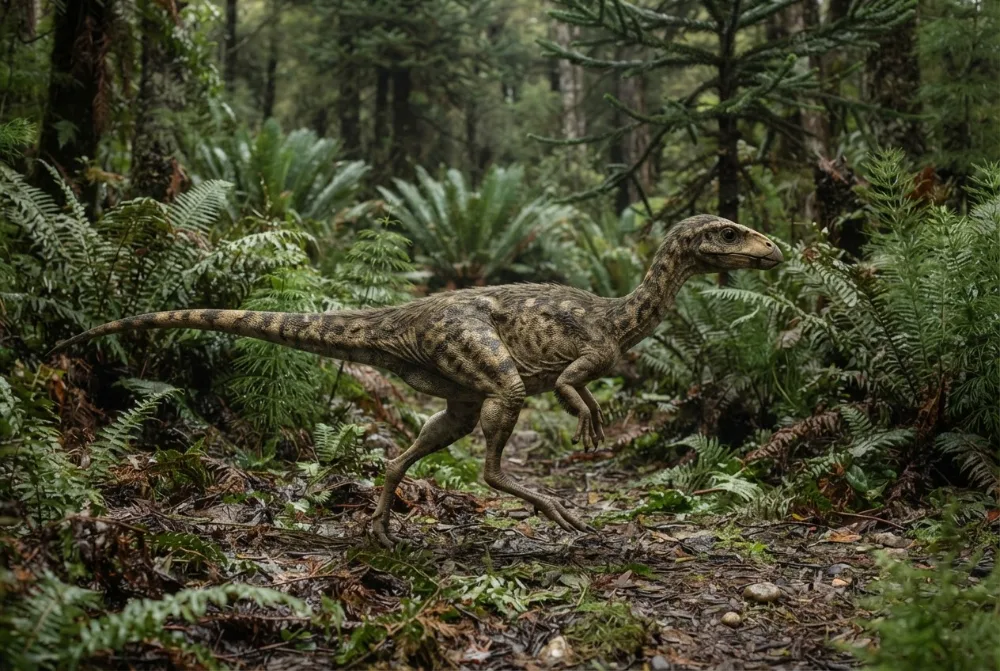
Manidens lived during the Middle Jurassic, about 171 to 167 million years ago, in a time when South America had many lakes and forests.1
Its name comes from the Latin words for 'hand' and 'tooth' because its last tooth looked like a tiny hand with fingers.1
Manidens is a heterodontosaurid, a group of small ornithischian dinosaurs that often had different types of teeth for different jobs.1
The only known skeleton of Manidens includes parts of the skull, jaws, backbone, shoulder, and hips, but not the tail or legs.1
Scientists think Manidens shows an intermediate step in the evolution of plant-eating: it had high tooth crowns but not the heavy wear facets that later relatives had.1
Manidens was one of the few ornithischian dinosaurs known from the Jurassic of South America, making it a rare find.1
Dipotso tse di botswang thata ka ga Manidens
?How big was Manidens?
Manidens was about 60 cm (2.0 ft) long and weighed around 500 g (1.1 lb), smaller than later heterodontosaurids.2
?What did Manidens eat?
Manidens was a plant-eater. It had high-crowned teeth for chewing plants, but it lacked the heavy wear facets seen in more advanced relatives.21
?When did Manidens live?
Manidens lived during the Early Jurassic, about 179 to 178 million years ago, in what is now Argentina.2
?Did Manidens have feathers?
Scientists think it might have. A close relative called Tianyulong had filamentous structures, so Manidens may have had them too.2
Ya baitseanape ba didino
- Leina la saense
- Manidens
- Leina le neilwe ke
- Pol et al. 20113
- Setlhopha
- Dija-dimela tse di nang le melomo
- Lelapa / clade
- Heterodontosauridae3
- Thulaganyo
- Ornithischia > Heterodontosauridae3
- Bogolo jwa matlapa
- 184 go ya go 171 dimilione tsa dingwaga (Toarcian / Aalenian)3
- Dibopego tsa matlapa
- Cañadón Asfalto3
- Dinaga
- Arejentina3
- Direkoto tsa difosili
- 2 mo The Paleobiology Database3
- Go fitlhelwa
- Manidens was named in 2011 by Diego Pol, Oliver Rauhut, and Marcos Becerra. The fossils were found at the Queso Rallado site near Cerro Cóndor, Argentina, in the Cañadón Asfalto Formation.13
- Go sa ntse go ganetsanwa
- Scientists are still debating exactly how Manidens chewed its food, since its teeth were high and close together but lacked the heavy wear seen in more advanced plant-eaters.1
Kwa dintlha di tswang teng
- A Middle Jurassic heterodontosaurid dinosaur from Patagonia and the evolution of heterodontosaurids (staff.mef.org.ar)
- Manidens (en.wikipedia.org)
- Manidens in The Paleobiology Database (CC BY 4.0): dingwaga, mafelo, dibopego tsa matlapa, thulaganyo.
Ntlha nngwe le nngwe mo tsebeng eno e na le nomoro e e supang motswedi wa yona. Fa re dirile phoso, maitshwarelo, re barati ba didino, ga re lokwalodikgang lwa saense. Re bolelele kwa [email protected] mme re tla e baakanya.
 Rex o tshwerwe ke tlala! Dino Wiki ke porojeke ya rre e a e diretseng morwawe yo o ratang didino, ke mahala, ga e na dipapatso e bile ga e na dilatedi. Batho ba bagolo ba ka fepa Rex senyamo go thusa gore e nne mo inthaneteng.Fepa Rex
 Iguanodon
 Tenontosaurus
 Thescelosaurus
 Zalmoxes
 Camptosaurus
 Rhabdodon
 Dilophosaurus
 Stenopterygius
 Dorygnathus
 Lufengosaurus
 Scutellosaurus
 Yunnanosaurus