 O dino efe? Kwisi
 Ntwa ya didino
 Peiso ya didino
 Metshamekwana ya didino
 Alebamo ya disetikara
 Manane a TOP a didino
 Ngakgamatsa!
Megacephalosaurus
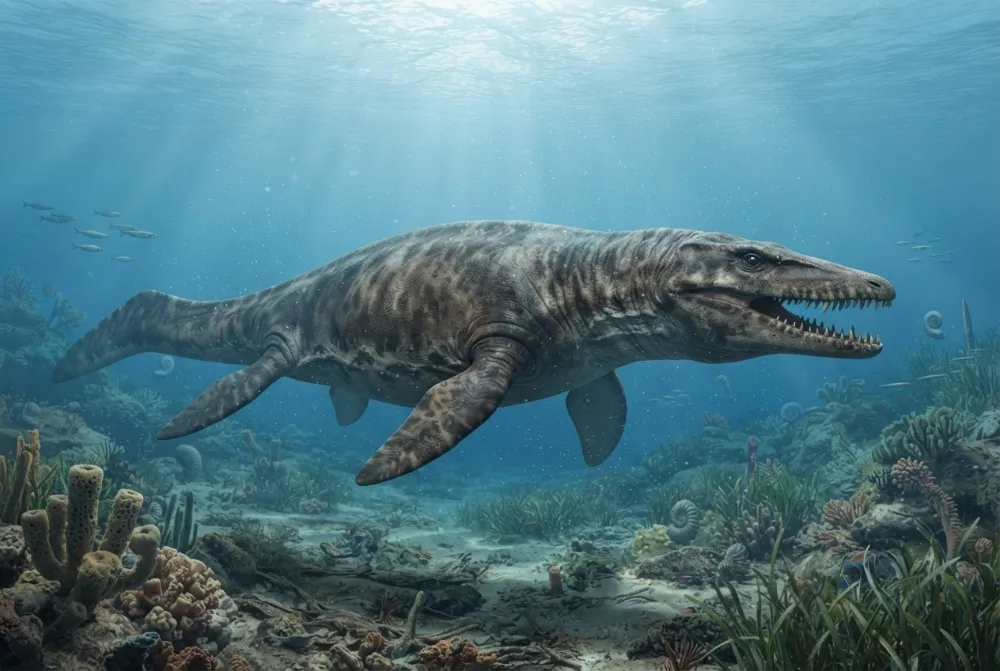
Megacephalosaurus was a huge, short-necked plesiosaur that swam in the ancient sea that split North America in two. It had a massive head, the biggest of any plesiosaur found on the continent, and used its long snout to catch smaller prey.1
E tshetse leng?
E ne e le kgolo go le kae?
E ne e le telele go le kae?
 telele jaaka dikoloi di le 2 di emisitswe mo moleng🍌telele jaaka dibanana di le 50 di latelana🏊e ne e ka thuma boleele jwa letamo le legolo la go thuma (50 m) mo metsotswaneng e le 7.8
Megacephalosaurus e ne e le kgolo go le kae fa e bapisiwa le WENA?
Ke dipalo fela mo sebatling sa gago. Ga go sepe se se bolokwang kgotsa se se romelwang gope.
E ne e le bonako go le kae?


Dintlha tse di monate
Megacephalosaurus was one of the last pliosaurs, living about 94 to 93 million years ago during the Turonian stage of the Late Cretaceous.1
Its skull was up to 1.75 meters (5.7 feet) long, making it the largest skull of any plesiosaur known from North America.1
The teeth had long, thin ridges called apicobasal ridges that helped grip and puncture slippery prey.1
It shared its ocean home with sharks like Cretoxyrhina and Squalicorax, as well as other marine reptiles like mosasaurs and sea turtles.1
The first fossils were found in 1950 and were originally thought to belong to a different pliosaur called Brachauchenius lucasi.1
It was not until 2013 that scientists realized the fossils were from a new, distinct animal and named it Megacephalosaurus.1
Dipotso tse di botswang thata ka ga Megacephalosaurus
?How big was Megacephalosaurus?
It was one of the largest marine reptiles of its time, estimated to be 6 to 9 meters (20 to 30 ft) long. Its skull alone could reach 1.75 meters (5.7 ft) in length.1
?What did Megacephalosaurus eat?
It likely ate smaller prey, because it had a long snout and teeth that were all about the same size. Its teeth had ridges that helped grip and puncture slippery animals.12
?When did Megacephalosaurus live?
It lived about 94 to 93 million years ago, during the Turonian stage of the Late Cretaceous. It was among the last of the pliosaurs.1
?Is Megacephalosaurus a dinosaur?
No, it is not a dinosaur. It is a plesiosaur, a type of marine reptile that lived in the ocean at the same time as dinosaurs.1
Ya baitseanape ba didino
- Leina la saense
- Megacephalosaurus
- Leina le neilwe ke
- Schumacher et al. 20133
- Setlhopha
- Dipleisiosoro
- Lelapa / clade
- Pliosauridae3
- Thulaganyo
- Plesiosauria > Pliosauridae > Sauropterygia3
- Bogolo jwa matlapa
- 94 go ya go 90 dimilione tsa dingwaga (Turonian)3
- Dibopego tsa matlapa
- Carlile Shale, Greenhorn Limestone3
- Dinaga
- Amerika3
- Direkoto tsa difosili
- 2 mo The Paleobiology Database3
- Go fitlhelwa
- The first fossils were discovered in 1950 by George F. Sternberg in Kansas. They were later studied by Bruce Schumacher, Kenneth Carpenter, and Mike Everhart, who named the new species Megacephalosaurus eulerti in 2013.1
- Go sa ntse go ganetsanwa
- Scientists are still debating how the last brachauchenine pliosaurs, including Megacephalosaurus, are related to each other and what their teeth tell us about their evolution.2
Kwa dintlha di tswang teng
- Megacephalosaurus (en.wikipedia.org)
- Morphological and phylogenetic aspects of the dentition of Megacephalosaurus eulerti , a pliosaurid from the Turonian of Kansas, USA, with remarks on the cranial anatomy of the taxon (cambridge.org)
- Megacephalosaurus in The Paleobiology Database (CC BY 4.0): dingwaga, mafelo, dibopego tsa matlapa, thulaganyo.
Ntlha nngwe le nngwe mo tsebeng eno e na le nomoro e e supang motswedi wa yona. Fa re dirile phoso, maitshwarelo, re barati ba didino, ga re lokwalodikgang lwa saense. Re bolelele kwa [email protected] mme re tla e baakanya.
 Rex o tshwerwe ke tlala! Dino Wiki ke porojeke ya rre e a e diretseng morwawe yo o ratang didino, ke mahala, ga e na dipapatso e bile ga e na dilatedi. Batho ba bagolo ba ka fepa Rex senyamo go thusa gore e nne mo inthaneteng.Fepa Rex
 Elasmosaurus
 Pliosaurus
 Plesiosaurus
 Cimoliasaurus
 Colymbosaurus
 Trinacromerum
 Tyrannosaurus
 Triceratops
 Velociraptor
 Spinosaurus
 Ankylosaurus
 Parasaurolophus