 O dino efe? Kwisi
 Ntwa ya didino
 Peiso ya didino
 Metshamekwana ya didino
 Alebamo ya disetikara
 Manane a TOP a didino
 Ngakgamatsa!
E tshetse leng?

E ne e le kgolo go le kae?
E ne e le kwa godimo go le kae?
E ne e le bokete go le kae?
Mirarce e ne e le kgolo go le kae fa e bapisiwa le WENA?
Ke dipalo fela mo sebatling sa gago. Ga go sepe se se bolokwang kgotsa se se romelwang gope.
E ne e le bonako go le kae?


Dintlha tse di monate
Its fossil was discovered in 1992 but was not officially named until 2018.1
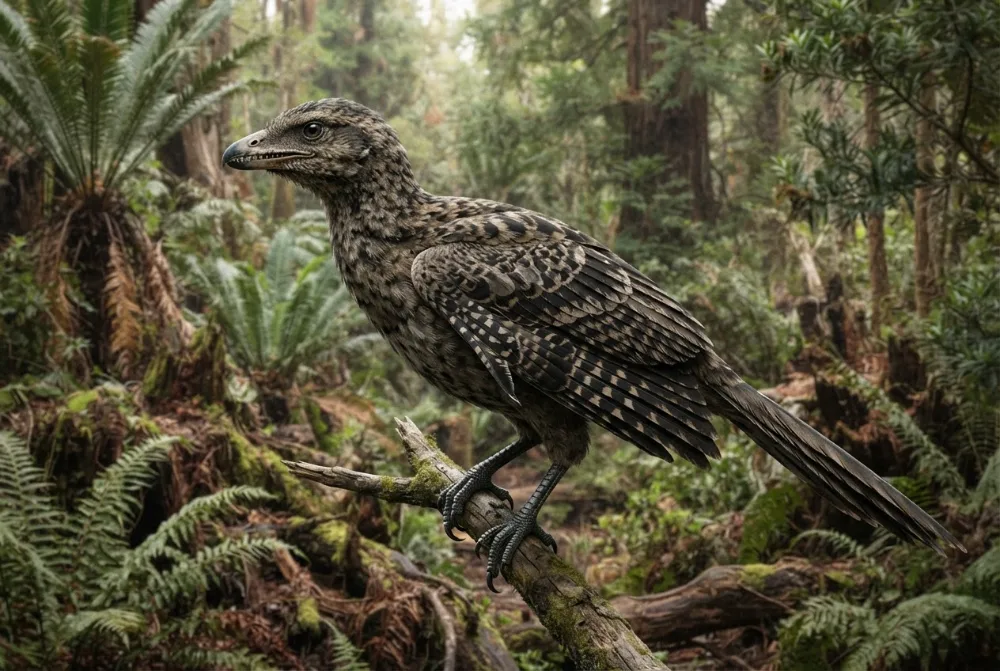
Mirarce had quill knobs on its ulna bone, which are bumps that help anchor flight feathers. This is the first time such knobs have been found in enantiornithine birds.21
It had a deeply keeled sternum (breastbone) and a narrow furcula (wishbone), features that improved its flight abilities.2
Mirarce lived during the Campanian age of the Late Cretaceous, about 76 to 74 million years ago.1
Its name combines Latin 'mirus' (wonderful) and the Greek messenger Arke, referring to its well-preserved flight-related features.1
Dipotso tse di botswang thata ka ga Mirarce
?Was Mirarce a dinosaur?
Yes, Mirarce was a bird, and birds are a type of dinosaur called avialan theropods. So it was a dinosaur, but not a non-avian dinosaur like T. rex.1
?How big was Mirarce?
Mirarce was about the size of a turkey vulture, growing to around 60 cm tall. It weighed about 0.45 kg.13
?What did Mirarce eat?
Mirarce was a raptorial predator, meaning it hunted and ate other animals. It had powerful talons and leg tendons, similar to modern birds of prey.1
?When did Mirarce live?
Mirarce lived during the Campanian age of the Late Cretaceous, about 76 to 74 million years ago.1
Ya baitseanape ba didino
- Leina la saense
- Mirarce
- Leina le neilwe ke
- Atterholt et al. 20184
- Setlhopha
- Dinonyane tsa ntlha
- Lelapa / clade
- Avisauridae4
- Thulaganyo
- Theropoda > Avialae4
- Bogolo jwa matlapa
- 84 go ya go 72 dimilione tsa dingwaga (Campanian)4
- Dibopego tsa matlapa
- Kaiparowits4
- Dinaga
- Amerika4
- Direkoto tsa difosili
- 1 mo The Paleobiology Database4
- Go fitlhelwa
- The fossil was collected in 1992 by Howard Hutchison in Utah. It was studied and named by Jesse Atterholt and colleagues in 2018, who called it Mirarce eatoni in honor of paleontologist Jeffrey Eaton.1
- Go sa ntse go ganetsanwa
- Scientists are still debating how enantiornithine birds like Mirarce compare to modern birds in terms of flight abilities and evolutionary relationships.2
Kwa dintlha di tswang teng
- Mirarce (en.wikipedia.org)
- The most complete enantiornithine from North America and a phylogenetic analysis of the Avisauridae (pmc.ncbi.nlm.nih.gov)
- Rare fossil bird deepens mystery of avian extinctions (vcresearch.berkeley.edu)
- Mirarce in The Paleobiology Database (CC BY 4.0): dingwaga, mafelo, dibopego tsa matlapa, thulaganyo.
Ntlha nngwe le nngwe mo tsebeng eno e na le nomoro e e supang motswedi wa yona. Fa re dirile phoso, maitshwarelo, re barati ba didino, ga re lokwalodikgang lwa saense. Re bolelele kwa [email protected] mme re tla e baakanya.
 Rex o tshwerwe ke tlala! Dino Wiki ke porojeke ya rre e a e diretseng morwawe yo o ratang didino, ke mahala, ga e na dipapatso e bile ga e na dilatedi. Batho ba bagolo ba ka fepa Rex senyamo go thusa gore e nne mo inthaneteng.Fepa Rex
 Archaeopteryx
 Hesperornis
 Ichthyornis
 Baptornis
 Jurapteryx
 Gobipteryx
 Tyrannosaurus
 Triceratops
 Velociraptor
 Spinosaurus
 Ankylosaurus
 Parasaurolophus