 O dino efe? Kwisi
 Ntwa ya didino
 Peiso ya didino
 Metshamekwana ya didino
 Alebamo ya disetikara
 Manane a TOP a didino
 Ngakgamatsa!
Natovenator
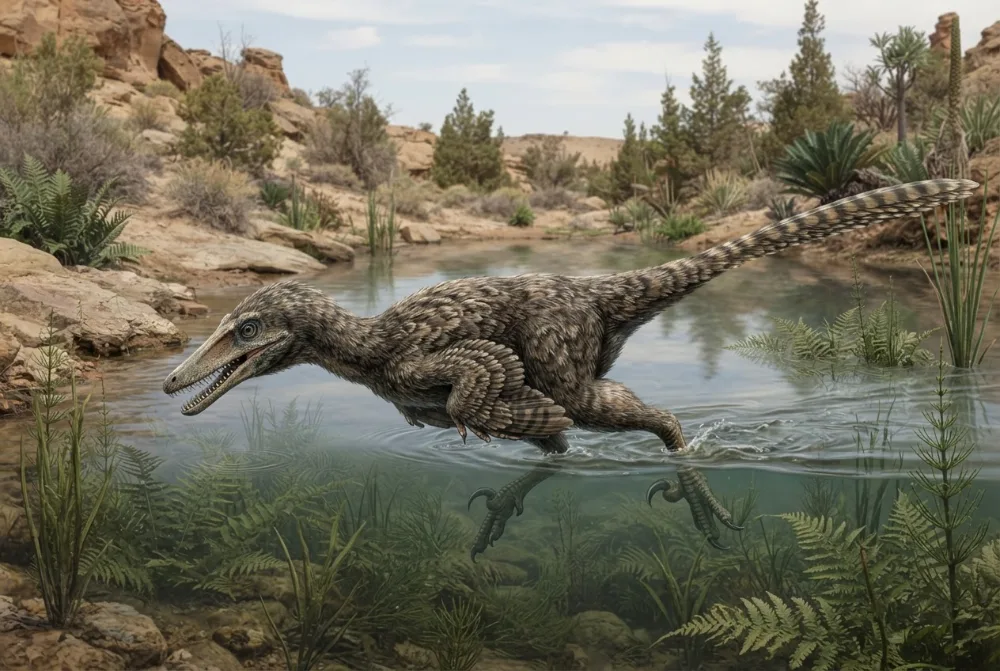
Natovenator was a tiny dinosaur that could swim! It had a streamlined body like a diving bird and a long snout full of teeth for catching fish. This little hunter lived in the deserts of Mongolia during the Late Cretaceous.21
E tshetse leng?
E ne e le kgolo go le kae?
E ne e le telele go le kae?
E ne e le kwa godimo go le kae?
kakanyo
E ne e le bokete go le kae?
Natovenator e ne e le kgolo go le kae fa e bapisiwa le WENA?
Ke dipalo fela mo sebatling sa gago. Ga go sepe se se bolokwang kgotsa se se romelwang gope.
E ne e le bonako go le kae?


Dintlha tse di monate
Natovenator had a streamlined body, which is very rare for non-avian dinosaurs. Its ribs pointed backwards to make it more hydrodynamic, just like diving birds and mosasaurs.21
It had 13 teeth in its premaxilla (the front of the upper jaw), which is an unusually high number for a dromaeosaurid.21
Its snout was long and full of many small holes (neurovascular foramina), which may have helped it sense movement in the water.21
Natovenator belongs to a group called Halszkaraptorinae, which are dromaeosaurids that may have been semi-aquatic. This group includes Halszkaraptor from Mongolia.13
Its neck was long, like many diving birds today, which helped it catch fish quickly.1
The name Natovenator means 'swimming hunter' in Latin, because scientists think it was a good swimmer that hunted in water.1
Dipotso tse di botswang thata ka ga Natovenator
?How big was Natovenator?
About 0.7 metres (2.3 feet) long and weighed around 0.3 kilograms (0.66 pounds). That is roughly the size of a duck.1
?Could Natovenator swim?
Yes, scientists think it was a good swimmer. Its ribs pointed backwards to make its body streamlined like a diving bird, and its long neck helped it catch fish.21
?What did Natovenator eat?
It likely ate fish and other small prey in the water. Its many sharp teeth and long snout were good for catching slippery food.12
?When did Natovenator live?
It lived during the Late Cretaceous, about 72 to 83 million years ago, in what is now the Gobi Desert of Mongolia.1
Ya baitseanape ba didino
- Leina la saense
- Natovenator
- Leina le neilwe ke
- Lee et al. 20224
- Setlhopha
- Diraptoro
- Lelapa / clade
- Dromaeosauridae4
- Thulaganyo
- Theropoda > Dromaeosauridae4
- Bogolo jwa matlapa
- 84 go ya go 72 dimilione tsa dingwaga (Campanian)4
- Dibopego tsa matlapa
- Baruungoyot4
- Dinaga
- Mongolia4
- Direkoto tsa difosili
- 1 mo The Paleobiology Database4
- Go fitlhelwa
- Natovenator was named in 2022 by Sungjin Lee and colleagues based on a nearly complete skeleton found in Mongolia. The fossil was first mentioned in a 2019 abstract.12
- Go sa ntse go ganetsanwa
- Scientists are still debating whether all halszkaraptorines were semi-aquatic, or if some were more terrestrial. Natovenator's streamlined body supports the swimming idea, but more fossils are needed to be sure.12
Kwa dintlha di tswang teng
- Natovenator (en.wikipedia.org)
- A non-avian dinosaur with a streamlined body exhibits potential adaptations for swimming | Communications Biology (preview-www.nature.com)
- PBDB Taxon (paleobiodb.org)
- Natovenator in The Paleobiology Database (CC BY 4.0): dingwaga, mafelo, dibopego tsa matlapa, thulaganyo.
Ntlha nngwe le nngwe mo tsebeng eno e na le nomoro e e supang motswedi wa yona. Fa re dirile phoso, maitshwarelo, re barati ba didino, ga re lokwalodikgang lwa saense. Re bolelele kwa [email protected] mme re tla e baakanya.
 Rex o tshwerwe ke tlala! Dino Wiki ke porojeke ya rre e a e diretseng morwawe yo o ratang didino, ke mahala, ga e na dipapatso e bile ga e na dilatedi. Batho ba bagolo ba ka fepa Rex senyamo go thusa gore e nne mo inthaneteng.Fepa Rex
 Velociraptor
 Microraptor
 Deinonychus
 Asiamericana
 Richardoestesia
 Saurornitholestes
 Tyrannosaurus
 Triceratops
 Spinosaurus
 Ankylosaurus
 Parasaurolophus
 Pteranodon