 O dino efe? Kwisi
 Ntwa ya didino
 Peiso ya didino
 Metshamekwana ya didino
 Alebamo ya disetikara
 Manane a TOP a didino
 Ngakgamatsa!
Navaornis
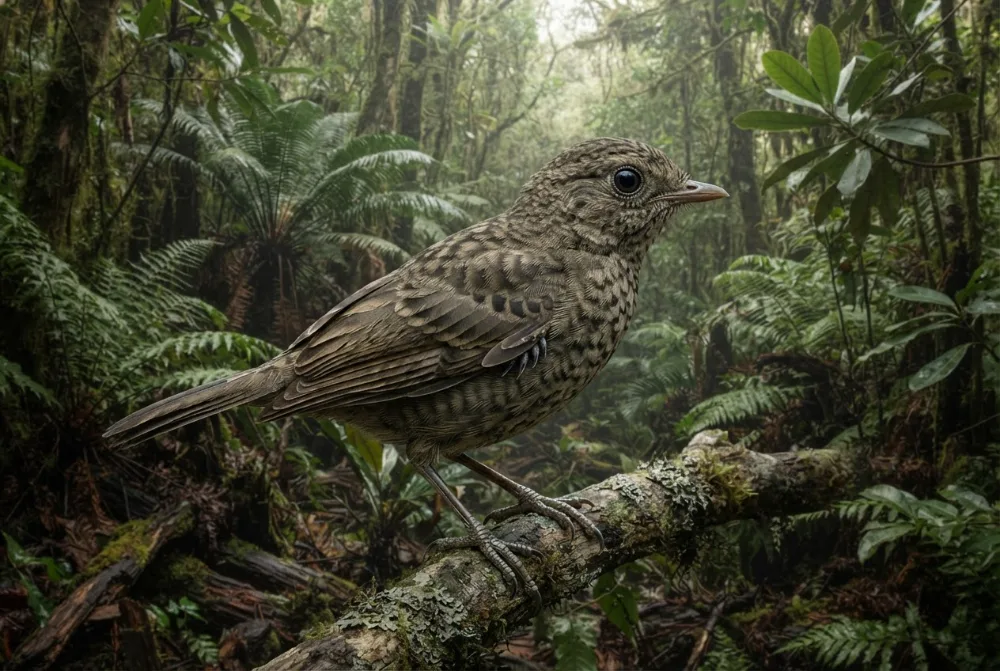
Navaornis was a starling-sized bird that lived about 80 million years ago in what is now Brazil. It had a toothless, large-eyed skull that looked almost like a modern bird, but it belonged to an ancient group called enantiornithines. Its beautifully preserved skull let scientists see inside its brain for the first time in such an old bird.12
E tshetse leng?
E ne e le bonako go le kae?


Dintlha tse di monate
Navaornis had a toothless skull with large eyes, just like many birds today, but its brain still had some ancient features like a small cerebellum and a weakly expanded telencephalon.1
Its skull is the best-preserved Mesozoic bird skull ever found, preserved in three dimensions without being flattened.1
The fossil site where Navaornis was found is very small, only about 6 square meters, but it has yielded hundreds of enantiornithine bird bones.1
Navaornis belongs to a group called Enantiornithes, which were the most diverse birds of the Mesozoic and lived on every continent except Antarctica.12
Its inner ear (bony labyrinth) was shaped like that of many modern birds but was much larger.1
Ya baitseanape ba didino
- Leina la saense
- Navaornis
- Leina le neilwe ke
- Chiappe et al. 20243
- Setlhopha
- Dinonyane tsa ntlha
- Lelapa / clade
- Enantiornithes3
- Thulaganyo
- Theropoda > Avialae3
- Bogolo jwa matlapa
- 84 go ya go 66 dimilione tsa dingwaga (Campanian / Maastrichtian)3
- Dibopego tsa matlapa
- Adamantina3
- Dinaga
- Borasele3
- Direkoto tsa difosili
- 1 mo The Paleobiology Database3
- Go fitlhelwa
- The fossil site was discovered in 2004 by William Nava, and the holotype skull was found in 2016. The species was named Navaornis hestiae by Chiappe and colleagues in 2024.13
- Go sa ntse go ganetsanwa
- Scientists are still debating exactly how Navaornis is related to other enantiornithines, because its toothless skull and modern-looking head make it hard to place in the family tree.1
Kwa dintlha di tswang teng
- Cretaceous bird from Brazil informs the evolution of the avian skull and brain | Nature (nature.com)
- Cretaceous bird from Brazil informs the evolution of the avian skull and brain (pmc.ncbi.nlm.nih.gov)
- Navaornis in The Paleobiology Database (CC BY 4.0): dingwaga, mafelo, dibopego tsa matlapa, thulaganyo.
Ntlha nngwe le nngwe mo tsebeng eno e na le nomoro e e supang motswedi wa yona. Fa re dirile phoso, maitshwarelo, re barati ba didino, ga re lokwalodikgang lwa saense. Re bolelele kwa [email protected] mme re tla e baakanya.
 Rex o tshwerwe ke tlala! Dino Wiki ke porojeke ya rre e a e diretseng morwawe yo o ratang didino, ke mahala, ga e na dipapatso e bile ga e na dilatedi. Batho ba bagolo ba ka fepa Rex senyamo go thusa gore e nne mo inthaneteng.Fepa Rex
 Archaeopteryx
 Hesperornis
 Ichthyornis
 Baptornis
 Jurapteryx
 Gobipteryx
 Tyrannosaurus
 Triceratops
 Velociraptor
 Spinosaurus
 Ankylosaurus
 Parasaurolophus