 O dino efe? Kwisi
 Ntwa ya didino
 Peiso ya didino
 Metshamekwana ya didino
 Alebamo ya disetikara
 Manane a TOP a didino
 Ngakgamatsa!
E tshetse leng?

E ne e le kgolo go le kae?
E ne e le telele go le kae?
E ne e le kwa godimo go le kae?
kakanyo
E ne e le bokete go le kae?
 telele jaaka dintšwa di le 3 go tswa kwa nkong go ya kwa mogatleng🍌telele jaaka dibanana di le 17 di latelana🍉bokete jaaka magapu a le 70🧸bokete jaaka bana ba kreše ba le 18🎒bokete jaaka bana ba sekolo ba le 11🏃e ne e ka taboga dimetara di le 100 mo metsotswaneng e le 13 (motho yo o bonako go gaisa o tlhoka 9,6)
Neimongosaurus e ne e le kgolo go le kae fa e bapisiwa le WENA?
Ke dipalo fela mo sebatling sa gago. Ga go sepe se se bolokwang kgotsa se se romelwang gope.
E ne e le bonako go le kae?


Dintlha tse di monate
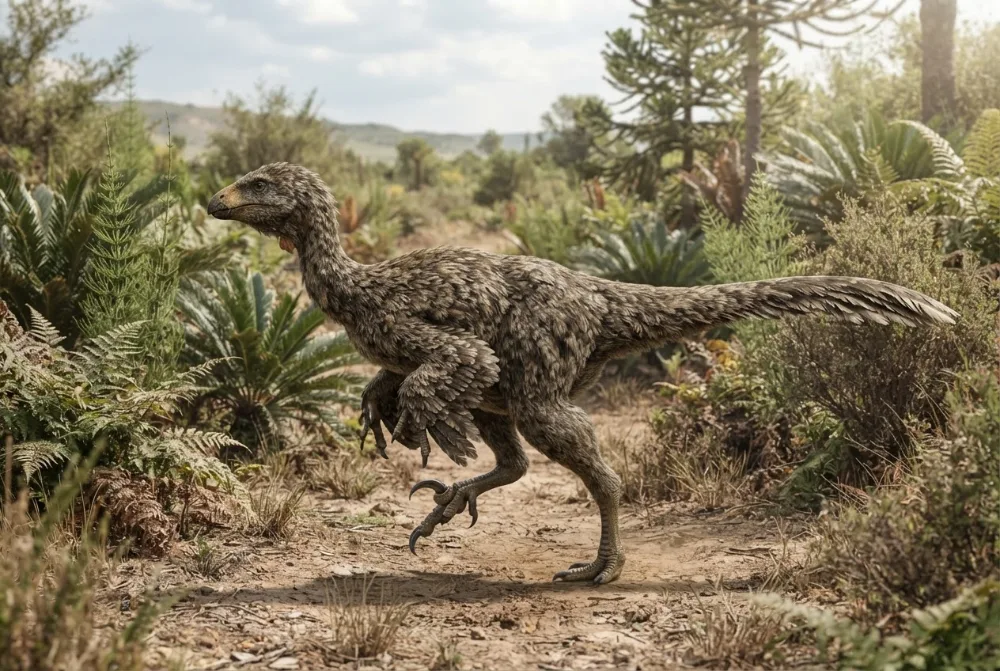
Neimongosaurus had one of the longest necks of any non-bird theropod, with about 14 neck vertebrae. That is more than most other meat-eating dinosaurs had.1
Its tail was fairly short, with only 22 tail vertebrae, which is unusual for a theropod.1
The front of its lower jaw was toothless, like a beak, and it had only a few teeth further back. This helped it eat plants.1
Its arm bones show a large bump for the biceps muscle, which may have given it strong arms for pulling branches.1
The vertebrae in its spine were hollow and filled with air spaces, a feature also seen in some advanced bird-like dinosaurs.2
Scientists think Neimongosaurus was closely related to oviraptorosaurs because of its long neck and short tail.2
Dipotso tse di botswang thata ka ga Neimongosaurus
?How big was Neimongosaurus?
About 2 to 3 metres long. It weighed around 350 kg, which is about the weight of a small horse.1
?What did Neimongosaurus eat?
It ate plants. Its lower jaw had a toothless, beak-like front and only a few teeth with serrated edges in the back.1
?Did Neimongosaurus have feathers?
Scientists think it likely had feathers, because its relatives (therizinosaurs) are often shown with feathers, but no direct feather fossils have been found for this species.1
Ya baitseanape ba didino
- Leina la saense
- Neimongosaurus
- Leina le neilwe ke
- Zhang et al. 20014
- Setlhopha
- Didino tse di sa tlwaelegang tsa dintsiba
- Lelapa / clade
- Therizinosauridae4
- Thulaganyo
- Theropoda > Therizinosauria4
- Bogolo jwa matlapa
- 86 go ya go 72 dimilione tsa dingwaga (Santonian / Campanian)4
- Dibopego tsa matlapa
- Iren Dabasu, Bostobe4
- Dinaga
- Tšhaena, Kazakhstan4
- Direkoto tsa difosili
- 2 mo The Paleobiology Database4
- Go fitlhelwa
- In 1999, a team from the Ministry of Land and Resources in Inner Mongolia found two skeletons at Sanhangobi, about 20 km southwest of Erenhot. In 2001, scientists named the new species Neimongosaurus yangi, honoring Chinese paleontologist Yang Zhongjian.1
- Go sa ntse go ganetsanwa
- Scientists are not sure exactly where Neimongosaurus sits on the family tree. Some studies place it outside the therizinosaurid group, while others put it inside, close to Therizinosaurus.1
Kwa dintlha di tswang teng
- Neimongosaurus (en.wikipedia.org)
- A LONG-NECKED THERIZINOSAUROID DINOSAUR FROM THE UPPER CRETACEOUS IREN DABASU FORMATION OF NEI MONGOL, PEOPL E’S REPUBLIC OF CHINA (vertpala.ac.cn)
- Neimongosaurus (en.wikipedia.org)
- Neimongosaurus in The Paleobiology Database (CC BY 4.0): dingwaga, mafelo, dibopego tsa matlapa, thulaganyo.
Ntlha nngwe le nngwe mo tsebeng eno e na le nomoro e e supang motswedi wa yona. Fa re dirile phoso, maitshwarelo, re barati ba didino, ga re lokwalodikgang lwa saense. Re bolelele kwa [email protected] mme re tla e baakanya.
 Rex o tshwerwe ke tlala! Dino Wiki ke porojeke ya rre e a e diretseng morwawe yo o ratang didino, ke mahala, ga e na dipapatso e bile ga e na dilatedi. Batho ba bagolo ba ka fepa Rex senyamo go thusa gore e nne mo inthaneteng.Fepa Rex
Tse dingwe tsa setlhopha se le sengwe: Didino tse di sa tlwaelegang tsa dintsiba
 TherizinosaurusDidino tse di sa tlwaelegang tsa dintsiba
 OviraptorDidino tse di sa tlwaelegang tsa dintsiba
 ChirostenotesDidino tse di sa tlwaelegang tsa dintsiba
 CitipesDidino tse di sa tlwaelegang tsa dintsiba
 LeptorhynchosDidino tse di sa tlwaelegang tsa dintsiba
 AvimimusDidino tse di sa tlwaelegang tsa dintsiba
 Tyrannosaurus
 Triceratops
 Velociraptor
 Spinosaurus
 Ankylosaurus
 Parasaurolophus