 O dino efe? Kwisi
 Ntwa ya didino
 Peiso ya didino
 Metshamekwana ya didino
 Alebamo ya disetikara
 Manane a TOP a didino
 Ngakgamatsa!
E tshetse leng?

E ne e le kgolo go le kae?
E ne e le telele go le kae?
E ne e le kwa godimo go le kae?
kakanyo
E ne e le bokete go le kae?
 telele jaaka dintšwa di le 5 go tswa kwa nkong go ya kwa mogatleng🍌telele jaaka dibanana di le 29 di latelana🍉bokete jaaka magapu a le 240🧸bokete jaaka bana ba kreše ba le 63🎒bokete jaaka bana ba sekolo ba le 38🐻❄️bokete jaaka dibere tse ditshweu di le 2.5🏃e ne e ka taboga dimetara di le 100 mo metsotswaneng e le 16 (motho yo o bonako go gaisa o tlhoka 9,6)
Nothronychus e ne e le kgolo go le kae fa e bapisiwa le WENA?
Ke dipalo fela mo sebatling sa gago. Ga go sepe se se bolokwang kgotsa se se romelwang gope.
E ne e le bonako go le kae?


Dintlha tse di monate
Nothronychus was the first therizinosaur ever found in the Americas. All earlier therizinosaur fossils came from China and Mongolia.1
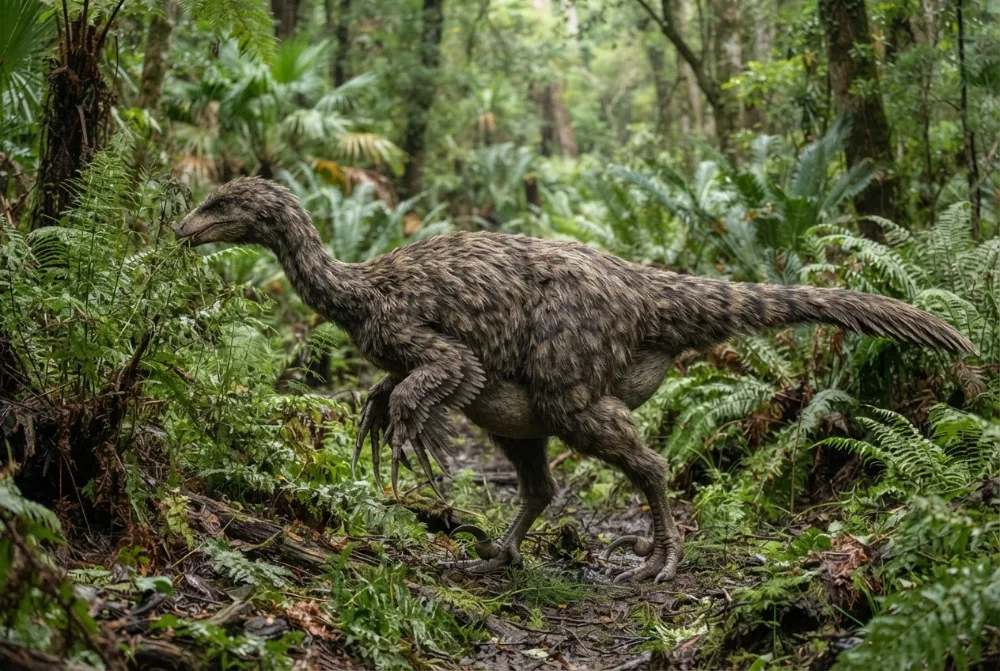
Its claws were up to 30 centimeters (12 inches) long and curved like hooks. Scientists think it used them to pull down branches to eat.1
Nothronychus had four forward-facing toes on each foot, which helped it walk slowly and steadily.1
One species, Nothronychus graffami, was found in rocks that were once under a shallow sea called the Western Interior Seaway. The dinosaur's bones were mixed with marine reptile fossils.1
The first Nothronychus bone was mistaken for part of a horned dinosaur's skull. Only later did scientists realize it was a hip bone from a therizinosaur.1
Dipotso tse di botswang thata ka ga Nothronychus
?How big was Nothronychus?
It was about 4.2 to 5.3 metres (14 to 17 feet) long and weighed 800 to 1,200 kilograms (1,800 to 2,600 pounds).1
?What did Nothronychus eat?
It ate plants. Even though it was a theropod dinosaur, it was a herbivore.12
?Did Nothronychus have feathers?
No feather fossils have been found, but its relatives had feathers, so scientists think it probably did too.3
?When did Nothronychus live?
It lived during the Late Cretaceous period, about 94 to 89 million years ago.2
?Why did Nothronychus have long claws?
It used its long, curved claws to pull down branches so it could eat leaves.1
Ya baitseanape ba didino
- Leina la saense
- Nothronychus
- Leina le neilwe ke
- Kirkland and Wolfe 20014
- Setlhopha
- Didino tse di sa tlwaelegang tsa dintsiba
- Lelapa / clade
- Therizinosauridae4
- Thulaganyo
- Theropoda > Therizinosauria4
- Bogolo jwa matlapa
- 94 go ya go 90 dimilione tsa dingwaga (Turonian)4
- Dibopego tsa matlapa
- Moreno Hill, Tropic Shale4
- Dinaga
- Amerika4
- Direkoto tsa difosili
- 2 mo The Paleobiology Database4
- Go fitlhelwa
- Nothronychus was named in 2001 by paleontologists James Kirkland and Douglas Wolfe. The first fossils were found in New Mexico on land owned by rancher Bobby McKinley, who the species N. mckinleyi is named after.1
- Go sa ntse go ganetsanwa
- Scientists are not sure if Nothronychus had feathers. Since it is a theropod closely related to birds, it might have had feathers, but no direct fossil evidence has been found yet.1
Kwa dintlha di tswang teng
- Nothronychus (en.wikipedia.org)
- Nothronychus | Natural History Museum (nhm.ac.uk)
- Nothronychus Fact Sheet - Enchanted Learning (enchantedlearning.com)
- Nothronychus in The Paleobiology Database (CC BY 4.0): dingwaga, mafelo, dibopego tsa matlapa, thulaganyo.
Ntlha nngwe le nngwe mo tsebeng eno e na le nomoro e e supang motswedi wa yona. Fa re dirile phoso, maitshwarelo, re barati ba didino, ga re lokwalodikgang lwa saense. Re bolelele kwa [email protected] mme re tla e baakanya.
 Rex o tshwerwe ke tlala! Dino Wiki ke porojeke ya rre e a e diretseng morwawe yo o ratang didino, ke mahala, ga e na dipapatso e bile ga e na dilatedi. Batho ba bagolo ba ka fepa Rex senyamo go thusa gore e nne mo inthaneteng.Fepa Rex
Tse dingwe tsa setlhopha se le sengwe: Didino tse di sa tlwaelegang tsa dintsiba
 TherizinosaurusDidino tse di sa tlwaelegang tsa dintsiba
 OviraptorDidino tse di sa tlwaelegang tsa dintsiba
 ChirostenotesDidino tse di sa tlwaelegang tsa dintsiba
 CitipesDidino tse di sa tlwaelegang tsa dintsiba
 LeptorhynchosDidino tse di sa tlwaelegang tsa dintsiba
 AvimimusDidino tse di sa tlwaelegang tsa dintsiba
 Tyrannosaurus
 Triceratops
 Velociraptor
 Spinosaurus
 Ankylosaurus
 Parasaurolophus