 O dino efe? Kwisi
 Ntwa ya didino
 Peiso ya didino
 Metshamekwana ya didino
 Alebamo ya disetikara
 Manane a TOP a didino
 Ngakgamatsa!
E tshetse leng?

E ne e le kgolo go le kae?
E ne e le telele go le kae?
E ne e le kwa godimo go le kae?
E ne e le bokete go le kae?

 telele jaaka dintšwa di le 8 go tswa kwa nkong go ya kwa mogatleng🍌telele jaaka dibanana di le 44 di latelanabokete jaaka dintšwa di le 170🍉bokete jaaka magapu a le 680🎒bokete jaaka diphaposiborutelo tse di tletseng bana di le 4🐻❄️bokete jaaka dibere tse ditshweu di le 8🏃e ne e ka taboga dimetara di le 100 mo metsotswaneng e le 15 (motho yo o bonako go gaisa o tlhoka 9,6)
Olorotitan e ne e le kgolo go le kae fa e bapisiwa le WENA?
Ke dipalo fela mo sebatling sa gago. Ga go sepe se se bolokwang kgotsa se se romelwang gope.
E ne e le bonako go le kae?


Dintlha tse di monate
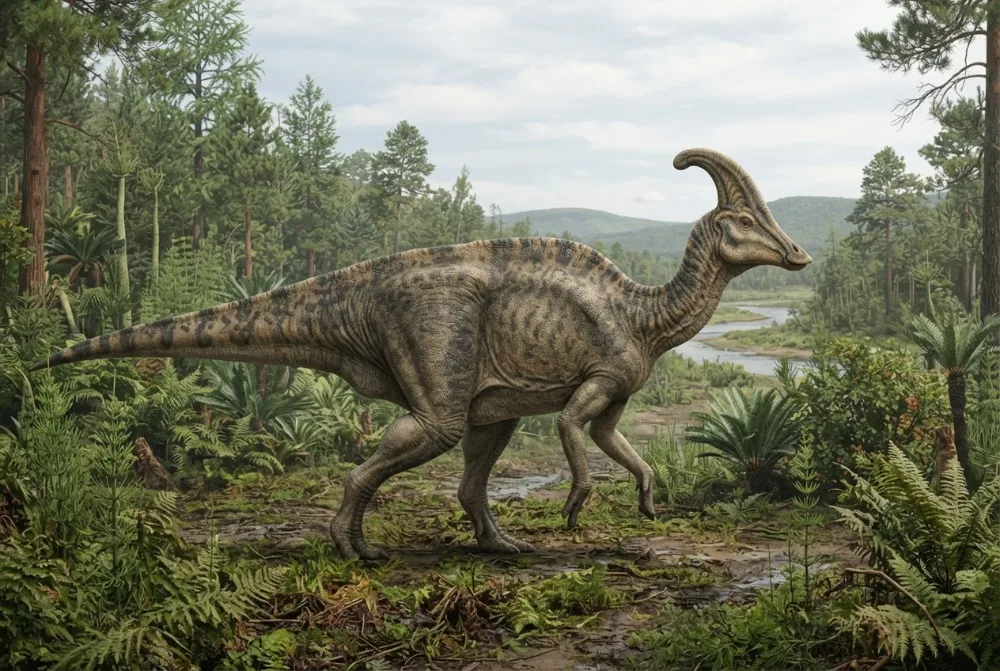
Olorotitan had a very long neck for a duck-billed dinosaur, with 18 neck bones. That is why its name means 'titanic swan'.12
Its hollow head crest was tall and helmet-shaped, made from expanded skull bones that held the nasal passages.12
The skeleton of Olorotitan is the most complete lambeosaurine (a type of duck-billed dinosaur) ever found outside North America.12
Olorotitan lived about 72 to 66 million years ago, during the Maastrichtian age of the Late Cretaceous.3
It was one of the last non-bird dinosaurs to go extinct, dying out in the great extinction event 66 million years ago.1
The tail of Olorotitan had extra connections between the bones in its upper part, which may have made that section stiff.2
Olorotitan is closely related to the North American dinosaurs Corythosaurus and Hypacrosaurus.2
Dipotso tse di botswang thata ka ga Olorotitan
?How big was Olorotitan?
Olorotitan grew up to 8 metres (26 feet) long, up to 3.5 metres (11 feet) tall, and weighed between 2.6 and 3.4 metric tons.1
?What did Olorotitan eat?
Olorotitan was a plant-eater. It used its strong beak and hundreds of constantly replaced teeth to grind tough plants.1
?When did Olorotitan live?
Olorotitan lived about 72 to 66 million years ago, during the Maastrichtian age of the Late Cretaceous. It was one of the last non-bird dinosaurs to go extinct.1
?Where was Olorotitan found?
Olorotitan fossils were found in the Amur region of eastern Russia, near the Amur River. The first nearly complete skeleton was discovered between 1999 and 2001.1
?Why did Olorotitan have a crest?
The tall, hollow crest on its head was made from skull bones that held the nasal passages. It probably helped Olorotitan identify others of its kind by sight and sound.1
?Is Olorotitan a dinosaur?
Yes, Olorotitan is a dinosaur. It is a type of duck-billed dinosaur called a lambeosaurine hadrosaurid.1
Ya baitseanape ba didino
- Leina la saense
- Olorotitan
- Leina le neilwe ke
- Godefroit et al. 20033
- Setlhopha
- Melomo-pidipidi
- Lelapa / clade
- Hadrosauridae3
- Thulaganyo
- Ornithischia > Ornithopoda > Iguanodontia > Hadrosauridae3
- Bogolo jwa matlapa
- 72 go ya go 66 dimilione tsa dingwaga (Maastrichtian)3
- Dibopego tsa matlapa
- Udurchukan3
- Dinaga
- Rašia3
- Direkoto tsa difosili
- 1 mo The Paleobiology Database3
- Go fitlhelwa
- Olorotitan was named by Pascal Godefroit and colleagues in 2003. The nearly complete skeleton was dug up between 1999 and 2001 in the Udurchukan Formation at Kundur, Russia.12
- Go sa ntse go ganetsanwa
- Scientists are not sure if the extra connections between the tail bones were a normal feature or a sign of disease.2
Kwa dintlha di tswang teng
- Olorotitan (en.wikipedia.org)
- doi:10.1016/S1631-0683(03)00017-4 (sciencepress.mnhn.fr)
- Olorotitan in The Paleobiology Database (CC BY 4.0): dingwaga, mafelo, dibopego tsa matlapa, thulaganyo.
Ntlha nngwe le nngwe mo tsebeng eno e na le nomoro e e supang motswedi wa yona. Fa re dirile phoso, maitshwarelo, re barati ba didino, ga re lokwalodikgang lwa saense. Re bolelele kwa [email protected] mme re tla e baakanya.
 Rex o tshwerwe ke tlala! Dino Wiki ke porojeke ya rre e a e diretseng morwawe yo o ratang didino, ke mahala, ga e na dipapatso e bile ga e na dilatedi. Batho ba bagolo ba ka fepa Rex senyamo go thusa gore e nne mo inthaneteng.Fepa Rex
 Parasaurolophus
 Edmontosaurus
 Saurolophus
 Hypacrosaurus
 Corythosaurus
 Kritosaurus
 Tyrannosaurus
 Triceratops
 Velociraptor
 Spinosaurus
 Ankylosaurus
 Pteranodon