 O dino efe? Kwisi
 Ntwa ya didino
 Peiso ya didino
 Metshamekwana ya didino
 Alebamo ya disetikara
 Manane a TOP a didino
 Ngakgamatsa!
E tshetse leng?

E ne e le kgolo go le kae?
E ne e le telele go le kae?
E ne e le kwa godimo go le kae?
kakanyo
 telele jaaka dikatse tsa mo gae di le 2 go tswa kwa nkong go ya kwa mogatleng🍌telele jaaka dibanana di le 5 di latelana🪑nnye mo e ka tsamayang ka fa tlase ga setulo🏊e ne e ka thuma boleele jwa letamo le legolo la go thuma (50 m) mo metsotswaneng e le 20
Parahesperornis e ne e le kgolo go le kae fa e bapisiwa le WENA?
Ke dipalo fela mo sebatling sa gago. Ga go sepe se se bolokwang kgotsa se se romelwang gope.
E ne e le bonako go le kae?


Dintlha tse di monate
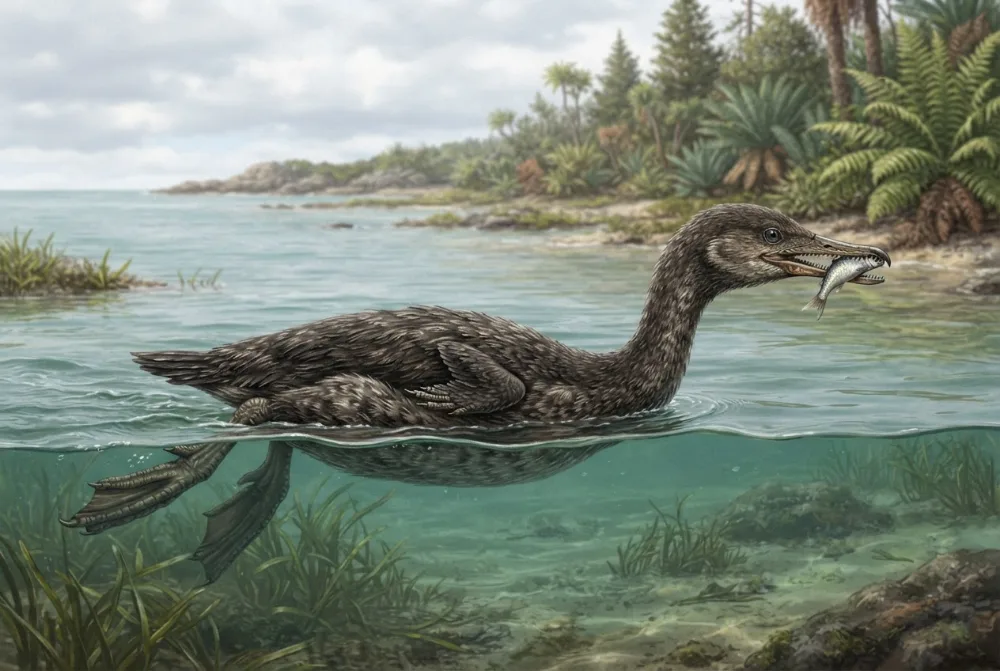
Parahesperornis could not fly. Its wings were tiny and useless for flying, but its legs were strong for swimming.12
It had sharp teeth in its beak, which is unusual for modern birds. These teeth helped it grab slippery fish.12
Parahesperornis is known from two nearly complete skeletons, which is rare for ancient birds. Most are found as just a few bones.2
It lived in the Western Interior Seaway, a shallow sea that covered central North America during the Cretaceous.1
The first fossil of Parahesperornis was found in 1894, but it was not named until 1984 by scientist L. D. Martin.24
Parahesperornis was about the size of a modern loon or a small penguin, around 60 to 90 centimeters long.2
Dipotso tse di botswang thata ka ga Parahesperornis
?Was Parahesperornis a dinosaur?
Yes, it was a type of prehistoric bird. While birds are descendants of dinosaurs, scientists classify Parahesperornis as an avialan bird rather than a dinosaur.1
?How big was Parahesperornis?
It was about 60 to 90 centimetres (2 to 3 feet) long, roughly the size of a modern loon or a small penguin.1
?Did Parahesperornis have teeth?
Yes, it had sharp teeth in its beak, which helped it grab slippery fish.2
?Could Parahesperornis swim?
Yes, it was a foot-propelled diving bird that swam like a penguin, using its strong legs to chase fish underwater.3
Ya baitseanape ba didino
- Leina la saense
- Parahesperornis
- Leina le neilwe ke
- Martin 19844
- Setlhopha
- Dinonyane tsa ntlha
- Lelapa / clade
- Hesperornithidae4
- Thulaganyo
- Theropoda > Avialae4
- Bogolo jwa matlapa
- 90 go ya go 84 dimilione tsa dingwaga (Coniacian / Santonian)4
- Dibopego tsa matlapa
- Niobrara4
- Dinaga
- Amerika4
- Direkoto tsa difosili
- 3 mo The Paleobiology Database4
- Go fitlhelwa
- The first fossil of Parahesperornis alexi was found in 1894 by H. T. Martin in Graham County, Kansas. It was later named by L. D. Martin in 1984.24
- Go sa ntse go ganetsanwa
- Scientists are not sure if some fossils from Mongolia belong to Parahesperornis or a different, similar bird.1
Kwa dintlha di tswang teng
- Parahesperornis (en.wikipedia.org)
- Anatomy of Parahesperornis: Evolutionary Mosaicism in the Cretaceous Hesperornithiformes (Aves) (mdpi.com)
- Anatomy of Parahesperornis: Evolutionary Mosaicism in the Cretaceous Hesperornithiformes (Aves) (pmc.ncbi.nlm.nih.gov)
- Parahesperornis in The Paleobiology Database (CC BY 4.0): dingwaga, mafelo, dibopego tsa matlapa, thulaganyo.
Ntlha nngwe le nngwe mo tsebeng eno e na le nomoro e e supang motswedi wa yona. Fa re dirile phoso, maitshwarelo, re barati ba didino, ga re lokwalodikgang lwa saense. Re bolelele kwa [email protected] mme re tla e baakanya.
 Rex o tshwerwe ke tlala! Dino Wiki ke porojeke ya rre e a e diretseng morwawe yo o ratang didino, ke mahala, ga e na dipapatso e bile ga e na dilatedi. Batho ba bagolo ba ka fepa Rex senyamo go thusa gore e nne mo inthaneteng.Fepa Rex
 Archaeopteryx
 Hesperornis
 Ichthyornis
 Baptornis
 Jurapteryx
 Gobipteryx
 Tyrannosaurus
 Triceratops
 Velociraptor
 Spinosaurus
 Ankylosaurus
 Parasaurolophus