 O dino efe? Kwisi
 Ntwa ya didino
 Peiso ya didino
 Metshamekwana ya didino
 Alebamo ya disetikara
 Manane a TOP a didino
 Ngakgamatsa!
E tshetse leng?

E ne e le bonako go le kae?


Dintlha tse di monate
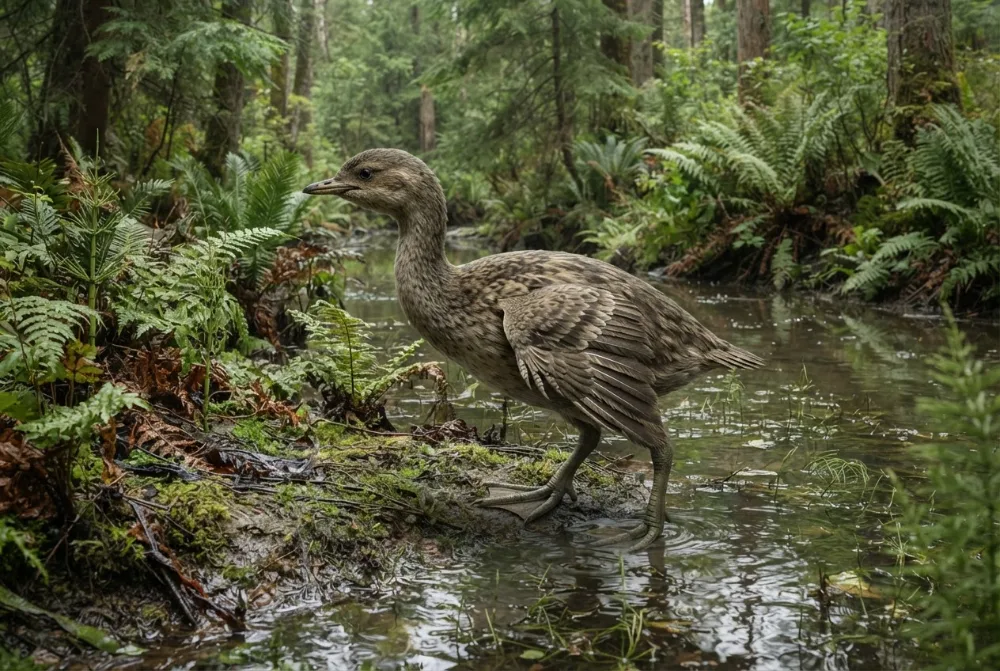
Pasquiaornis lived about 95 to 93 million years ago, during the Late Cretaceous period.1
Two species are known: Pasquiaornis hardiei and Pasquiaornis tankei. P. tankei was about one-third larger than P. hardiei.1
Pasquiaornis was a member of the Hesperornithes, a group of toothed, diving birds that were mostly flightless.1
Its wing bones were thickened and not well suited for flying, so scientists think it probably could not fly.1
Fossils of at least 9 individuals were found in a small area, which might mean they lived in colonies or died together in a mass event.1
The rocks where Pasquiaornis was found were once the bottom of the Western Interior Seaway, a shallow sea that split North America in two.1
Ya baitseanape ba didino
- Leina la saense
- Pasquiaornis
- Leina le neilwe ke
- Tokaryk et al. 19972
- Setlhopha
- Dinonyane tsa ntlha
- Lelapa / clade
- Hesperornithiformes2
- Thulaganyo
- Theropoda > Avialae2
- Bogolo jwa matlapa
- 100 go ya go 94 dimilione tsa dingwaga (Cenomanian)2
- Dibopego tsa matlapa
- Belle Fourche2
- Dinaga
- Khanata2
- Direkoto tsa difosili
- 2 mo The Paleobiology Database2
- Go fitlhelwa
- Pasquiaornis was named in 1997 by Tim Tokaryk, Stephen Cumbaa and John Storer. The fossils were collected near Arborfield, Saskatchewan, mostly during 1992 to 1993 expeditions by the Royal Saskatchewan Museum and the Canadian Museum of Nature.12
- Go sa ntse go ganetsanwa
- Scientists are not sure whether Pasquiaornis could still fly, because its wing bones look like those of flying birds but are too thick for good flight.1
Kwa dintlha di tswang teng
- Pasquiaornis (en.wikipedia.org)
- Pasquiaornis in The Paleobiology Database (CC BY 4.0): dingwaga, mafelo, dibopego tsa matlapa, thulaganyo.
Ntlha nngwe le nngwe mo tsebeng eno e na le nomoro e e supang motswedi wa yona. Fa re dirile phoso, maitshwarelo, re barati ba didino, ga re lokwalodikgang lwa saense. Re bolelele kwa [email protected] mme re tla e baakanya.
 Rex o tshwerwe ke tlala! Dino Wiki ke porojeke ya rre e a e diretseng morwawe yo o ratang didino, ke mahala, ga e na dipapatso e bile ga e na dilatedi. Batho ba bagolo ba ka fepa Rex senyamo go thusa gore e nne mo inthaneteng.Fepa Rex
 Archaeopteryx
 Hesperornis
 Ichthyornis
 Baptornis
 Jurapteryx
 Gobipteryx
 Tyrannosaurus
 Triceratops
 Velociraptor
 Spinosaurus
 Ankylosaurus
 Parasaurolophus