 O dino efe? Kwisi
 Ntwa ya didino
 Peiso ya didino
 Metshamekwana ya didino
 Alebamo ya disetikara
 Manane a TOP a didino
 Ngakgamatsa!
Simosaurus
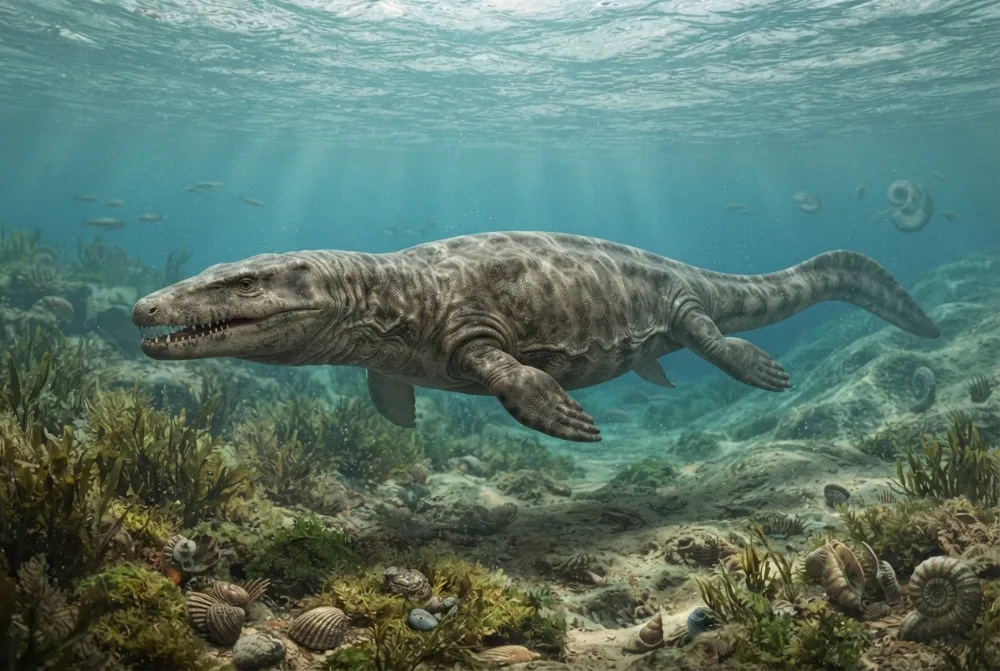
Simosaurus was a marine reptile that swam in warm, shallow seas during the Middle Triassic, about 240 to 230 million years ago. It had a blunt, flattened head and blunt teeth for crushing hard-shelled prey like clams and ammonites.1
E tshetse leng?
E ne e le kgolo go le kae?
E ne e le telele go le kae?
E ne e le bokete go le kae?
 telele jaaka dintšwa di le 4 go tswa kwa nkong go ya kwa mogatleng🍌telele jaaka dibanana di le 22 di latelana🍉bokete jaaka magapu a le 26🧸bokete jaaka bana ba kreše ba le 7🎒bokete jaaka bana ba sekolo ba le 4🏊e ne e ka thuma boleele jwa letamo le legolo la go thuma (50 m) mo metsotswaneng e le 7.8
Simosaurus e ne e le kgolo go le kae fa e bapisiwa le WENA?
Ke dipalo fela mo sebatling sa gago. Ga go sepe se se bolokwang kgotsa se se romelwang gope.
E ne e le bonako go le kae?


Dintlha tse di monate
Simosaurus had large openings behind its eyes called upper temporal fossae, which were bigger than its eye sockets.1
Its jaw joint was set far back, projecting beyond the main part of the skull, giving it a unique bite.1
Simosaurus had a flattened trunk that prevented side-to-side swimming, unlike most other nothosaurs.1
It swam using powerful downstrokes of its forelimbs, but its upstroke was weak, making it a moderately strong swimmer.1
The first Simosaurus fossils were found in Lunéville, France, and described by German paleontologist Hermann von Meyer in 1842.1
Simosaurus is known from the Muschelkalk deposits in Germany, where it appears in layers marked by the ammonite Ceratites nodosus.1
Dipotso tse di botswang thata ka ga Simosaurus
?How big was Simosaurus?
Simosaurus grew from 3 to 4 metres (9.8 to 13.1 ft) in length.1
?What did Simosaurus eat?
It ate hard-shelled organisms like ammonites and holostean fish, using its blunt teeth to crush them.1
?How did Simosaurus swim?
It swam with powerful downstrokes of its forelimbs, but its upstroke was weak, making it a moderately strong swimmer.1
Ya baitseanape ba didino
- Leina la saense
- Simosaurus
- Leina le neilwe ke
- Meyer 18423
- Setlhopha
- Digagabi tsa lewatle
- Lelapa / clade
- Simosauridae3
- Thulaganyo
- Nothosauria > Sauropterygia3
- Bogolo jwa matlapa
- 247 go ya go 201 dimilione tsa dingwaga ()3
- Dibopego tsa matlapa
- Jilh, Erfurt, Gevanim3
- Dinaga
- Jeremane, Fora, Saudi Arabia, Iseraele, Itali3
- Direkoto tsa difosili
- 15 mo The Paleobiology Database3
- Go fitlhelwa
- German paleontologist Christian Erich Hermann von Meyer named Simosaurus in 1842 based on a skull from Lunéville, France. That original skull has since been lost.1
- Go sa ntse go ganetsanwa
- Scientists debate whether Simosaurus was a nothosaur, a pachypleurosaur, or a more primitive sauropterygian.1
Kwa dintlha di tswang teng
- Simosaurus (en.wikipedia.org)
- Bone histology, microanatomy, and growth of the nothosauroid Simosaurus gaillardoti (Sauropterygia) from the Upper Muschelkalk of southern Germany/Baden-Württemberg - Scientific Publications of the Muséum national d'Histoire naturelle, Paris (sciencepress.mnhn.fr)
- Simosaurus in The Paleobiology Database (CC BY 4.0): dingwaga, mafelo, dibopego tsa matlapa, thulaganyo.
Ntlha nngwe le nngwe mo tsebeng eno e na le nomoro e e supang motswedi wa yona. Fa re dirile phoso, maitshwarelo, re barati ba didino, ga re lokwalodikgang lwa saense. Re bolelele kwa [email protected] mme re tla e baakanya.
 Rex o tshwerwe ke tlala! Dino Wiki ke porojeke ya rre e a e diretseng morwawe yo o ratang didino, ke mahala, ga e na dipapatso e bile ga e na dilatedi. Batho ba bagolo ba ka fepa Rex senyamo go thusa gore e nne mo inthaneteng.Fepa Rex
 Nothosaurus
 Placodus
 Lariosaurus
 Cyamodus
 Cymatosaurus
 Proneusticosaurus
 Massospondylus
 Plateosaurus
 Coelophysis
 Podokesaurus
 Thecodontosaurus
 Eudimorphodon