 O dino efe? Kwisi
 Ntwa ya didino
 Peiso ya didino
 Metshamekwana ya didino
 Alebamo ya disetikara
 Manane a TOP a didino
 Ngakgamatsa!
Platecarpus
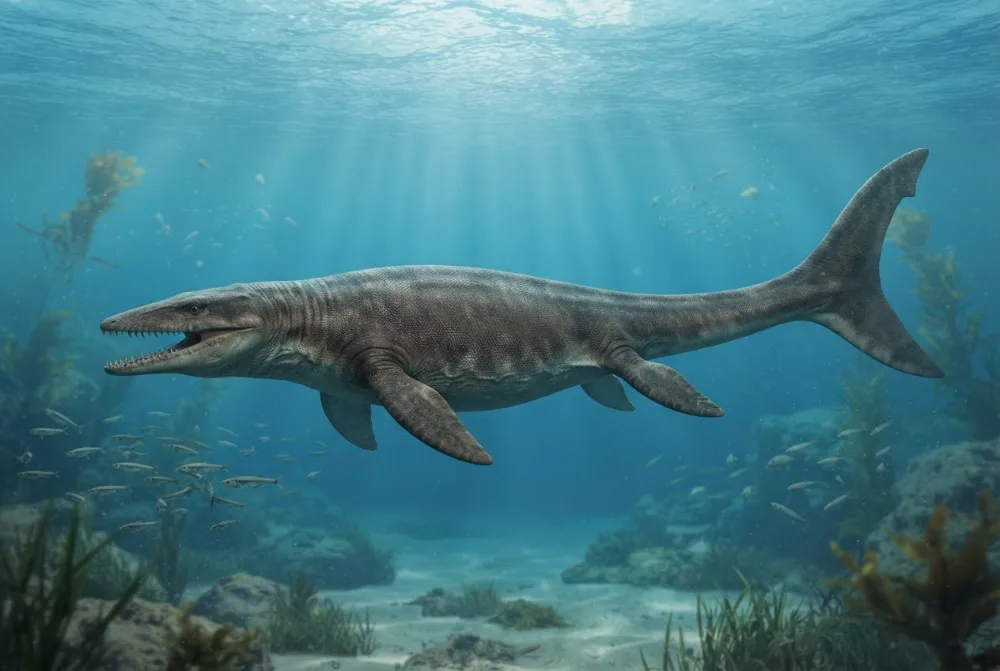
Platecarpus was a fast-swimming marine lizard that lived in the sea during the time of the dinosaurs. It had a long tail with a shark-like fin and ate fish and squid. Platecarpus was not a dinosaur, but a mosasaur, a kind of giant sea lizard.1
E tshetse leng?
E ne e le kgolo go le kae?
E ne e le telele go le kae?
 telele jaaka dintšwa di le 6 go tswa kwa nkong go ya kwa mogatleng🍌telele jaaka dibanana di le 32 di latelana🏊e ne e ka thuma boleele jwa letamo le legolo la go thuma (50 m) mo metsotswaneng e le 4.7
Platecarpus e ne e le kgolo go le kae fa e bapisiwa le WENA?
Ke dipalo fela mo sebatling sa gago. Ga go sepe se se bolokwang kgotsa se se romelwang gope.
E ne e le bonako go le kae?


Dintlha tse di monate
Platecarpus had a short skull and fewer teeth than any other mosasaur, with only about 10 teeth in each lower jaw bone.1
A well-preserved fossil shows skin impressions, pigments near the nostrils, and even the shape of the tail fluke, which was like a shark's tail.1
Platecarpus swam by moving its tail side to side, but its deep tail fin made it a powerful, fast swimmer, not like an eel.1
Fossilized stomach contents show that Platecarpus ate fish and did not digest its food completely, passing bones and scales quickly.1
A 2026 study of tooth chemistry suggests that Platecarpus was warm-blooded, like modern sharks and whales.1
Platecarpus fossils are very common in the Smoky Hill Chalk of Kansas, which was once the bottom of a shallow sea.1
Dipotso tse di botswang thata ka ga Platecarpus
?How big was Platecarpus?
About 5.7 metres (18.7 feet) long, based on a complete fossil. That is roughly the length of a small bus.1
?What did Platecarpus eat?
It ate medium-sized fish, and probably also squid and ammonites. Fossil stomach contents show it swallowed fish whole and digested them quickly.1
?When did Platecarpus live?
It lived about 84 to 81 million years ago, during the Late Cretaceous period. That was the time of the dinosaurs.1
?Is Platecarpus a dinosaur?
No, it is not a dinosaur. It is a mosasaur, a kind of giant marine lizard that lived in the sea.1
?Where have Platecarpus fossils been found?
Mostly in the United States, especially in Kansas. Fossils have also been found in Belgium, Australia, and Africa.1
Mothubi wa ditlhamane
Tlhamane: Many people think mosasaurs like Platecarpus swam like eels, wiggling their whole body.
Boammaaruri: Platecarpus had a crescent-shaped tail fluke and swam more like a shark, using its tail for powerful thrusts.1
Ya baitseanape ba didino
- Leina la saense
- Platecarpus
- Leina le neilwe ke
- Cope 18692
- Setlhopha
- Dimosasoro
- Lelapa / clade
- Mosasauridae2
- Thulaganyo
- Mosasauroidea2
- Bogolo jwa matlapa
- 100 go ya go 66 dimilione tsa dingwaga (Cenomanian / Maastrichtian)2
- Dibopego tsa matlapa
- Pierre Shale, Niobrara, Molecap Greensand2
- Dinaga
- Amerika, Khanata, Swedene, Borasele, Ositerelia, Rašia2
- Direkoto tsa difosili
- 60 mo The Paleobiology Database2
- Go fitlhelwa
- Platecarpus was named by the famous paleontologist Edward Drinker Cope in 1869, based on fossils found in Mississippi, USA.12
- Go sa ntse go ganetsanwa
- Scientists still debate whether some fossils belong to Platecarpus or to other closely related mosasaurs, and some species have been moved to different genera.1
Kwa dintlha di tswang teng
- Platecarpus (en.wikipedia.org)
- Platecarpus in The Paleobiology Database (CC BY 4.0): dingwaga, mafelo, dibopego tsa matlapa, thulaganyo.
Ntlha nngwe le nngwe mo tsebeng eno e na le nomoro e e supang motswedi wa yona. Fa re dirile phoso, maitshwarelo, re barati ba didino, ga re lokwalodikgang lwa saense. Re bolelele kwa [email protected] mme re tla e baakanya.
 Rex o tshwerwe ke tlala! Dino Wiki ke porojeke ya rre e a e diretseng morwawe yo o ratang didino, ke mahala, ga e na dipapatso e bile ga e na dilatedi. Batho ba bagolo ba ka fepa Rex senyamo go thusa gore e nne mo inthaneteng.Fepa Rex
 Mosasaurus
 Prognathodon
 Tylosaurus
 Clidastes
 Globidens
 Halisaurus
 Tyrannosaurus
 Triceratops
 Velociraptor
 Spinosaurus
 Ankylosaurus
 Parasaurolophus