 O dino efe? Kwisi
 Ntwa ya didino
 Peiso ya didino
 Metshamekwana ya didino
 Alebamo ya disetikara
 Manane a TOP a didino
 Ngakgamatsa!
Psephoderma
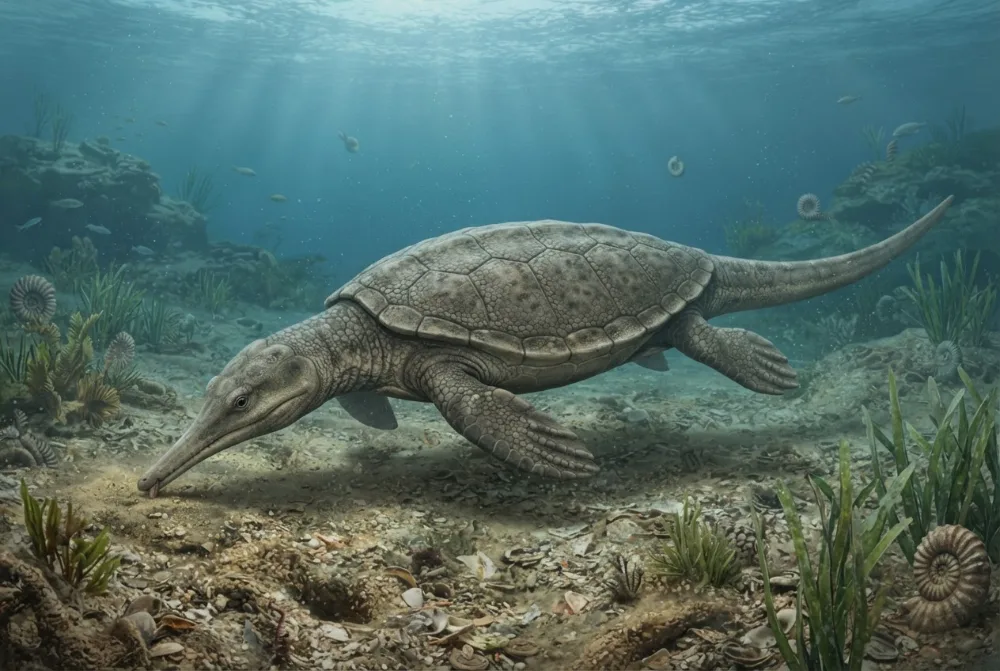
Psephoderma was a marine reptile that lived in the Late Triassic, about 210 million years ago. It had a flat skull and a shell made of two parts, like a turtle, and used its long snout to dig up shellfish from the seafloor.1
E tshetse leng?
E ne e le kgolo go le kae?
E ne e le telele go le kae?
 telele jaaka dikatse tsa mo gae di le 4 go tswa kwa nkong go ya kwa mogatleng🍌telele jaaka dibanana di le 10 di latelana🏊e ne e ka thuma boleele jwa letamo le legolo la go thuma (50 m) mo metsotswaneng e le 16
Psephoderma e ne e le kgolo go le kae fa e bapisiwa le WENA?
Ke dipalo fela mo sebatling sa gago. Ga go sepe se se bolokwang kgotsa se se romelwang gope.
E ne e le bonako go le kae?


Dintlha tse di monate
Psephoderma had a long tail, up to about 80 cm (31 inches), covered in bony scutes.1
Its shell was split into two pieces: one over the ribs and another over the pelvis.1
The largest known Psephoderma fossil is 180 cm (5.9 feet) long.3
Its skull had a narrow, straight snout with grooves that led to the nostrils.1
Psephoderma had no teeth at the front of its mouth, only four large crushing teeth on each side of the palate.1
It lived in shallow, oxygen-rich waters near tidal channels, where it fed on shellfish like Modiolus and Isognomon.3
Dipotso tse di botswang thata ka ga Psephoderma
?Was Psephoderma a dinosaur?
No, Psephoderma was not a dinosaur. It was a marine reptile called a placodont, which is a type of sauropterygian.1
?How big was Psephoderma?
Psephoderma grew up to 180 centimetres (5.9 feet) long, which is about as long as a bathtub.1
?What did Psephoderma eat?
Psephoderma ate shellfish like Modiolus and Isognomon. It used its long snout to dig them up and crushed them with its large, flat teeth.3
?Could Psephoderma swim?
Yes, Psephoderma could swim. Its shell was streamlined for swimming, and it used its paddle-like limbs to move through the water.3
Ya baitseanape ba didino
- Leina la saense
- Psephoderma
- Leina le neilwe ke
- von Meyer 18584
- Setlhopha
- Digagabi tsa lewatle
- Lelapa / clade
- Placochelyida4
- Thulaganyo
- Placodontia > Sauropterygia4
- Bogolo jwa matlapa
- 243 go ya go 201 dimilione tsa dingwaga ()4
- Dibopego tsa matlapa
- Calcare di Zu, Kössener Schichten, Zorzino Limestone4
- Dinaga
- Itali, Osteria, Iseraele, Bogosi jo bo Kopaneng4
- Direkoto tsa difosili
- 10 mo The Paleobiology Database4
- E itsiwe gape e le
- Placochelyanus (maina a bogologolo jaanong a balwa jaaka phologolo e le nngwe)4
- Go fitlhelwa
- Psephoderma was named by German paleontologist Hermann von Meyer in 1858. Fossils have been found in the Alps and England.12
- Go sa ntse go ganetsanwa
- Scientists are not sure if Psephoderma used its shell mainly for defense or for swimming, but some think it was shaped to help it glide through water.3
Kwa dintlha di tswang teng
- Psephoderma (en.wikipedia.org)
- PBDB Taxon (paleobiodb.org)
- FUNCTIONAL MORPHOLOGY AND MODE OF LIFE OF THE LATE TRIASSIC PLACODONT PSEPHODERMA ALPINUM MEYER FROM THE CALCARE DI ZORZINO (LOMBARDY, N ITALY) | RIVISTA ITALIANA DI PALEONTOLOGIA E STRATIGRAFIA (riviste.unimi.it)
- Psephoderma in The Paleobiology Database (CC BY 4.0): dingwaga, mafelo, dibopego tsa matlapa, thulaganyo.
Ntlha nngwe le nngwe mo tsebeng eno e na le nomoro e e supang motswedi wa yona. Fa re dirile phoso, maitshwarelo, re barati ba didino, ga re lokwalodikgang lwa saense. Re bolelele kwa [email protected] mme re tla e baakanya.
 Rex o tshwerwe ke tlala! Dino Wiki ke porojeke ya rre e a e diretseng morwawe yo o ratang didino, ke mahala, ga e na dipapatso e bile ga e na dilatedi. Batho ba bagolo ba ka fepa Rex senyamo go thusa gore e nne mo inthaneteng.Fepa Rex
 Nothosaurus
 Placodus
 Lariosaurus
 Cyamodus
 Cymatosaurus
 Proneusticosaurus
 Massospondylus
 Plateosaurus
 Coelophysis
 Podokesaurus
 Thecodontosaurus
 Eudimorphodon