 O dino efe? Kwisi
 Ntwa ya didino
 Peiso ya didino
 Metshamekwana ya didino
 Alebamo ya disetikara
 Manane a TOP a didino
 Ngakgamatsa!
Ptychotherates
Ptychotherates was a meat-eating dinosaur that lived near the end of the Triassic Period. It had a very deep cheek bone, deeper than any other Triassic dinosaur. Only one skull has been found, but it tells us a lot about how early dinosaurs lived in what is now New Mexico, USA.1
E tshetse leng?
E ne e le bonako go le kae?


Dintlha tse di monate
Ptychotherates is known from only one partial skull, which was found in a block of rock collected in 1982 by the Carnegie Museum of Natural History.1
Its cheek bone (the jugal) is the deepest known for any Triassic dinosaur, meaning it was very tall from top to bottom.21
Ptychotherates lived alongside the famous dinosaur Coelophysis, which is known from thousands of skeletons at the same quarry.1
It belongs to a group of early meat-eating dinosaurs called Morphoraptora, which includes Tawa and Chindesaurus.21
The name Ptychotherates means 'fold hunter' because the skull bones were twisted and hard to put back together.1
This dinosaur lived about 205 to 201 million years ago, near the very end of the Triassic Period.4
Ptychotherates shows that some early dinosaur groups survived longer at low latitudes (near the equator) than they did elsewhere.2
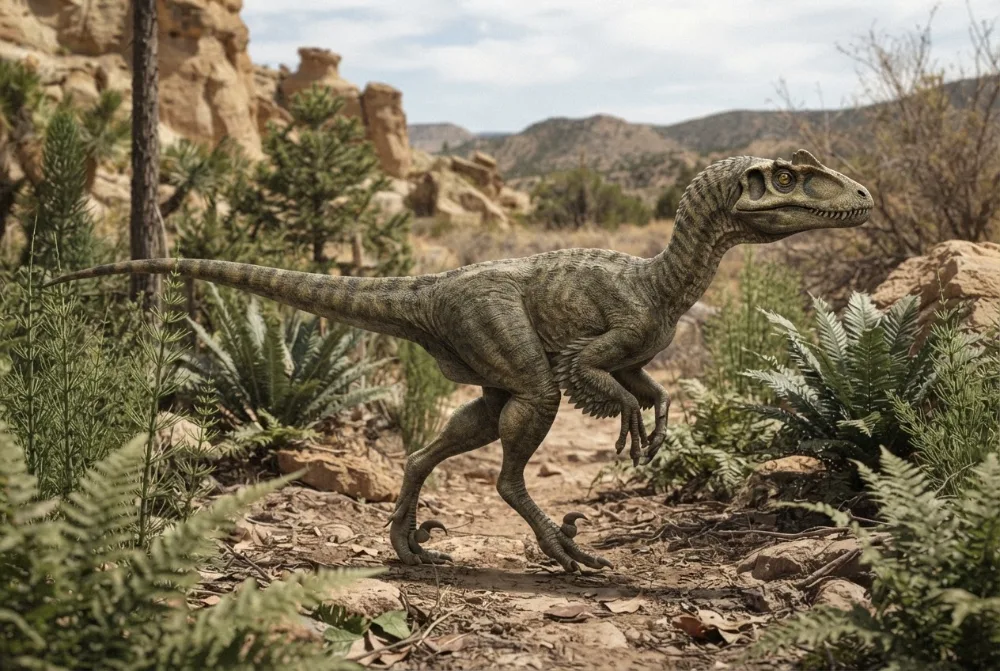
Dipotso tse di botswang thata ka ga Ptychotherates
?How big was Ptychotherates?
Nobody knows for sure because only one partial skull has been found. The skull is about 29 mm tall at the cheek bone, but the full size of the dinosaur is unknown.1
?What did Ptychotherates eat?
It was a meat-eater. Its name means 'fold hunter' because of its carnivorous habits inferred from its teeth.31
?When did Ptychotherates live?
It lived near the end of the Triassic Period, about 205 to 201 million years ago, during the Norian or Rhaetian ages.3
?Where was Ptychotherates found?
It was discovered in the Coelophysis Quarry at Ghost Ranch, New Mexico, USA, in rocks of the Chinle Formation.3
Ya baitseanape ba didino
- Leina la saense
- Ptychotherates
- Leina le neilwe ke
- Srivastava and Nesbitt 20264
- Setlhopha
- Dinosoro tsa ntlha
- Lelapa / clade
- Morphoraptora4
- Bogolo jwa matlapa
- 206 go ya go 201 dimilione tsa dingwaga (Rhaetian)4
- Dibopego tsa matlapa
- Chinle4
- Dinaga
- Amerika4
- Direkoto tsa difosili
- 1 mo The Paleobiology Database4
- Go fitlhelwa
- Ptychotherates was named in 2026 by scientists S. Srivastava and S. J. Nesbitt. The only fossil, a partial skull, came from the Coelophysis Quarry at Ghost Ranch, New Mexico, and was collected by the Carnegie Museum of Natural History in 1982.41
- Go sa ntse go ganetsanwa
- Scientists are not sure exactly how Ptychotherates is related to other early dinosaurs, because its skull has a mix of features from both herrerasaurians and neotheropods.1
Kwa dintlha di tswang teng
- A new taxon of saurischian dinosaur from the Coelophysis Quarry of New Mexico, USA (Triassic: latest Norian or Rhaetian) highlights herrerasaurian diversity in the latest Triassic (dinodata.de)
- A new taxon of saurischian dinosaur from the Coelophysis Quarry of New Mexico, USA (Triassic: latest Norian or Rhaetian) highlights herrerasaurian diversity in the latest Triassic | NSF Public Access Repository (par.nsf.gov)
- Ptychotherates (en.wikipedia.org)
- Ptychotherates in The Paleobiology Database (CC BY 4.0): dingwaga, mafelo, dibopego tsa matlapa, thulaganyo.
Ntlha nngwe le nngwe mo tsebeng eno e na le nomoro e e supang motswedi wa yona. Fa re dirile phoso, maitshwarelo, re barati ba didino, ga re lokwalodikgang lwa saense. Re bolelele kwa [email protected] mme re tla e baakanya.
 Rex o tshwerwe ke tlala! Dino Wiki ke porojeke ya rre e a e diretseng morwawe yo o ratang didino, ke mahala, ga e na dipapatso e bile ga e na dilatedi. Batho ba bagolo ba ka fepa Rex senyamo go thusa gore e nne mo inthaneteng.Fepa Rex
 Herrerasaurus
 Tawa
Tawa Chindesaurus
 Nyasasaurus
 Staurikosaurus
 Alwalkeria
 Nothosaurus
 Massospondylus
 Plateosaurus
 Coelophysis
 Podokesaurus
 Simosaurus