 O dino efe? Kwisi
 Ntwa ya didino
 Peiso ya didino
 Metshamekwana ya didino
 Alebamo ya disetikara
 Manane a TOP a didino
 Ngakgamatsa!
Pycnonemosaurus
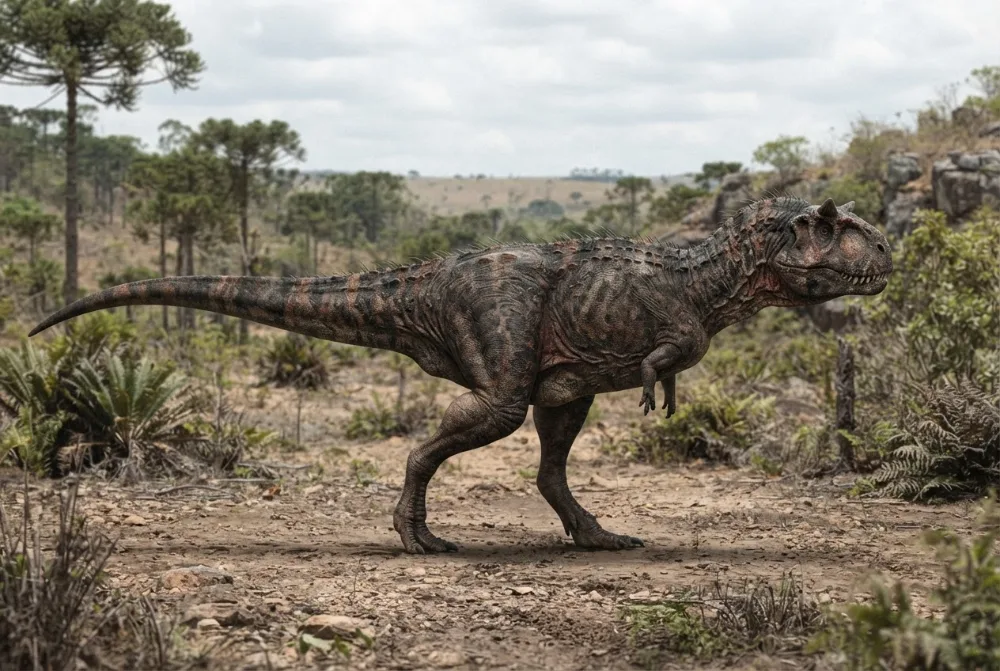
Pycnonemosaurus was a big meat-eating dinosaur with sharp teeth and strong legs. It lived in what is now Brazil, about 72 million years ago. It was one of the largest abelisaurids, a group of short-snouted predators.1
E tshetse leng?
E ne e le kgolo go le kae?
E ne e le telele go le kae?
E ne e le kwa godimo go le kae?
kakanyo
E ne e le bokete go le kae?
 telele jaaka dikoloi di le 2 di emisitswe mo moleng🍌telele jaaka dibanana di le 50 di latelana
 bokete jaaka dintšwa di le 180🍉bokete jaaka magapu a le 720🎒bokete jaaka diphaposiborutelo tse di tletseng bana di le 4🐻❄️bokete jaaka dibere tse ditshweu di le 8🏃e ne e ka taboga dimetara di le 100 mo metsotswaneng e le 12 (motho yo o bonako go gaisa o tlhoka 9,6)
Pycnonemosaurus e ne e le kgolo go le kae fa e bapisiwa le WENA?
Ke dipalo fela mo sebatling sa gago. Ga go sepe se se bolokwang kgotsa se se romelwang gope.
E ne e le bonako go le kae?


Dintlha tse di monate
Pycnonemosaurus is the largest formally described abelisaurid, with later estimates reaching about 8.9 metres (29.2 ft) long.1
Its bones were found in red conglomeratic sandstone, and the surface was abraded, meaning the bones were partly exposed before being collected.1
The only known skeleton is incomplete, including five teeth, parts of seven tail vertebrae, a right pubis, a right tibia, and part of a right fibula.12
It had a small pubic foot and a hatchet-shaped cnemial crest on its tibia, which are unique features among abelisaurs.12
The specimen is thought to be from an immature individual, probably a subadult, so adults might have been even larger.1
Its tail vertebrae have fan-shaped transverse processes and forward projections, typical of abelisaurids, but these projections become smaller towards the end of the tail.1
Dipotso tse di botswang thata ka ga Pycnonemosaurus
?How big was Pycnonemosaurus?
It was about 8.9 metres long and weighed around 3.6 tonnes. That makes it the largest formally described abelisaurid.1
?What did Pycnonemosaurus eat?
It was a predator that probably ate titanosaurs, which were huge long-necked dinosaurs found in the same area. Its small, sharp teeth helped it grip struggling prey.1
?Where was Pycnonemosaurus found?
Its bones were found in Brazil, in the state of Mato Grosso, in red conglomeratic sandstone of the Cachoeira do Bom Jardim Formation.1
?When did Pycnonemosaurus live?
It lived during the Late Cretaceous, about 72 million years ago, in the late Campanian to early Maastrichtian stages.1
?Was Pycnonemosaurus a dinosaur?
Yes, it was a carnivorous theropod dinosaur, part of the group Abelisauridae.1
?Is Pycnonemosaurus bigger than Carnotaurus?
Yes, Pycnonemosaurus was larger. It reached about 8.9 metres long, while Carnotaurus was about 7.8 metres long.3
Mothubi wa ditlhamane
Tlhamane: Pycnonemosaurus was a small dinosaur.
Boammaaruri: It was actually one of the largest abelisaurids, with length estimates up to 9 metres (29.5 ft) and weight up to 3.6 tonnes (4.0 short tons).1
Ya baitseanape ba didino
- Leina la saense
- Pycnonemosaurus
- Leina le neilwe ke
- Kellner and Campos 20024
- Setlhopha
- Didino tse di jang nama
- Lelapa / clade
- Abelisauridae4
- Thulaganyo
- Theropoda > Ceratosauria > Abelisauridae4
- Bogolo jwa matlapa
- 100 go ya go 66 dimilione tsa dingwaga (Cenomanian / Maastrichtian)4
- Dinaga
- Borasele4
- Direkoto tsa difosili
- 1 mo The Paleobiology Database4
- Go fitlhelwa
- The fossils were collected in 1952 to 1953 by Llewellyn Ivor Price at a farm called Roncador in Mato Grosso, Brazil. The species was named by Kellner and Campos in 2002.14
- Go sa ntse go ganetsanwa
- Scientists are not sure about its exact size because the only skeleton is incomplete and from a young individual, so estimates range from 6 to 9 metres long.1
Kwa dintlha di tswang teng
- Pycnonemosaurus (en.wikipedia.org)
- On a theropod dinosaur (Abelisauria) from the continental Cretaceous of Brazil (eurekamag.com)
- Allometry and body length of abelisauroid theropods: Pycnonemosaurus nevesi is the new king (sciencedirect.com)
- Pycnonemosaurus in The Paleobiology Database (CC BY 4.0): dingwaga, mafelo, dibopego tsa matlapa, thulaganyo.
Ntlha nngwe le nngwe mo tsebeng eno e na le nomoro e e supang motswedi wa yona. Fa re dirile phoso, maitshwarelo, re barati ba didino, ga re lokwalodikgang lwa saense. Re bolelele kwa [email protected] mme re tla e baakanya.
 Rex o tshwerwe ke tlala! Dino Wiki ke porojeke ya rre e a e diretseng morwawe yo o ratang didino, ke mahala, ga e na dipapatso e bile ga e na dilatedi. Batho ba bagolo ba ka fepa Rex senyamo go thusa gore e nne mo inthaneteng.Fepa Rex
 Allosaurus
 Carnotaurus
 Dilophosaurus
 Giganotosaurus
 Compsognathus
 Paronychodon
 Tyrannosaurus
 Triceratops
 Velociraptor
 Spinosaurus
 Ankylosaurus
 Parasaurolophus