 O dino efe? Kwisi
 Ntwa ya didino
 Peiso ya didino
 Metshamekwana ya didino
 Alebamo ya disetikara
 Manane a TOP a didino
 Ngakgamatsa!
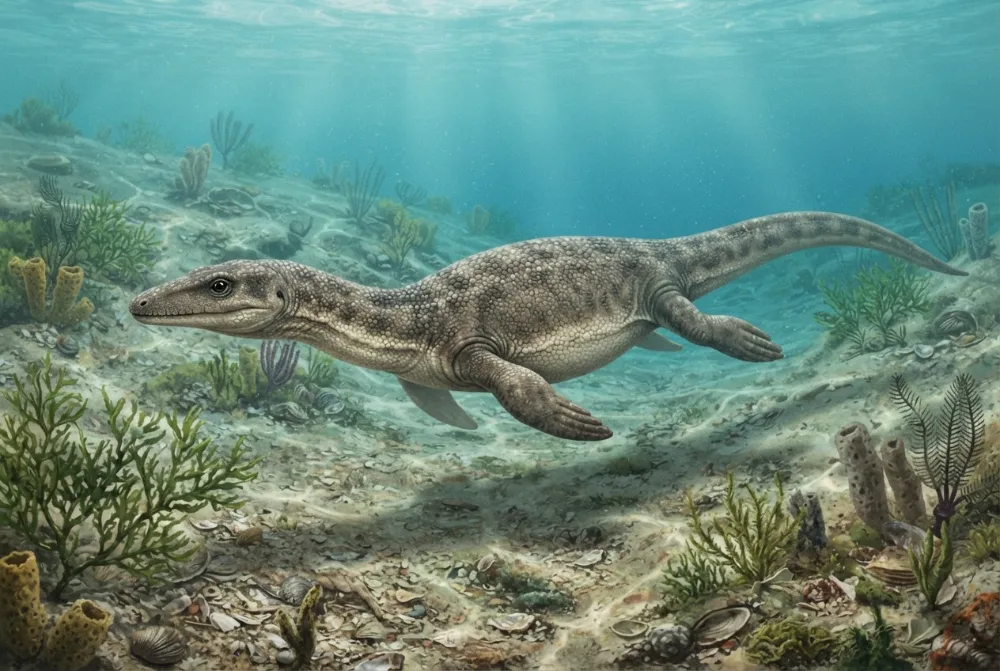
Qianxisaurus
Qianxisaurus was a marine reptile that swam in the warm seas of China about 238 million years ago. It had a long body, a long tail, and a snout longer than the rest of its skull. This creature was not a dinosaur, but a type of eosauropterygian, a group of ancient sea reptiles.1
E tshetse leng?
E ne e le kgolo go le kae?
E ne e le telele go le kae?
 telele jaaka dikatse tsa mo gae di le 1.5 go tswa kwa nkong go ya kwa mogatleng🍌telele jaaka dibanana di le 4 di latelana🏊e ne e ka thuma boleele jwa letamo le legolo la go thuma (50 m) mo metsotswaneng e le 26
Qianxisaurus e ne e le kgolo go le kae fa e bapisiwa le WENA?
Ke dipalo fela mo sebatling sa gago. Ga go sepe se se bolokwang kgotsa se se romelwang gope.
E ne e le bonako go le kae?


Dintlha tse di monate
Qianxisaurus had 28 back vertebrae and four sacral vertebrae, which is unusual for early sauropterygians.1
Its skull was only 7.6 cm (3 inches) long, but the whole animal was over 80 cm (2 feet 7 inches) in length.1
The name Qianxisaurus comes from 'Qianxi', meaning western Guizhou in Chinese, and 'saurus' meaning lizard.1
Qianxisaurus had a very small supratemporal fenestra, a hole in the skull roof, which was only slightly larger than a foramen in the parietal bone.1
Its dorsal ribs had a longitudinal groove on the upper-back surface, a feature shared with some other early marine reptiles like Corosaurus and Sanchiaosaurus.1
The only known fossil of Qianxisaurus was discovered in 2006 near the Huangnihe River in Xingyi, Guizhou, and is now kept at the National Museum of Natural Science in Taiwan.1
Ya baitseanape ba didino
- Leina la saense
- Qianxisaurus
- Leina le neilwe ke
- Cheng et al. 20122
- Setlhopha
- Digagabi tsa lewatle
- Lelapa / clade
- Eosauropterygia2
- Thulaganyo
- Sauropterygia2
- Bogolo jwa matlapa
- 241 go ya go 237 dimilione tsa dingwaga (Ladinian)2
- Dibopego tsa matlapa
- Falang2
- Dinaga
- Tšhaena2
- Direkoto tsa difosili
- 1 mo The Paleobiology Database2
- Go fitlhelwa
- Qianxisaurus was named by Yen-Nien Cheng, Xiao-Chun Wu, Tamaki Sato and Hsi-Yin Shan in 2012 based on a nearly complete skeleton found in the Zhuganpo Member of the Falang Formation in Guizhou, China.1
- Go sa ntse go ganetsanwa
- Scientists are not sure whether Qianxisaurus was a pachypleurosaur or a more basal eosauropterygian, and its exact relationships within the group are still debated.1
Kwa dintlha di tswang teng
- Qianxisaurus (en.wikipedia.org)
- Qianxisaurus in The Paleobiology Database (CC BY 4.0): dingwaga, mafelo, dibopego tsa matlapa, thulaganyo.
Ntlha nngwe le nngwe mo tsebeng eno e na le nomoro e e supang motswedi wa yona. Fa re dirile phoso, maitshwarelo, re barati ba didino, ga re lokwalodikgang lwa saense. Re bolelele kwa [email protected] mme re tla e baakanya.
 Rex o tshwerwe ke tlala! Dino Wiki ke porojeke ya rre e a e diretseng morwawe yo o ratang didino, ke mahala, ga e na dipapatso e bile ga e na dilatedi. Batho ba bagolo ba ka fepa Rex senyamo go thusa gore e nne mo inthaneteng.Fepa Rex
 Nothosaurus
 Placodus
 Lariosaurus
 Cyamodus
 Cymatosaurus
 Proneusticosaurus
 Chonespondylus
 Cymbospondylus
 Phalarodon
 Mixosaurus
 Chaohusaurus
 Chensaurus