 O dino efe? Kwisi
 Ntwa ya didino
 Peiso ya didino
 Metshamekwana ya didino
 Alebamo ya disetikara
 Manane a TOP a didino
 Ngakgamatsa!
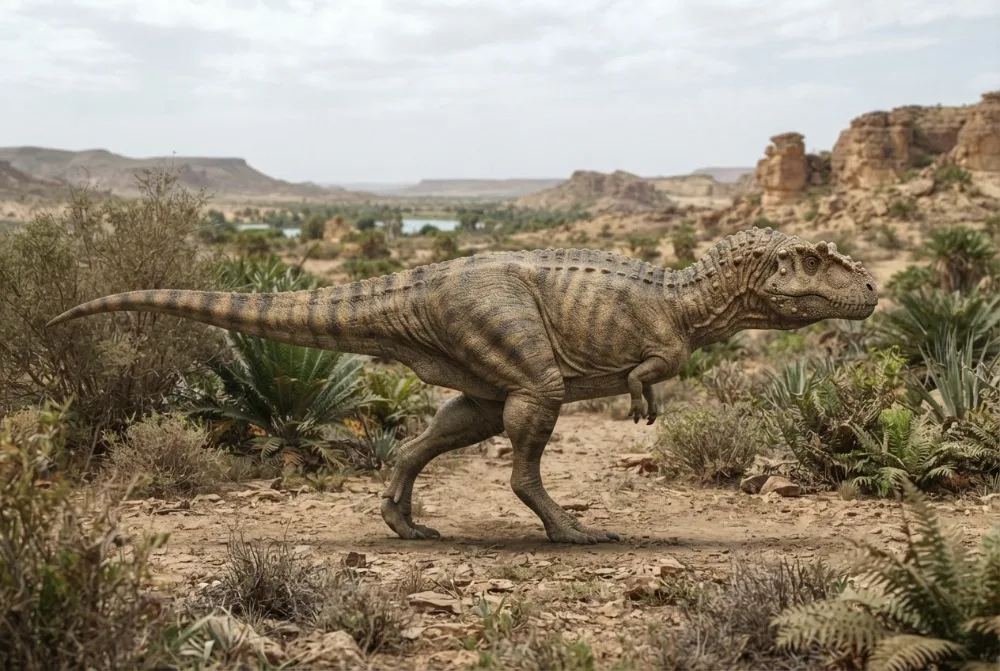
Rugops
Rugops was a meat-eating dinosaur that lived in what is now Niger, Africa, about 95 million years ago. It had a wrinkled, bumpy face and a delicate skull, which scientists think means it was a scavenger rather than a fierce hunter.12
E tshetse leng?
E ne e le kgolo go le kae?
E ne e le telele go le kae?
E ne e le kwa godimo go le kae?
E ne e le bokete go le kae?
 telele jaaka dintšwa di le 5 go tswa kwa nkong go ya kwa mogatleng🍌telele jaaka dibanana di le 29 di latelana🍉bokete jaaka magapu a le 82🧸bokete jaaka bana ba kreše ba le 22🎒bokete jaaka bana ba sekolo ba le 13🏃e ne e ka taboga dimetara di le 100 mo metsotswaneng e le 8.2 (motho yo o bonako go gaisa o tlhoka 9,6)
Rugops e ne e le kgolo go le kae fa e bapisiwa le WENA?
Ke dipalo fela mo sebatling sa gago. Ga go sepe se se bolokwang kgotsa se se romelwang gope.
E ne e le bonako go le kae?


Dintlha tse di monate
Rugops is known from only a partial skull, which is about 31.5 centimetres (12.4 inches) long.2
The top of its skull had many pits and bumps, which would have supported scales and a tough, armour-like skin on its snout.2
Rows of holes in the skull may mean Rugops had a crest or some kind of display structure on its head.1
Rugops lived alongside other huge predators like Carcharodontosaurus and Spinosaurus.2
The type specimen might have been a subadult, because its skull bones were not fully fused together.2
Rugops was one of the earliest abelisaurids, a group of horned, short-snouted theropods that lived in the southern continents.2
Dipotso tse di botswang thata ka ga Rugops
?How big was Rugops?
Scientists estimate Rugops was about 4.4 to 5.3 metres (14 to 17 feet) long and weighed around 410 kilograms (900 pounds). Some earlier estimates suggested it was up to 6 metres (20 feet) long and 750 kilograms (1,650 pounds).2
?What did Rugops eat?
Rugops was a carnivore, meaning it ate meat. Its delicate skull suggests it was a scavenger that fed on dead animals rather than a hunter that killed its own prey.13
?Where did Rugops live?
Rugops lived in what is now Niger, Africa, about 95 million years ago. Its fossils were found in the Echkar Formation, which was a river and lake environment.2
?Did Rugops have feathers?
Nobody knows for sure. Rugops is known only from a skull, and no feathers or feather impressions have been found with it. Its skull had pits and bumps that supported scales, not feathers.2
?Why is it called Rugops?
Rugops means 'wrinkle face' in Latin and Greek. It was named for the wrinkled, bumpy texture on its skull bones.2
?Was Rugops bigger than T. rex?
No, Rugops was much smaller. Rugops was about 4.4 to 5.3 metres (14 to 17 feet) long, while T. rex was over 12 metres (40 feet) long.2
Ya baitseanape ba didino
- Leina la saense
- Rugops
- Leina le neilwe ke
- Sereno et al. 20044
- Setlhopha
- Didino tse di jang nama
- Lelapa / clade
- Abelisauridae4
- Thulaganyo
- Theropoda > Ceratosauria > Abelisauridae4
- Bogolo jwa matlapa
- 100 go ya go 94 dimilione tsa dingwaga (Cenomanian)4
- Dibopego tsa matlapa
- Echkar4
- Dinaga
- Niger4
- Direkoto tsa difosili
- 1 mo The Paleobiology Database4
- Go fitlhelwa
- Rugops was named in 2004 by paleontologist Paul Sereno and his team, based on a partial skull found in the Echkar Formation of Niger during an expedition funded by the National Geographic Society.2
- Go sa ntse go ganetsanwa
- Scientists are not sure exactly how Rugops is related to other abelisaurids; some studies place it as the most primitive, while others put it in a group with several other genera.2
Kwa dintlha di tswang teng
- Rugops | Natural History Museum (nhm.ac.uk)
- Rugops (en.wikipedia.org)
- Discoveries | Paul Sereno - Paleontologist | The University of Chicago (paulsereno.uchicago.edu)
- Rugops in The Paleobiology Database (CC BY 4.0): dingwaga, mafelo, dibopego tsa matlapa, thulaganyo.
Ntlha nngwe le nngwe mo tsebeng eno e na le nomoro e e supang motswedi wa yona. Fa re dirile phoso, maitshwarelo, re barati ba didino, ga re lokwalodikgang lwa saense. Re bolelele kwa [email protected] mme re tla e baakanya.
 Rex o tshwerwe ke tlala! Dino Wiki ke porojeke ya rre e a e diretseng morwawe yo o ratang didino, ke mahala, ga e na dipapatso e bile ga e na dilatedi. Batho ba bagolo ba ka fepa Rex senyamo go thusa gore e nne mo inthaneteng.Fepa Rex
 Allosaurus
 Carnotaurus
 Dilophosaurus
 Giganotosaurus
 Compsognathus
 Paronychodon
 Tyrannosaurus
 Triceratops
 Velociraptor
 Spinosaurus
 Ankylosaurus
 Parasaurolophus